

Things have been quiet around here as I’ve been focusing on my newsletter and building closer contact with readers. But as things are always in a constant flow of change I now desire to open the doors to more frequent writing on here again. So I creak open the door with a deck review.
For the past couple years I have not been participating in the acquisition of new tarot decks as I feel I have a good and decent collection, I am satisfied. What I have been doing, on and off, is keeping an eye out for playing card reproductions that catch my eye. Well, this year a deck was published that I have been following for a while. It is a Lenormand deck, a strikingly iconic Lenormand deck. Iconic in an emblematic sense, and this is the deck I want to talk about now.
The Fortune’s Fools deck is a creation from and with the times, to be precise and per the guidebook it “is a two-year collaboration between Gordon White and Scottish illustrator, Colin Alexander.” What is really, I have to say, cool, about the deck is that it is truly a communal and collaborative creation, since it was created through youtube lives, with active participants in the conversation of each of the cards. “The finished product (the deck) is as good as it is thanks to the generous collective insight of the RuneSoup community.” So besides being a collaborative creation, it is also, given the medium through which it arose, an international creation, with voices from diverse parts. For all these reasons, before diving into the aesthetics, it is a unique fortunetelling deck with it’s own particularly strong voice.
“We have also sought to make the deck more of a global, polyvalent affair, rather than cleaving too close to Lenormand’s European pastoral tableau. And so the whole thing is a love letter to rich, adventurous engagement with a vibrant, living cosmos.”
I’m going to swerve into the aesthetics. The technical points are, it is printed on a premium matte black cardstock, with high intensity color images, from my perspective high intensity as the colors really do pop out against the matte black background. The playing card insets are included in the cards, which is always a plus in my book. I don’t believe it was specified in the guidebook but the deck is poker size, allowing it to be manageable for big spreads. The card edges are black, and it comes with a 161-page book on fortunetelling. The book is divided into two parts, the first part is on how to step into becoming a better fortuneteller with any deck. The second part is a overview of each of the cards in the deck. Admittedly, I purchased the whole package, partly from wanting the deck but also because I really wanted the book as well.
I have read a good amount of Lenormand books, and mostly all of Camelia Elias’ writings on Lenormand card reading. My favorite book being Lenormand Thirty Six Cards: An Introduction to the Petit Lenormand by Andy Boroveshengra. But I wanted to read Gordon White on fortunetelling, as he has mentioned previously that this is his fortunetelling book.
It does not disappoint, re-enlivening the landscape of telling fortunes, weaving in the whole animate cosmos in light of what it means to tell fortunes, reading signs, and symbols. There’s a brief history of Madame Le Normand, of cartomancy in general as well as tarot, and then it dives right into the metaphysics of play and omen logic. No corner is left untouched in the fortunetelling section, it is succinct, to the point, yet eloquent, as it guides the reader around the world of telling fortunes.
In the second part of the guidebook, each of the cards get roughly 2 pages of descriptive information along with reading examples, keywords, and even songs to think with that go with the card. Which is a fun rabbit hole to jump into, listening to the songs for each of the cards. All in all the guidebook is excellent, and serves as an excellent companion to the deck.
What else can I say about the deck other than it is saucy, talkative, colorful, and easy to use. The images are well defined and easy to read. I will add as a caveat, as someone who uses glasses, that all except 2 of the cards were easy to recognize. The two exceptions for me were the house and the mice card. Now that I know them I don’t get confused, but initially I did need to turn up the room light to see them better on the spread.
Speaking of lighting, the cards are well suited to moody, atmospheric, candlelit readings. It is very apropos to the feel of the deck. Actually, I will add that the deck is also very well suited as a trusty traveling companion, for unexpected encounters, engaging in new landscapes, and exploring different places. It is adventurous.
On shuffling, they shuffle wonderfully smooth. Flexible cardstock. For overhand shuffling, the cards do tend to stick together initially but ease into it with use.
Here are images of a grand tableau, in thinking with Gordon’s words on this spread:
The grand tableau is the most animist of layouts. Along with the more than human, quotidian motifs of the Lenormand oracle, it offers up to the skilled fortuneteller a web of complex relationalities and a process-oriented way of seeing we have almost lost. It is quite literally a jungle (White, pg. 80).
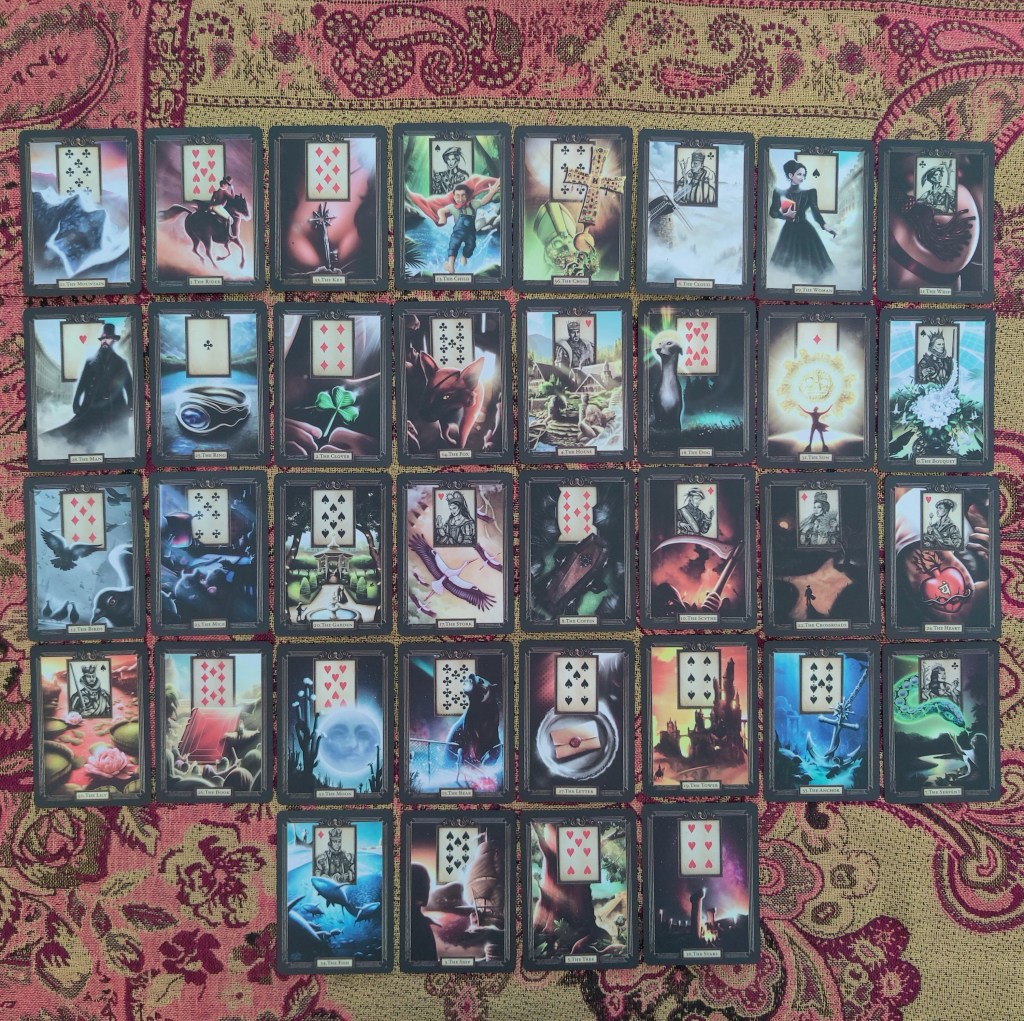
All in all I heartily recommend this deck for fortunetellers, cartomancers, and diviners. It is a deck that walks both with tradition, while also surmounting boundaries, it is daring and fresh.
- To watch all the cards as they are born, see this youtube playlist: here.
- To purchase the deck: Fortune’s Fools.

 Natalia Lee