Category: Musings

  • “And so the urn flows on…”

    It all starts in pieces, two or three sentences on endpapers of a night-table book. A smattering of brief voice notes. Spontaneous scratches and scribbles. Days pass, weeks, a month, three. I keep stewing the matter [in a container], gathering ingredients in the pot. Stirring, turning… It’s in this pot we begin. The cave, the clay jar. But given the nature of these thoughts it will likely spill out in a flood and make meandering sense.

    Pandora, first woman, she who is endowed by all gods, the enticing gift for Epimetheus. She holds a jar and in this closed container are the swirling and seething secrets, evils. To speak about Epimetheus is to speak about Pandora, both woman and vessel, through whom the deluge spilled over unto all lands.

    Here I am, Epimetheus, not that other, my brother, his liver eaten daily by an eagle. I am this one here with Pandora and her jar, inside Pandora and her jar. Inside, a flood.

    Pandora, a gift, a coming together with Epimetheus, and the spilling that turns into a flood. A sequence that when typed up or written down seems almost facile, this one thing led to this other thing and then consequently, oops, the breaking of the container, many things spill forth, the watershed moment. Let’s talk about flooding for a moment, string together a couple notes here and there in between the fractures of the vessel.

    When I went looking for information on flooding cycles, the Nile kept turning up as most prominent.

    The flooding of the Nile has been an important natural cycle in Nubia and Egypt since ancient times. It is celebrated by Egyptians as an annual holiday for two weeks starting August 15, known as Wafaa El-Nil. It is also celebrated in the Coptic Church by ceremonially throwing a martyr’s relic into the river, hence the name, The Martyr’s Finger (Coptic: ⲡⲓⲧⲏⲃ ⲛⲙⲁⲣⲧⲏⲣⲟⲥ, Arabic: Esba` al-shahīd). […]The flooding as such was foreseeable, although its exact dates and levels could be forecast only on a short-term basis, by transmitting the gauge readings at Aswan to the lower parts of the kingdom where the data had to be converted to the local circumstances. What was not foreseeable, of course, was the extent of flooding and its total discharge.

    The flooding was not merely a natural event; it held deep cultural significance for the Egyptians. It was mythologically linked to the tears of Isis mourning Osiris, symbolizing both life-giving and destructive forces. Festivals celebrated the inundation, reinforcing its importance in Egyptian society.

    The flooding of the Nile occurred by way of the yearly monsoons in the Ethiopian Highlands. The phase of the event seen through the Egyptian calendar: Akhet (Inundation), Peret (Growth), and Shemu (Harvest), with Akhet covering the flood cycle.

    The annual flooding was vital for agriculture in ancient Egypt, as it deposited nutrient-rich silt on the land, making it fertile for crop cultivation. The Egyptians celebrated this event as a gift from the Nile, marking it with festivals such as Wafaa El-Nil. This celebration honors the bounty provided by the river and reflects on its importance in sustaining life in an otherwise arid environment.

    This is a flood cycle that forms part of the life rhythm of place; integrated into the dynamics of living. A flood cycle experienced by a people’s and a place that speaks of their relation to water and its waterways.

    After this calendar lesson, I went hunting for more on what flooding is from the perspective of its beneficial aspects. I stumbled upon the word floodplains; a wide expanse of flat land next to a river or body of water that periodically experiences overflow, typically due to rains.

    In this context, I see ecosystems that express interrelationships with water, land, and sky. A water dance.

    Yet, there is complexity here, in its very nature a flooding is a moment of rupture, a crisis “event” when all spills out and intermixes, overwhelms, and clashes. All beings submerged. An influx of rushing water that subsumes it all. Flooding events arise from various causes including heavy rainfall, hurricanes, dam failures, and snowmelt. It is a coming together and over of waters. Boundaries are transgressed, there are no dividing lines in a flood.

    In the month of September, heavy rains continually fell in Henan Province, specifically near the Yellow River in China. The persistence of the heavy rains led to the rising of waters of the Yellow River, which led to the breaking of the dikes [boundary lines/containers] that delimited the river’s reach. The flooding was so catastrophic, inundating the landscape, farmland, homes and settlements. Not only did many drown, but the destruction was beyond bounds.

    The floodwaters quickly spread across Northern China, inundating around 50,000 square miles (130,000 km²) and affecting millions of people. The flood led to an estimated death toll ranging from 930,000 to 2 million people, making it the deadliest flood in Chinese history and one of the deadliest natural disasters globally.

    This is a flooding event as a great sorrow, a crisis, a devastating erasure of bounds, a drowning event. Pandora’s vessel spilled forth all combinations of sorrows and devastation.

    As metaphor, flooding also presents us with nuance, one could say this is also the overwhelm of cacophony during certain happenings or events, states of mind when thoughts lack cohesion, excess of information through media like a constant bombardment. Flood does not have to be subsumed to water (definitionally), a flood can encompass a flooding of words, flooding of horrors, flooding of media, flooding of thoughts, flooding of emotions. As metaphor, I can also see the swarms of evil spirits and dis-ease that would forever plague mankind spilling forth from Pandora’s jar.

    I speak of floods which have no order, it is a rupture, an inundation of matter and quantity. All things everywhere all at once, but like in all occurrences there are varying perspectives to the flooded moment. There is the sorrow, the devastation, the destruction, the overflow that submerges and subsumes. Then there is the the slow boon of the cleansing, of removing barriers to re-nourish the soil. Shifting the ground, re-positioning. What does Epimetheus tell us about this moment, about flood? It wasn’t exactly water that overwhelmed him as Pandora cracked the vessel and the jar tipped over.

    Moreover, what can be gathered, recuperated and salvaged in a flood? The evil spirits spilled out, all the horrors, Epimetheus couldn’t contain them, it was too much too quick. Perhaps these moments of rupture teach us the art of dancing or… swimming amidst the chaos of the flooding event.

    In a narrative that has emulated the overarching grandeur of Prometheus, the linear progressivism of this titan, what does his counterpart Epimetheus, husband of Pandora, teach us in this scenario? I read omission as fertile ground for storying with Epimetheus. So I say, the urn flows ever on, outward the waters flow, as there are no details that describe exactly what Epimetheus does, hence, he just is amidst this flood. I see him as pacing himself, slowing down, breathing deeply through what has happened and what is, and from what is, then an articulation of what is his to do can take shape.

    Do we let the waters carry us, do we swim through the inundation of waters, things, events, horrors, all the diverse aspects that encapsulate living? Or do we move toward the floodplain and learn to cultivate water gardens, salvaging along the way?

    In the span of histories, both reaching back and forward to the present, events of flooding, both tangible and metaphorical, occur. Do we know how to recognize when we are amidst such events when they are happening at the metaphorical level? And what is ours to do amidst these moments in time? When all things inundate our awareness and our attention? Have we each cultivated a floodplain area in our lives to allow for the seeding of these waters to bring benefit as well?

    Turning the fractal coin of the matter once more, I look at whole systems thinking. Which is thinking with things as interconnected webs of agencies and events, a dynamic thinking with…

    Whole systems thinking posits that elements within a system are not isolated; rather, they interact dynamically. For example, in ecological systems, elements such as water, soil, air, plants, and animals work together to sustain life. Understanding these relationships allows for a more comprehensive view of how changes in one element can impact the entire system.

    Benefits:
    ~Systems-level understanding: Recognize the interconnectedness of components and the system as a whole.
    ~Holistic solutions: Address multiple issues simultaneously, rather than focusing on individual components.
    ~Increased resilience: Design systems that can adapt and evolve in response to changing conditions.

    My apprehension here is that Epimetheus is the teacher of whole systems thinking. Yes, I know he is afterthought… Perhaps more than this, he can be viewed as harbinger of thinking with all things as they happen at once. Pandora’s name is all-gifts. Not good gifts, nor bad gifts. All- Gifts. All things intermingled. LIFE. Epimetheus teaches that we must all get comfortable with a degree of uncertainty, and how to life amidst this uncertainty, how to swim in these flooded waters. I add a qualifier to the movement, that pacing is the key that Epimetheus hides in his teaching, which aids in seeing what needs salvaging and what can be let go.

    Pacing, moving with the moment so as to allow one’s self to flow with the current, the waves, the great wave that overcomes. I imagine a submersion under the weight of the occurrence, or many leaves swirling in a wind gust, a spiral dance. I like to en-vision Epimetheus like this, the submerged dancer, an immersed swimmer. Through Pandora and the spillage we re-gather and salvage the gems of Epimethean wisdom.

    Now I spiral back to Ganymede, the story of the Aquarian constellation. A linked story through meandering ways. The horror of the theft, taken hostage, given immortality before reaching adulthood, the jar, eternal-pouring. Constrained by a divine court to pour, dreaming of the depths, of unleashing the bounds, ever-pouring one. The vessel from which outpours the inky black waters of the starry heavens speckled with jewels, the marker of floods in calendrical systems. Ganymede as an expression of Epimethean embodiment.

    In these threaded stories is formed a woven wisdom, of rupture, flood, sorrow, loss, cleansing, renewal; but far seeing and deep like the waters of the starry way. Something about cycles, what is inevitable, what breaks the bounds to reshape the landscapes, something about transformation.

    ~~~

  • Caves with underwater entries
    Some caves are isolated by a waterway, resulting in the air inside to be isolated, always at the same temperature and, if the water does not move, perfectly still. For the air to not escape through other cracks, the geology of the cave needs to be in such a fashion that it has little to no cracks. If the waterway falls dry for some time of the year, then the air inside will move for that duration, but otherwise be perfectly still. (from a basic text search in browser: https://worldbuilding.stackexchange.com/questions/246081/what-geographic-features-could-cause-a-stable-pocket-of-unmoving-air)

    Let me tell you a story of an ageless youth. This is a love letter to my self in these times of great change, of groaning and wailing, of horrors and desperations. A portion of the cup bearer’s nectar, if I may, that trickles outward through the spaces of these uttered words. Of a boy who is not quite a man, but might be a girl. Of woman’s work and men’s work. Ganymede. Whose youthful beauty and strength captured the Jovian sight.

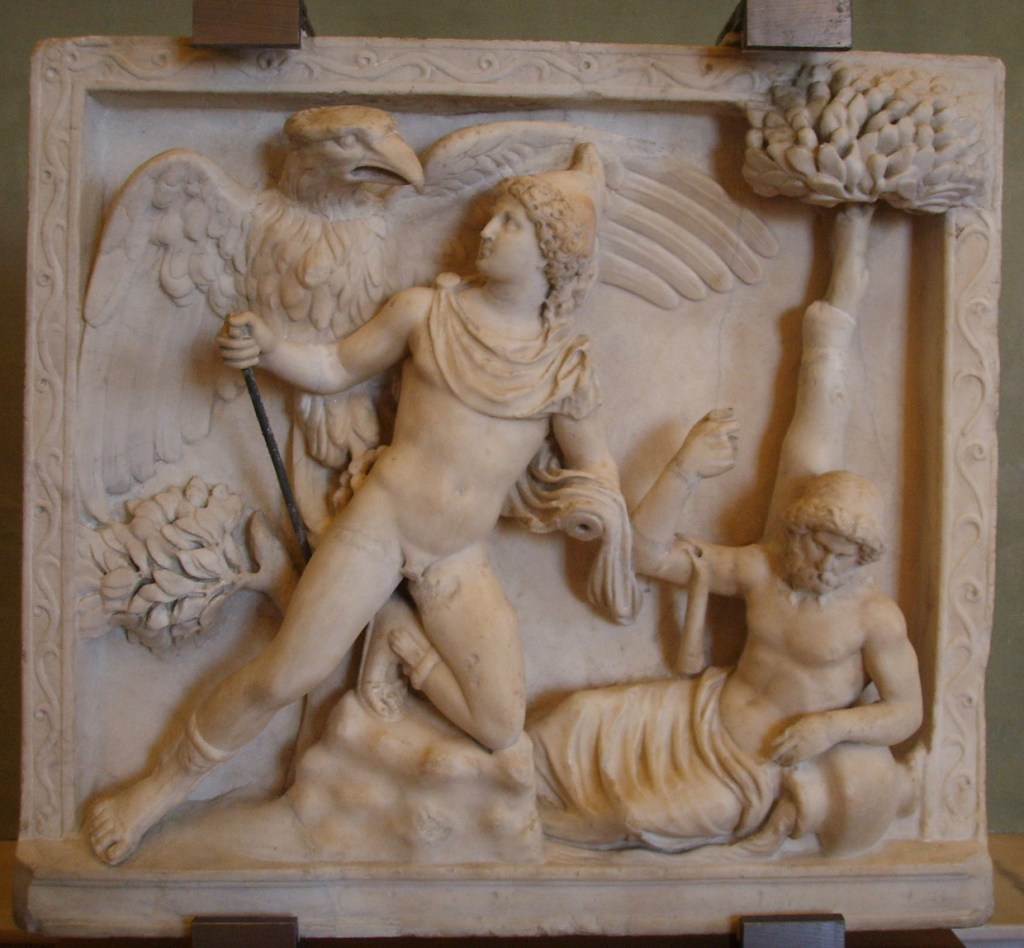
    Roman-era relief depicting the eagle of Zeus abducting Ganymede, his Phrygian cap denoting an eastern origin, and a river god https://en.wikipedia.org/wiki/Ganymede_(mythology)

    We begin with the thunderous King enraptured as eagle, descending to the green fields to pluck the beautiful youth from his sheep tending. Stolen to the court of the undying ones, Ganymede is handed his duty, a cup which ever-pours, to be cupbearer for the gods, displacing the goddess of youth, Hebe.

    Ages pass, and in the doing of their office, Ganymede becomes immortal. The child of kings now immortal to watch from afar the affairs on earth. The strivings, joys, expansions and defeats, war and peace. The little things and the big. To watch but not to participate, to observe and think, but no longer to directly touch. Engaged in remembrance as Ganymede is beyond the mortal realm looking ahead, but also down. Let us say, that as the cup-bearer of the gods and watcher from afar, they put forward a request to the great craftsman Hephaestus for an aid in time-keeping. From this request a lustrous silvery-colored metallic fish is constructed, whose articulated scales can each be flipped over to reveal a contrasting color. In doing so, Ganymede can count the earthly days. Counting remembrances. A techne.

    The wear, sorrow, and melancholia that steals over the lovely youth as witness to the cycles of time and the repetitions of human doings, the hubris and the failures, but also the joys and celebrations, dresses Ganymede in paradox, the wise youth, forever to remain in pre-pubescence outwardly, yet inwardly an old, aged seer. The time arrives when Jupiter releases the cup-bearer from the court to emplace them amidst the starry fields, and Aquarius the constellation is birthed to swim amidst the deep waters of the Via Lactea.

    An equatorial constellation, hard to locate in the night skies, and none of it’s stars are particularly bright. These are just some of the points that stand out when doing a quick search on Aquarius the constellation.

    Now I turn to Epimetheus by way of Prometheus, his brother. The two brothers, two sides of the same coin. Forethought and Afterthought in dynamic tension and relation.

    Epimetheus’ [the] name was derived from the Greek words epi-, epeita, and mêtis, and means “afterthought” or “late counselling.” (From https://www.theoi.com/Titan/TitanEpimetheus.html)

    Prometheus the name, is Greek, and anciently was interpreted etymologically as “forethinker, foreseer,” from promēthēs “thinking before,” from pro “before” (see pro-) + *mēthos, related to mathein “to learn” (from an enlargement of PIE root *men- (1) “to think”). In another view, Watkins suggests the second element is possibly from a base meaning “to steal,” also found in Sanskrit mathnati “he steals.” (From https://www.etymonline.com/search?q=prometheus)

    Epimetheus against the advise of others entwined with Pandora, the first woman, formed of clay. She came to the marriage with a closed jar, a container. “Zeus gave Pandora a storage jar (pithos) as a wedding gift which she opened, releasing the swarm of evil spirits trapped within. These [evil spirits] would forever after plague mankind. Only Elpis (Hope) remained behind [inside the jar], a single blessing to ease mankind’s suffering.”

    Contrary to Prometheus defying necessity and fate, calculating, thinking ahead and stealing fire to bring aid to mortals, knowledge, warmth, forward vision, progress; Epimetheus in entwining himself with Pandora unknowingly twined himself with the unknown, both the seen and unseen, the heaving, whirling and coiling rhizome of life. Foolishly disarmed, he comes to embracing the one remaining gift in the cavernous depth of the clay jar, Hope. Not Foresight, that at the peak of exuberance, in hubris provides the tools to construct Life as Idol. Life as idol to enthrone, banishing all the corners and recesses, the cracks, the inaccessible, the whispers, and the plethora unnamed, the dark.

    Here Prometheus as fore-thinker becomes in eventuality, attaining arrogance, the fool. And here we are left with Epimetheus, the first fool, dancing with hope in the still air of the cavernous jar stirring the warp and weft, summoning more than can be named. Perhaps even, with Hope, engaged in imaginings, foolish imaginings that dares to weave dreams of different ways of being and living. A ceding of hubris, a ceding of control to allow for a dancing with all these beings, and Hope. It is an engaged surrender that requires an imagination of remembrance and of being with the unseen dead. Since in foolishness Epimetheus did not think first, he acted first, he was disarmed finding himself without recourse. And it is through these actions, these mistakes, that remembrance opens and populates the heart with Hope, Mercy, Humility, and dare I say Grace.

    I hold up Epimetheus not as an idol to replace Prometheus and allow for late counsels or rash actions to dictate our current doings, the truth is we are already in the realm of late counsels. Instead I hold up Epimetheus as the bridge to dancing with Hope, the remaining gift. Exactly at the point of embracing this gift and beginning the dance, not with coordinated steps, but the dance of flow, of air that two begin to stir. A rhizomatic, feeling dance.

    With these words I drop back into the story of Ganymede, twining iridescent strands between these two stories to unite them in a cohesion of paradoxes and opposites. Of currently unsung world-ings. One of the eternal youth, child of kings, stolen by the gods and taken to the place of gods, disarmed and caught in the volatile flights of the lofty. An aged-wise youth in relation to the foolish sage that brings us hope when all else has ossified inaccessibly or in irrelevance.

    I propose alternate livings, by way of these re-woven iridescent strands, a living that arises between the cracks. A living that embodies Ganymede, the dancer at the edges, in the dark, behind the scenes, whose function is to pour and to watch and to inhabit the eternal. Engaged in a surrender that hopes, longs for, yearns, and watches, an Epimethean living.

    In French Wikipedia I found a curious little quote, speaking about Ganymede from an alchemical perspective, noted by alchemist  Michaël Maïer: “C’est le fixe amené par le volatil à la plus haute dignité.” (https://fr.wikipedia.org/wiki/Ganym%C3%A8de)

    An image here arises: a flowing imagination, interweaving seeing with, seeing into and in between. First, a still air, that in stillness pierces in between the opening cracks, quietly weaving light. A cavernous jar, the cave. The lengthening cracks of towers, foundations, of what is concrete. An agitation of clothe draped arms, shaking the quiet air, stirring upward, downward, around, a whirling. Whirl, whirl, whirl. Moving arms and limbs about these walls, dancing around the boundaries so that that which was still and unseen, stifling unmoving air, penetrates between the cracks. A break.

    And so why do I share all this, or what does this have to do with anything related to I? Well, this is me thinking with technologies, and the idols we live with in conjunction with the sorrows that beset us in these dark times. What is ours to do, what shape is our response to all of this grand-scale unfolding around us? The whole machinery we “modern” humans have co-fabricated, what does it mean to respond in our small scale, day-by-day lives, our every-day living? Or what does this mean-ing, look like in metaphor that can be brought into one’s living. Bayo Akomolafe would say, “times are fast, let us slow down.”

    I agree.

    Let us also learn to dance in this cave, reaching out to hope, dancing with hope, filling our jar with the nectar of these cavernous waters, in order to pour it outward, not for the gods but in hope, as nurture for our surroundings, our localities, our landscapes, our hearts.

    I invite you to peruse this list of links that helped inform, enrich, and articulate this essay.

  • I originally began writing this as an exploration of historiolae and their narratives within a Cyprianic context. To be sure, historiola as a thing is the basis for this piece, but my focus has changed. I want to zoom in on “Saint Cyprian as a Healer and Further Considerations on Sorcerous Poetics” from Jose Leitao’s Opuscula Cypriani, specifically on that last part, sorcerous poetics, elaborating on ideas around my personal perspective; how I see incantations, the lyricism of the charm or historiola, and what it portends to utter these lyrical narratives. My exploration will be via a collage of sources from several books and places, with my thoughts interspersed in between, as inspiration has led me.

    In crude terms the historiola is a narrative (often rhyming) one voices in order to achieve X desire. The charmer (or insert whichever title preferable that points to the one who voices the narrative), as an individual within a community and immersed in a landscape, is a person embedded in a living terrain of interactions. This terrain is like a breathing web of continuously moving connections. Immersed within this web, the historiola can be seen as a thing that erupts like an out-breath through the voice, a self in response to the terrain and to desire. From Henni Ilomaki’s The Self of a Charm, “Charms can be seen as an act of communication, in which it is assumed that the singer’s message has a (supranormal) recipient. A charm can thus be seen as speech (parole) containing a given message. Formally speaking a charm is a monologue uttered against another’s force” (53). They are “texts for specific rites, for which the reciter must be entirely committed; a vehicle for momentary yet intense influence, which draws each charm-reciter into that influential power” (55). The historiola as a charm enfolded with a specific desire, arises out of a milieu like an out-breath, and it is inextricably in-relation with the (a) terrain, the body, the voice, the charmer, all within a web of reciprocal interactions.

    In David Abram’s The Spell of the Sensuous he illustrates how we, people, live in a an embedded perceptual field of meanings in an animate flesh-world of relationships, not just human to human, but human and the landscape, the topography, the flora, the fauna, etc. His “field of meanings” is what arises out of this sensuous relationship between the human and more than human embedded in this landscape. It is a web of interlaced threads, the human perceptual experience in place, the more than human, and the terrain within a temporal influx and efflux.

    We are all participants in this field of meanings, within a conversant constantly interacting landscape. From here Abrams proposes arises language. Language arises out of this interconnected perceptual experience of place. The voice and the breathe give a form to experience, yet semantic-ally condensed. “The sensing body is not a programmed machine but an active and open form, continually improvising its relation to things and to the world” (49). All are in continuous sense-uous involvement and by “affirming the animated-ness of perceived things do we allow our words to emerge directly from the depths of our ongoing reciprocity with the world” (56). Hence, as our bodies are enmeshed in this breathing web, and if language is met in the body, through the body, as in the body as a place of encounter, then voice is another expression of the body in relation to the living terrain of forms and beings. Moreover, when what is voiced mirrors this lyrical involvement of form and movement, then potentially one enters into a field of creation through influence.

    Now I want to slide into Sorcerous Poetics.

    In the typical realms of Cyprian magic, the incantations used most frequently take the form of historiolae, stories, be them canonical or not, through which a certain power, entity or aspect of that power or entity is called forth for a particular action to be named and discussed in the remaining incantation. [Involving] linguistic artifices that produce a sought-after sound in order to make up what might be perceived as a powerful utterance.

    The presence of such linguistic and poetic tricks brings us to the idea that there is no monolithic source of power when dealing with verbal folk magic. One may call upon a Saint or spirit through a predetermined incantation specific for that effect, but one can also apparently call on a certain ‘faceless’ power by the skilled use of voice and sound. Such an example can be seen in incantations which, while not calling on any power whatsoever, are used to gain power over a disease or evil by describing it in appropriate poetic verbal terms.

    Therefore, when an individual within a community in-cants particular verses, themselves arising within a particular milieu, expressing a desire through voice, said individual enacts its participation in the multifaceted field of forms and relations, of sensuous involvement, and through this enters into a field of creation where reordering through the voice (what is spoken) is possible, as, “In the Beginning God said… and in the Beginning was the Word.” The keys here are enunciating the “appropriate poetic verbal terms,” cohering the rhyme and the flow. Hence, the key is unlocking the rhyme that mirrors the temporally emplaced interactions in the field of meaning, translating desire (what is desired) through this web to allow for influence/change. One can see it as a spontaneous dance between desire and the breathing web, where the poetic voice is the vehicle that influences.

    In his commentary, Jose Leitao is focusing specifically on folk magic within a Cyprianic context. Yet I find that one can dive into this and need not conscript it to folk magic, and extract it as such exclusively. One can instead perceive the jewels and gems that form historiolae, and from there explore ones own participation within ones own animate landscape. Voicing for oneself a lyrical involvement, in-line with a Cyprianic context yet embedded in one’s own terrain.

    To condense what I aim to express, if language arises in relation, and lyrical language holds the key to express this reciprocal web while also allowing for desire to be a channel for creation, then taking a cue from Jose Leitao, we can begin to weave “our” own historiolae fed by the same Cyprianic stream.

    My aim here was to cohere a thought by various ways, a thought that arose out of, and inspired by, this section of Opuscula Cypriani written by Jose Leitao. True to form, towards the end of this section he adds his own lyrical creations given as examples, cementing the idea that Cyprianic charms or historiolae can and should be contemporaneously explored.

    • David Abrams (1996). The Spell of the Sensuous.
    • Henni Ilomaki (2004). “The Self of a Charm.” In Charms And Charming In Europe, ed. by Jonathan Roper (pp. 47-57).
    • Jose Leitao (2019). “Saint Cyprian as a Healer and Further Considerations on Sorcerous Poetics.” Opuscula Cypriani (pp.103-11).

    ~~~

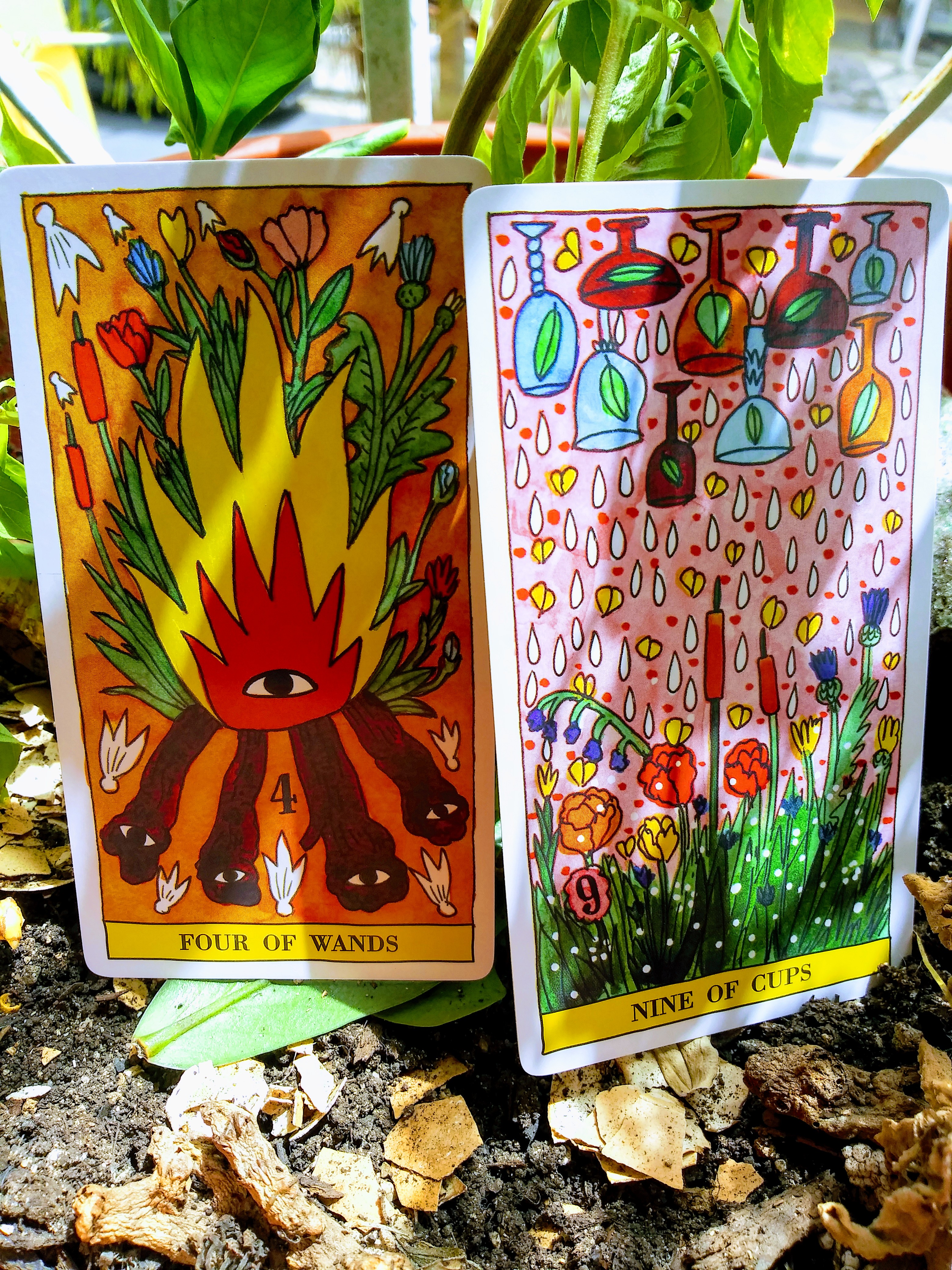
  • Tarot del Fuego Fournier tarot deck
    Tarot del Fuego by Ricardo Cavolo published by Naipes Heraclio Fournier, Spain, 2014.

    The eve of St. John the Baptist is here and for me the actual eve, the night, of this day is about imaginal, and not so imaginal, escapades. Wild nights under the starts, ecstatic dancing, and a communion between the living and the spirits (including the dead). Since this is about entering into more fluid territory, I want to talk a little about tarot and dreaming, or dreaming tarot.

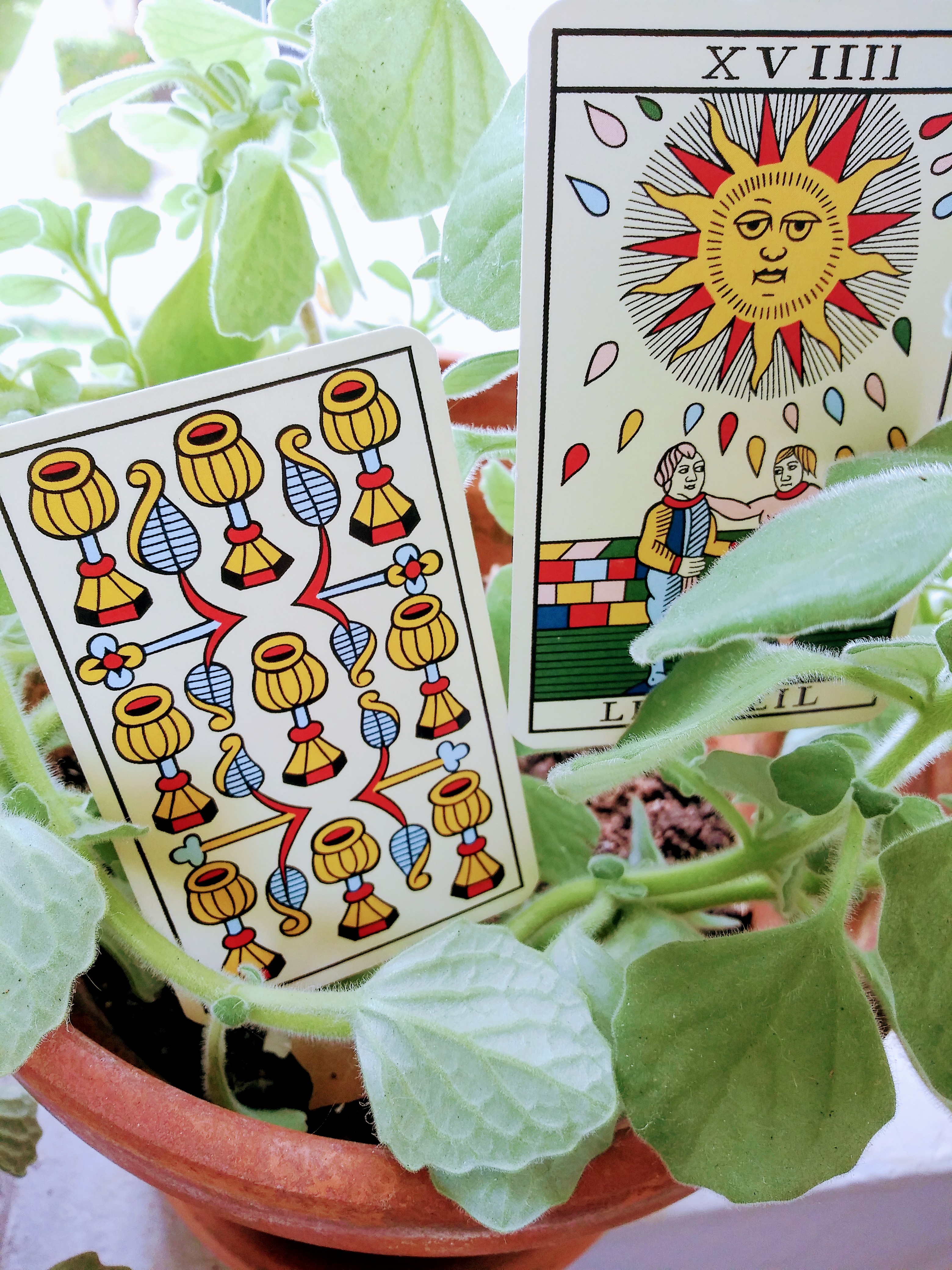
    Through my play with the cards I’ve found that dreaming with tarot is an excellent way of loosening the boundaries around the tarot and the signification of the cards. I mean here both using tarot cards to describe (de-code) dreams as well as using the cards for dreaming. What I’ve found through doing this is that the card image bends to dream logic. For example, coins can become mirrors, portals, heads, seeds, fruits, or even summoning circles. What is coin breaks down and morphs into varied shapes and things encountered in dream. The same goes for swords, batons, and cups. What is sword blurs beyond recognition so that I as the reader seeing the cards and having experienced the dream recognize the multi-valent capabilities of the thing portrayed on the card (s), the image. Meanings loose their solid state, warping into imaginal dimensions, coaxed into a realm outside objective frameworks.

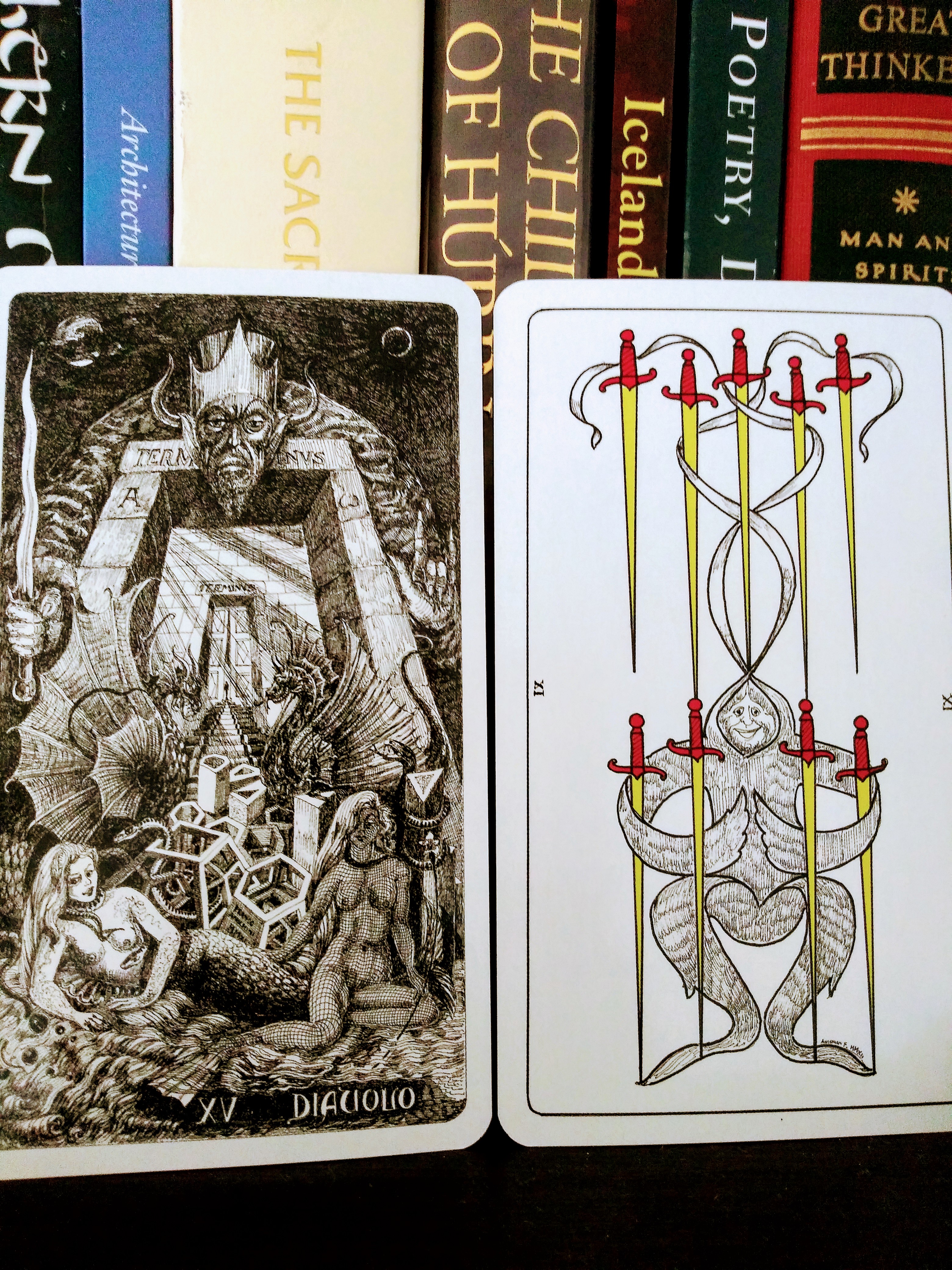
    Fantarocco di Franco Anichini, published by Modiano, Italy.
    Fantarocco di Franco Anichini, published by Modiano, Italy.

    To describe dreams with the tarot:

    • Immediately as you wake up before speaking, shuffle the deck and lay out cards, a handful at most.
    • While you’re shuffling and laying out the cards, ask about your dream, ask the cards to describe it or show you your dream.
    • You want to start small and build up, as if you were having a conversation with the cards. By small I mean lay out a handful of cards first and build up from there.
    • Also, it is best to keep the deck next to you while you sleep, on the night table or the floor.
    • Review your dream as you read the cards.
    • Think about the ways in which the cards on the table/bed describe your dream and what it says about it.

    On the other hand, using the cards to dream, while still allowing for the same malleability of significations and experiences, can also open up interesting and often profound avenues of exploration.

    Jean Noblet Tarot de Marseille, reproduced by Jean-Claude Flornoy, editions le-tarot.com, France, 2014.
    Jean Noblet Tarot de Marseille, reproduced by Jean-Claude Flornoy, editions le-tarot.com, France, 2014.

    To dream with the tarot:

    • Choose a deck, preferably a deck you keep hot, that you use often.
    • Have a question or purpose/focus in mind. (What do you want to find/encounter/discover in the dream? What you want answered through the dream?).
    • Before sleep play with the deck, and look at the images.
    • Take your time doing so, along the lines of meditative contemplation of the cards in the deck.
    • While thinking on your question and/or focus, choose no more than two cards (three or more cards gives muddled dreams), that you feel are descriptive to your goal/question.
    • Look at these cards just before sleep and lay them next to your head before laying down, you can also put them under your pillow if you prefer.
    • Sleep.

    When you awake, recall your dream and look at the cards again, thinking on how they addressed what you wanted to uncover, and also review what you actually uncovered. I’ve found that this method needs to be done often so as to really pinpoint a couple things. One is finding the right hot deck that is conducive for your dreams, to how you dream and your dream landscape, not all decks are the same. I’ve found that the best decks for me are less than a handful from my collection. Second, it is learning the language of the cards within imaginal territory. It takes time to bend toward different ways of seeing and reading the image (s). Third and tied with the second, it takes practice to learn to find what cards best describe what you seek in dreams. This is one of the reasons that it is best to keep the card count for this approach at no more than two.

    Now that I’ve shared a little about what I like to do with the cards besides reading for  querents and for myself, I want to close with a small prayer to St. John the Baptist:

    Sacred precursor of Christ; Sanctified in the womb; Admiration of all in the exercise of the virtues and privileges with which the creator enriched you. Angelic in chastity; Blessed apostle. Martyr, in the constancy with which in your rebuke of Herod you offered your head to the knife. Luminous prophet, of whom Christ himself declared: “Of those born of women non greater than John the Baptist.” Glorious Saint grant unto us the grace of spiritual joy, today and always. Amen.  

    On this St. John’s eve, seize the opportunity to glimpse beyond, divine, dream with the cards, and experience what unfolds for you.

    ~~~

    † I specify tarot in this post but you can replace tarot with an oracle or playing card deck. What is important is that it is a deck you use frequently.

    Natalia Lee