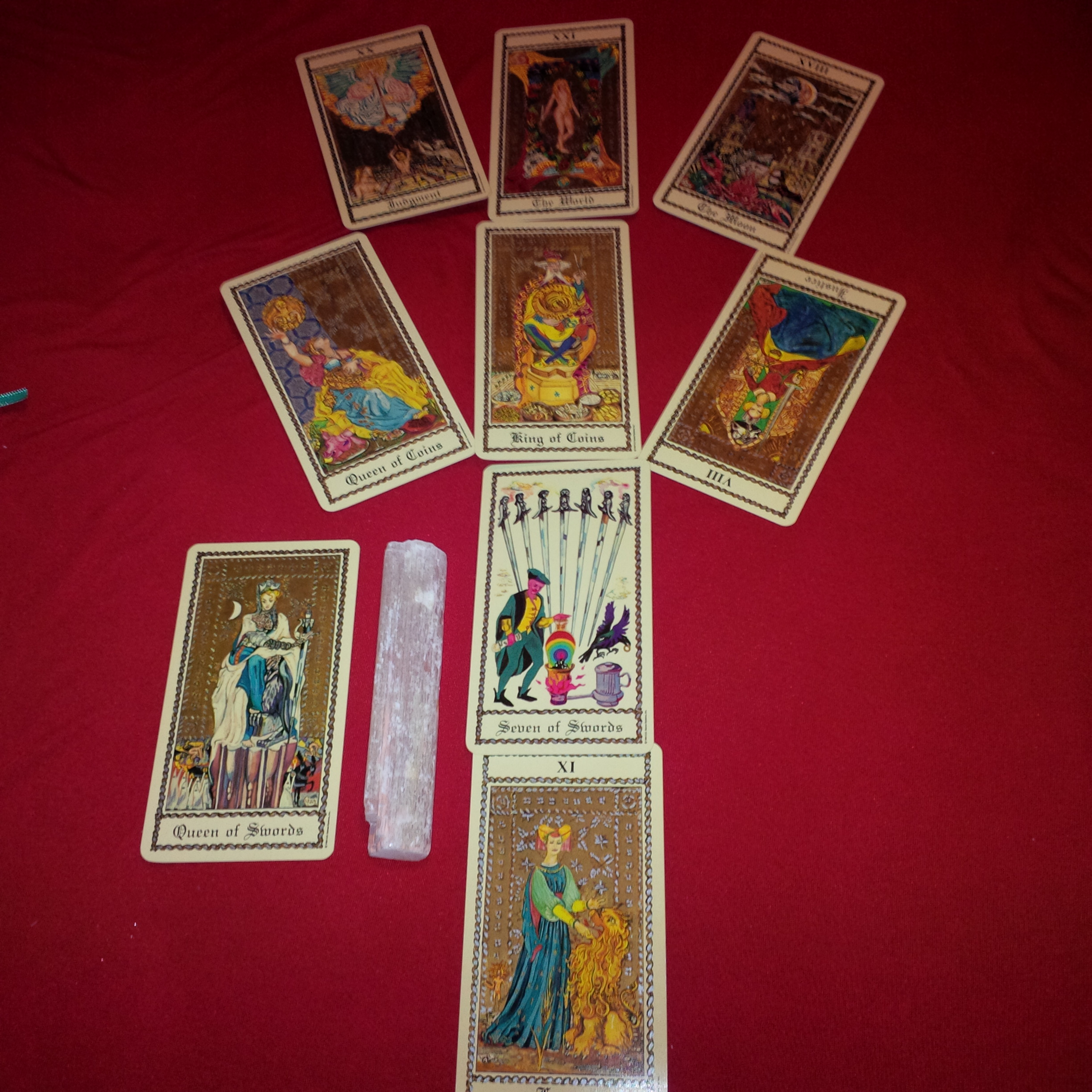
Category: Lenormand

  • Things have been quiet around here as I’ve been focusing on my newsletter and building closer contact with readers. But as things are always in a constant flow of change I now desire to open the doors to more frequent writing on here again. So I creak open the door with a deck review.

    For the past couple years I have not been participating in the acquisition of new tarot decks as I feel I have a good and decent collection, I am satisfied. What I have been doing, on and off, is keeping an eye out for playing card reproductions that catch my eye. Well, this year a deck was published that I have been following for a while. It is a Lenormand deck, a strikingly iconic Lenormand deck. Iconic in an emblematic sense, and this is the deck I want to talk about now.

    The Fortune’s Fools deck is a creation from and with the times, to be precise and per the guidebook it “is a two-year collaboration between Gordon White and Scottish illustrator, Colin Alexander.” What is really, I have to say, cool, about the deck is that it is truly a communal and collaborative creation, since it was created through youtube lives, with active participants in the conversation of each of the cards. “The finished product (the deck) is as good as it is thanks to the generous collective insight of the RuneSoup community.” So besides being a collaborative creation, it is also, given the medium through which it arose, an international creation, with voices from diverse parts. For all these reasons, before diving into the aesthetics, it is a unique fortunetelling deck with it’s own particularly strong voice.

    “We have also sought to make the deck more of a global, polyvalent affair, rather than cleaving too close to Lenormand’s European pastoral tableau. And so the whole thing is a love letter to rich, adventurous engagement with a vibrant, living cosmos.”

    I’m going to swerve into the aesthetics. The technical points are, it is printed on a premium matte black cardstock, with high intensity color images, from my perspective high intensity as the colors really do pop out against the matte black background. The playing card insets are included in the cards, which is always a plus in my book. I don’t believe it was specified in the guidebook but the deck is poker size, allowing it to be manageable for big spreads. The card edges are black, and it comes with a 161-page book on fortunetelling. The book is divided into two parts, the first part is on how to step into becoming a better fortuneteller with any deck. The second part is a overview of each of the cards in the deck. Admittedly, I purchased the whole package, partly from wanting the deck but also because I really wanted the book as well.

    I have read a good amount of Lenormand books, and mostly all of Camelia Elias’ writings on Lenormand card reading. My favorite book being Lenormand Thirty Six Cards: An Introduction to the Petit Lenormand by Andy Boroveshengra. But I wanted to read Gordon White on fortunetelling, as he has mentioned previously that this is his fortunetelling book.

    It does not disappoint, re-enlivening the landscape of telling fortunes, weaving in the whole animate cosmos in light of what it means to tell fortunes, reading signs, and symbols. There’s a brief history of Madame Le Normand, of cartomancy in general as well as tarot, and then it dives right into the metaphysics of play and omen logic. No corner is left untouched in the fortunetelling section, it is succinct, to the point, yet eloquent, as it guides the reader around the world of telling fortunes.

    In the second part of the guidebook, each of the cards get roughly 2 pages of descriptive information along with reading examples, keywords, and even songs to think with that go with the card. Which is a fun rabbit hole to jump into, listening to the songs for each of the cards. All in all the guidebook is excellent, and serves as an excellent companion to the deck.

    What else can I say about the deck other than it is saucy, talkative, colorful, and easy to use. The images are well defined and easy to read. I will add as a caveat, as someone who uses glasses, that all except 2 of the cards were easy to recognize. The two exceptions for me were the house and the mice card. Now that I know them I don’t get confused, but initially I did need to turn up the room light to see them better on the spread.

    Speaking of lighting, the cards are well suited to moody, atmospheric, candlelit readings. It is very apropos to the feel of the deck. Actually, I will add that the deck is also very well suited as a trusty traveling companion, for unexpected encounters, engaging in new landscapes, and exploring different places. It is adventurous.

    On shuffling, they shuffle wonderfully smooth. Flexible cardstock. For overhand shuffling, the cards do tend to stick together initially but ease into it with use.

    Here are images of a grand tableau, in thinking with Gordon’s words on this spread:

    The grand tableau is the most animist of layouts. Along with the more than human, quotidian motifs of the Lenormand oracle, it offers up to the skilled fortuneteller a web of complex relationalities and a process-oriented way of seeing we have almost lost. It is quite literally a jungle (White, pg. 80).
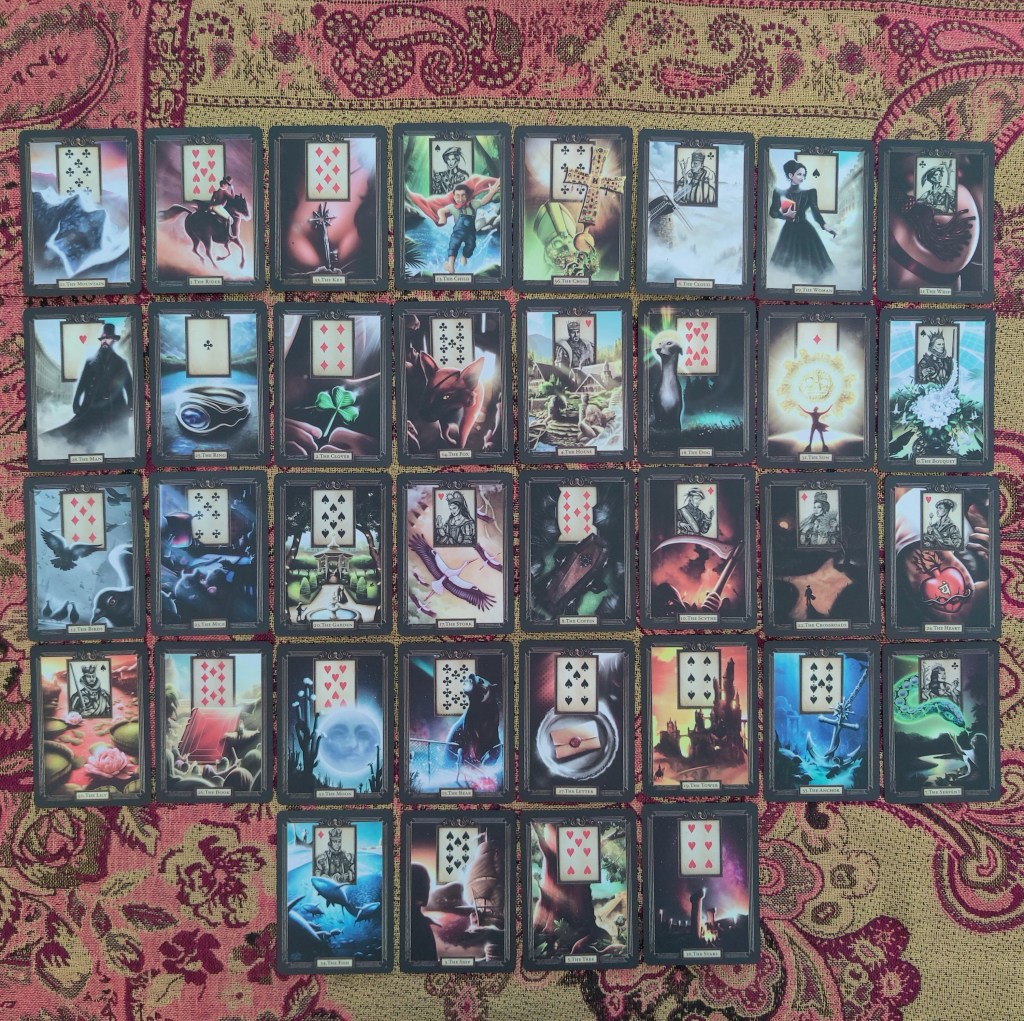
    All in all I heartily recommend this deck for fortunetellers, cartomancers, and diviners. It is a deck that walks both with tradition, while also surmounting boundaries, it is daring and fresh.

    • To watch all the cards as they are born, see this youtube playlist: here.
    • To purchase the deck: Fortune’s Fools.
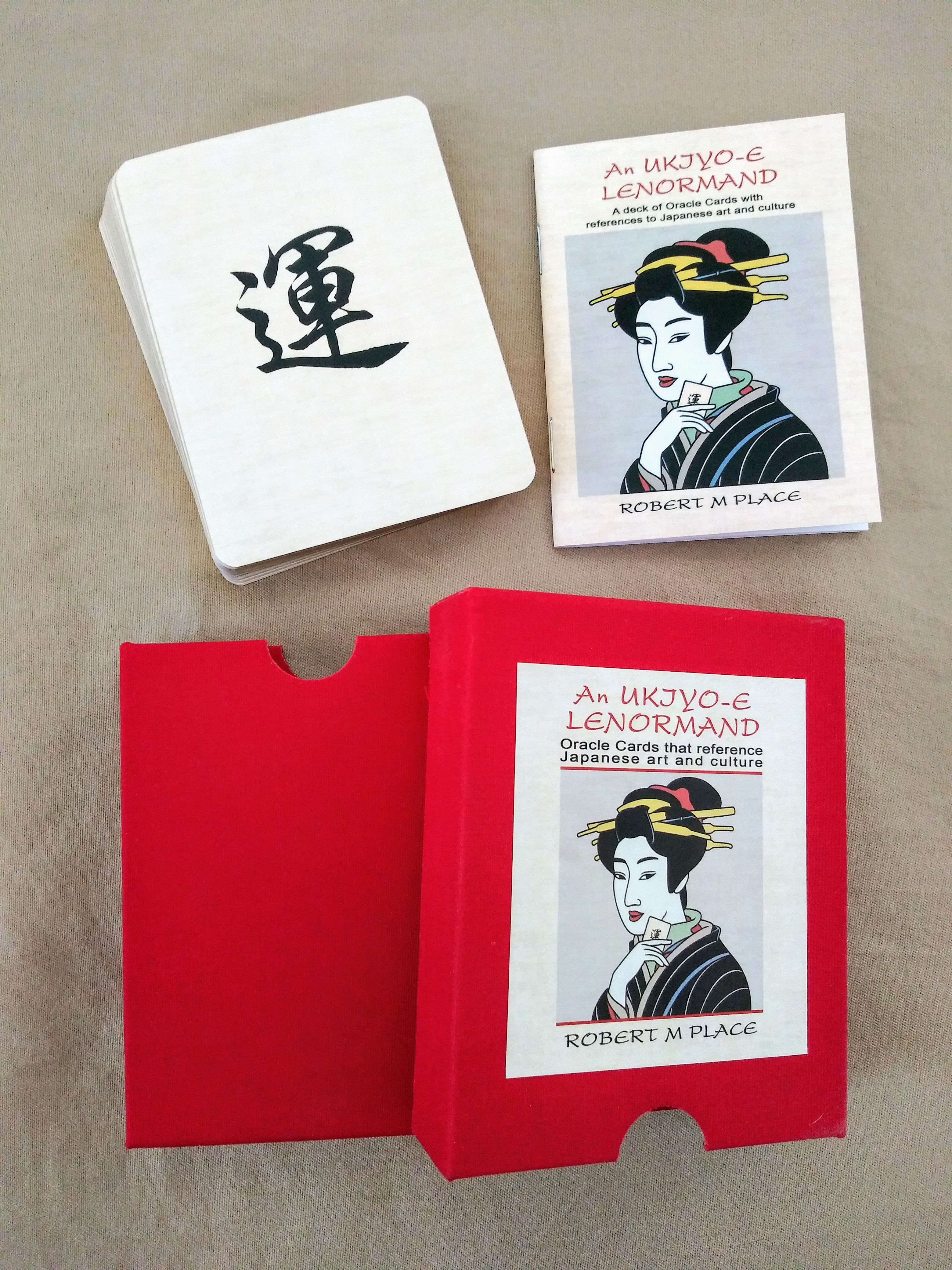
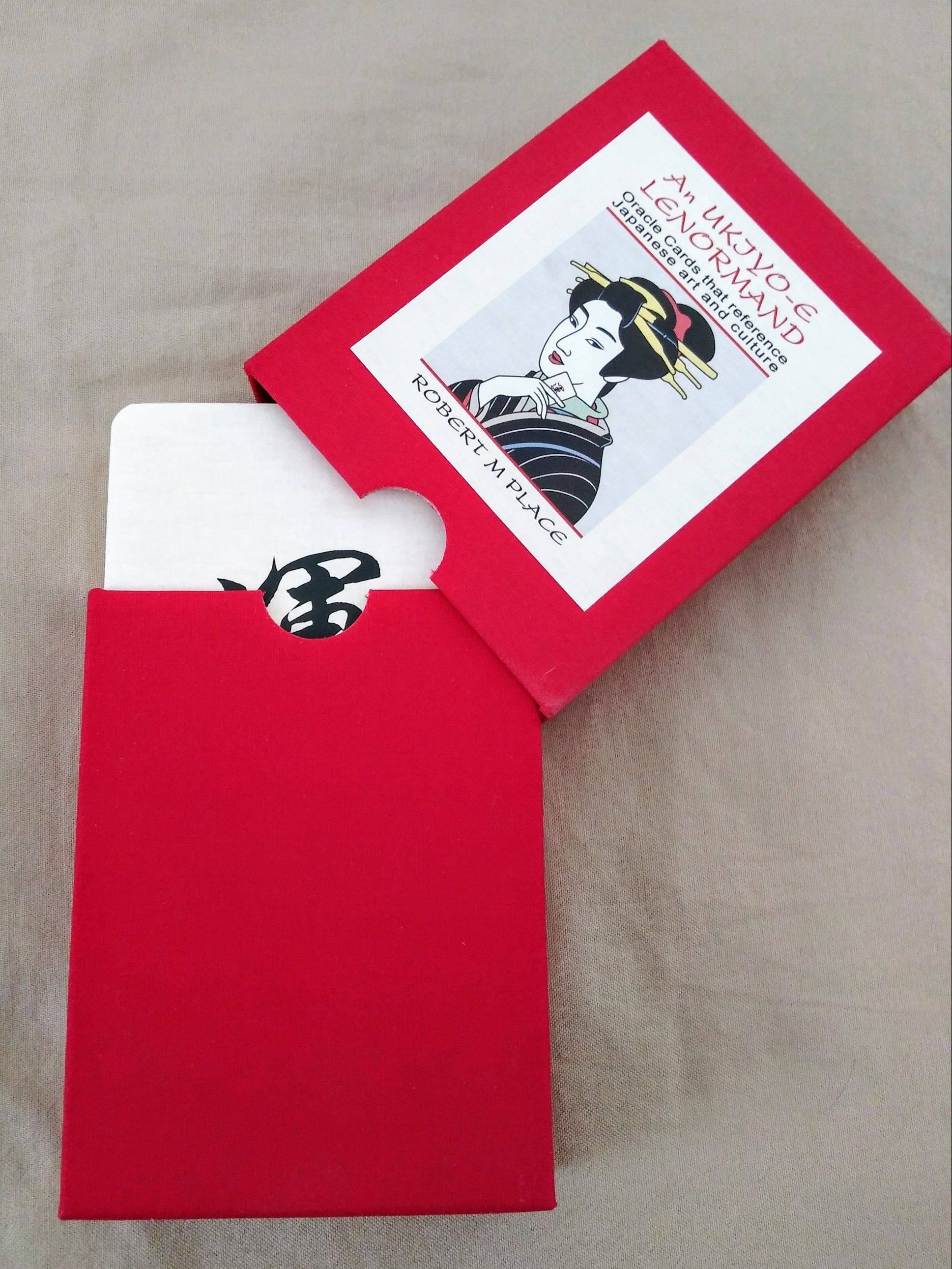
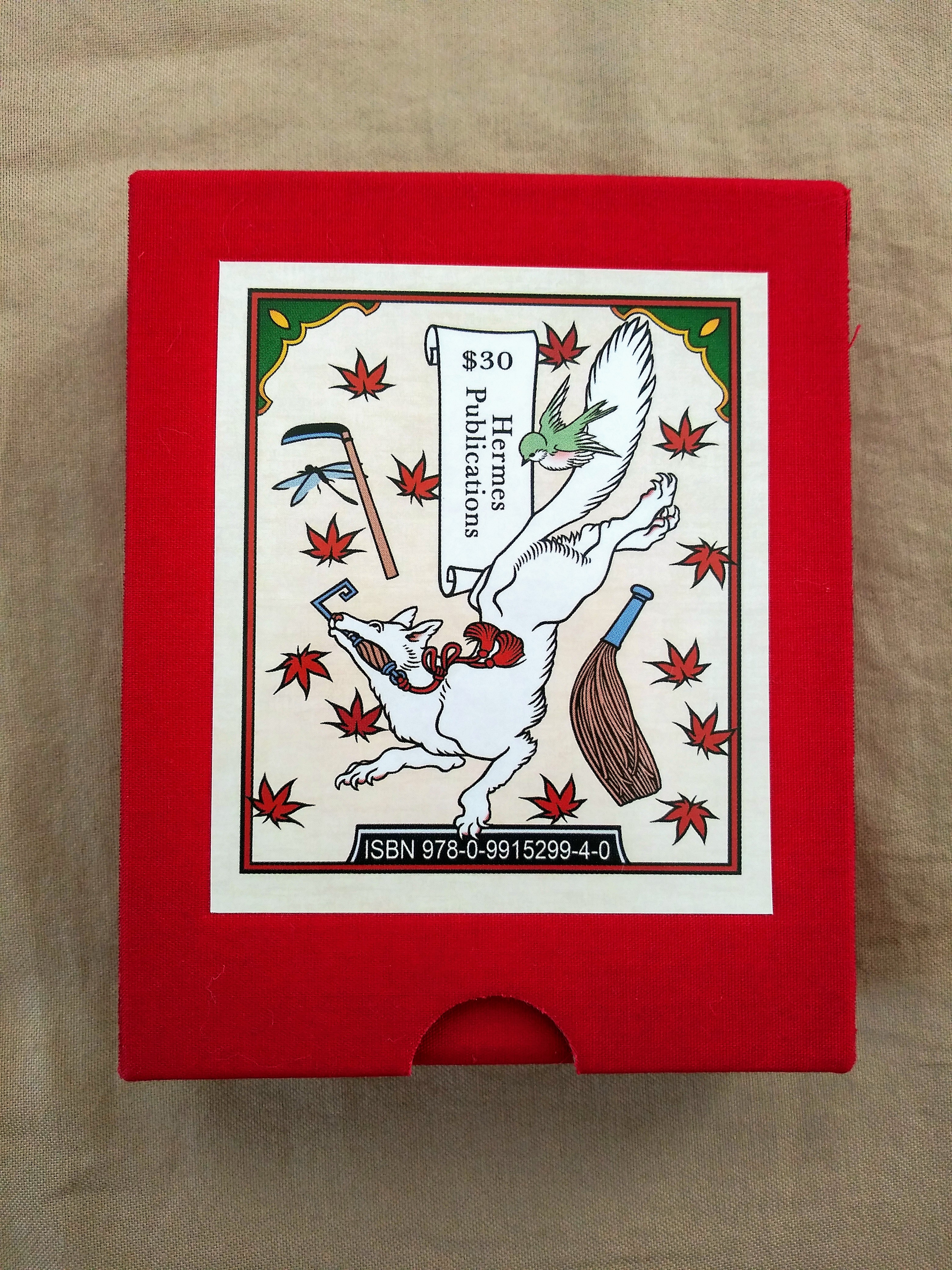
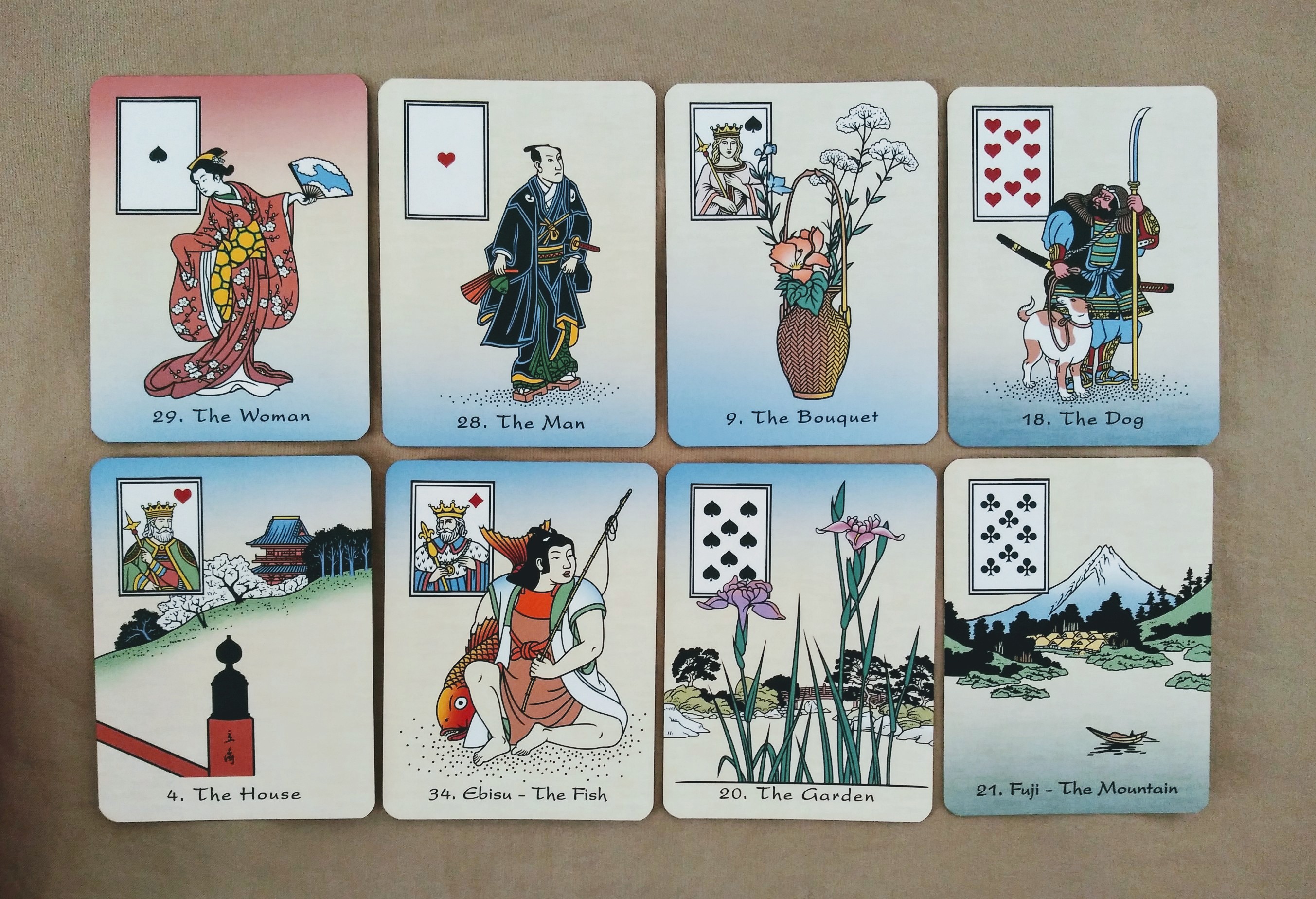
  • An Ukiyo-e Lenormand by Robert M. Place is beautiful. It comes in a red cloth two part box that slides out, with arched grooves on both of the boxes for easy access. This is the packaging that Robert Place looks to be implementing in all his new decks and I love it. As per Place himself: “The box is based on an antique deck in my collection. It is a design that I have not seen being used for 100 years.” It keeps the deck neatly in place, provides a sturdy home for storing the deck, and also for carrying it around in a bag. The top box has two labels, one on each side.

    The deck comes inside the inner box wrapped in a thin layer of plastic along with the small guidebook. The cards themselves are edged in gold, and their size is more square than rectangular, slightly larger than a regularly sized bridge or poker deck. Four by three inches to be exact. The cardstock is a silky smooth matte, and easy to shuffle. I should add that I’ve owned previous Robert Place decks in the past and in comparison, the cardstsock quality on this one is much improved.

    The guidebook is small and brief, mostly including the same information already available on the cards themselves from Robert Place’s website, linked below. There are one or two paragraphs on the Lenormand in general, and a couple more on how to read the cards towards the end. What I liked about the guidebook, which can also found on the website, are the description of the cards. Although each is short in length, it addresses how he linked the traditional cards within Japanese culture, mythos, and the ukiyo-e aesthetic. There are tidbits from history and Japanese culture that I enjoyed as well.

    “The name Ukiyo-e, meaning “floating world,” refers to the style of Japanese woodcuts and paintings made famous in the 19thcentury. The deck references Japanese art and culture, including Shinto deities (called kami), Buddhist bodhisattvas, and other mythic figures. At times, these references may modify the meaning of the card.”

    Some of the traditional cards have been re-positioned through a Japanese cultural lens. These cards add a rich texture of Japanese mythos. They are re-interpretations that offer different perspectives on the traditional card meanings. It should be noted as well, that some of the cards are reworkings of Ukiyo-e prints from Place’s own collection.

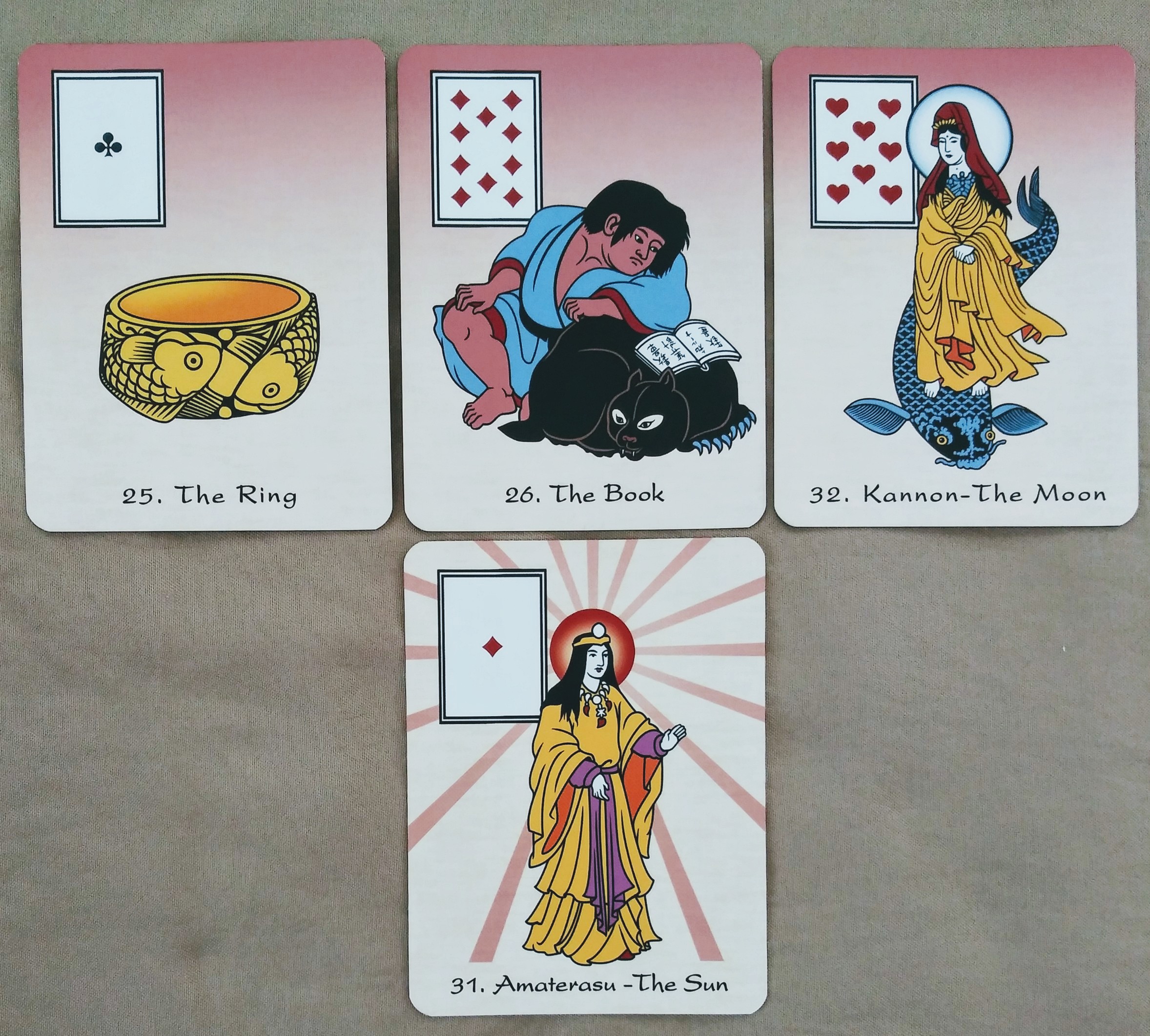
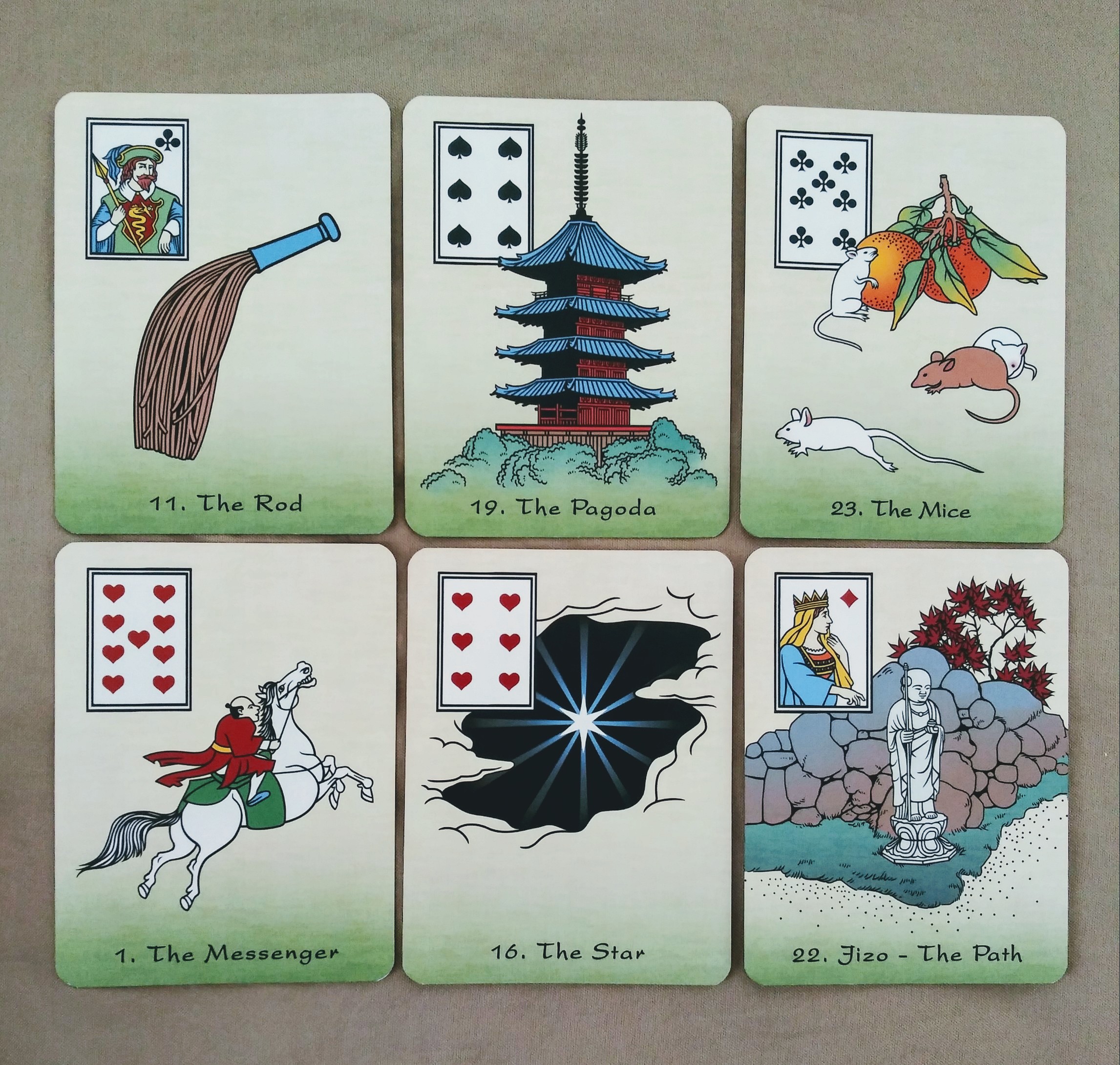
    Qualities of the cards include strong lines, a rich color palette, borderless cards, with a background the color of rice paper. The inserts are large and clear, and I find the courts to be surprisingly animated.

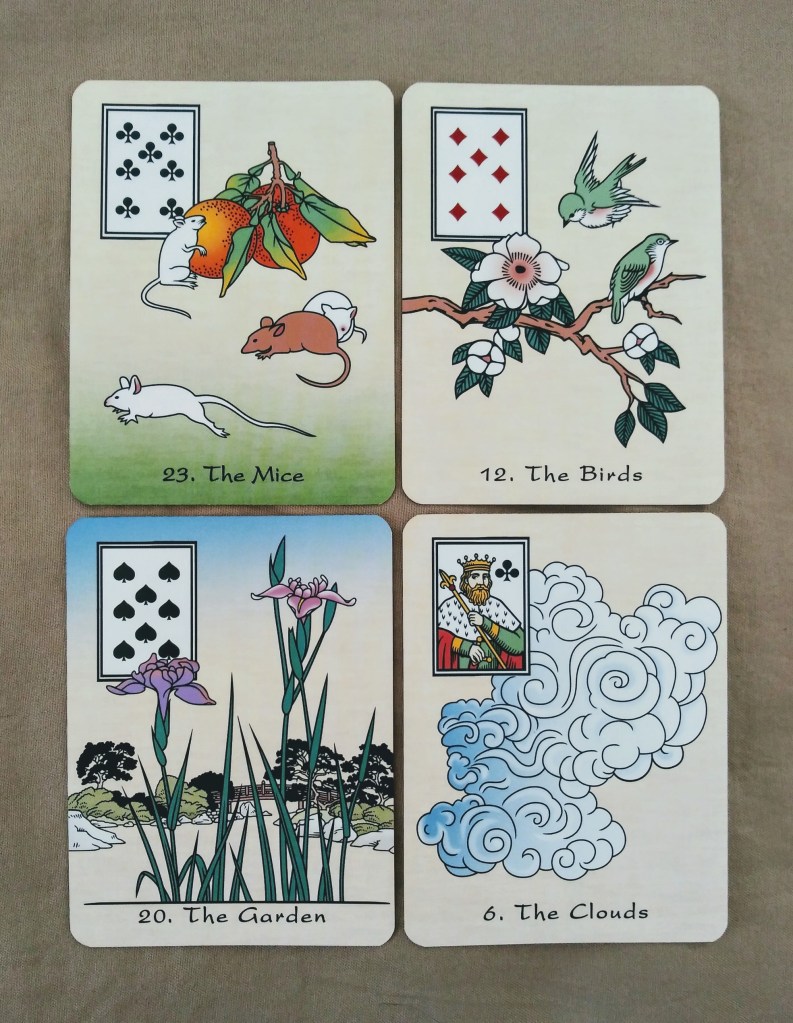
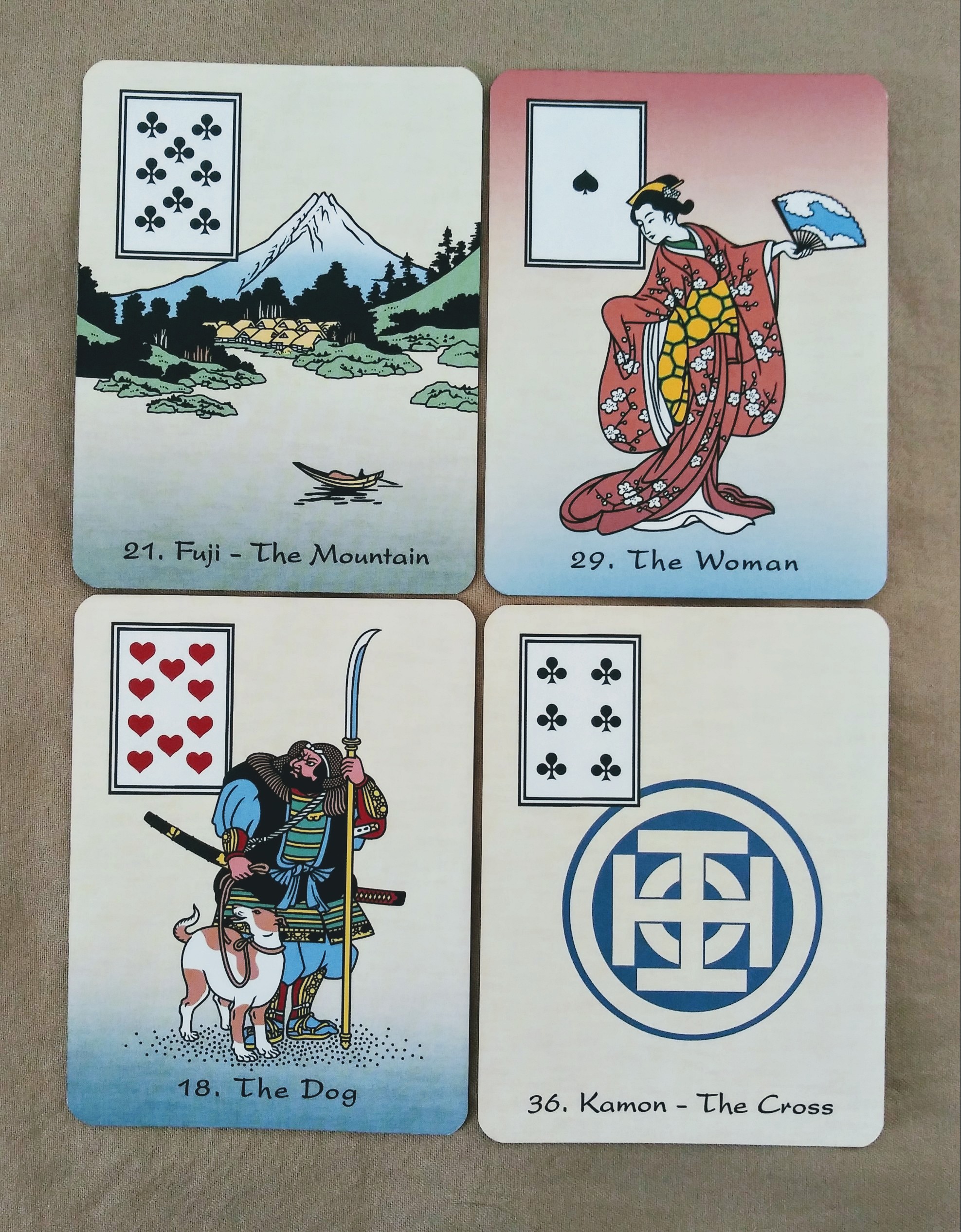
    There are also sets of cards in no particular order, or grouping, from what I can see, which I find interesting because the coloration above or below lend themselves to an added subtlety of tone within a reading when looking at a tableau. Especially considering the interplay of color significations and their associated meanings. For example, and these are brief:

    Bad words and malicious gossip eat away at the fecundity on offer throwing a cold pall over the gathering/party. (The green in the mice card that turns into the blue in the garden card, from fecund to stagnant.)

    An Ukiyo-e Lenormand: A deck of Oracle Cards with references to Japanese art and culture, by Robert M Place, Hermes Publications, 2019.

    Or, looming difficulties cloud loyalty, dampening commitments. (Looking specifically at the grayish bottom of the mountain card and the bottom blue of the dog card.)

    An Ukiyo-e Lenormand: A deck of Oracle Cards with references to Japanese art and culture, by Robert M Place, Hermes Publications, 2019.

    Overall, this deck is cohesive in presenting the art and culture it aims to explore through the creator’s eyes, while somewhat in keeping with the Lenormand frame. Robert M. Place has created a deck imbued with a deep appreciation and respect for Ukiyo-e art and the culture within which it arose. It is harmonious and elegant. A divinatory reading with the deck is clear and dynamic. To be frank, there is nothing I do not like about the deck, I bought it because of its beauty, and find myself reaching for it often because the readings are eloquent.* Needless to say, I highly recommend this deck for cartomancy lovers, especially those that appreciate a differently structured voice from the traditional Lenormand world.

    • To order the deck and see all the cards: An Ukioy-e Lenormand.
    • To read more on how the creation of the deck arose: here.
    • Caveat: I’m not fully versed in lenormand reading and admit that this deck would read more as an oracle than as a straight traditional lenormand deck.
  • Things have been a bit hectic around here these days, especially with the baby. I haven’t had time to really sit down and order my thoughts and share my daily draws and spreads. I have been intermittently playing around with the Lenormand. As a literature scholar, or so I consider myself, and theory enthusiast, I find the Lenormand to be deeply rooted in Semiotics. As opposed to the Tarot which is also somewhat semiotic in nature but loaded with esoteric references, astrology and a depth of background. The Lenormand is purely symbolic in nature, it rests entirely in the signs and their meanings. No extensive background base in esoteric knowledge and astrology is needed. Of course, this is purely my opinion, I am open to being incorrect and being corrected. In this respect, I am really loving Lenormand, the use of the signifier and signified and how that plays out in the cartomancer’s head, the one reading the cards. This is further amplified when reading for someone else.

    So far I have done simple card layouts, I am still trying to get a feel on the logistics of reading Lenormand spreads. I have found a couple resources on the Lenormand: here (for symbol meanings), here, and this youtube channel is great.

    These are some of my results for dailly draws and simple questions. the long 5-card spread is asking about this week.

    I love how one has to construct the answer, sentence, putting cards together.

    In regards to Tarot, my first love, I found a good spread by The New Age Hipster. I tried it out and the result was fantastic.

    IMG_20160322_113527

    Lastly, I have just received the Golden Universal by Lo Scarabeo in the mail, I haven’t opened it yet but I am very excited to find some time during my day today to do so. Maybe this deck will be the bridge that helps me connect with the traditional RWS…

  • Silly, silly me, I have been doing it wrong. My previous posts on the Lenormand spreads have been incorrect. More specifically, my Lenormand inquiries have been wrong. I started looking around the web for information on the Lenormand, since the LWB that accompanied my deck is in German and I don’t, unfortunatley, read German. I stumbled across an excellent site that gave me loads of info and resources. After looking around I realized, as I said, I was using the Lenormand wrong. So I went back and looked at my spreads and applied my newfound knowledge, things were a bit clearer. Now, given that the nuances of the Lenormand differ from the tarot, today I decided to do a simple question reading with the Lenormand. 6 cards, paired.

    My question was about this creative, literary project I have been wanting to start. From the cards I see that the work needs to be started and that I hold the tools, the message, I want to impart. What I need to solidify this idea is commitment, and by discarding my errors in the past I should find luck in this new endeavor.

    Very simple read, combining cards to get full messages, very cartomantic. Coming from my immersion in studying Qabalah and the Hermetic deck this is really refreshing.

    As some may already know, tonight is a full moon. I have such a nice spread awaiting use with a special invocational card. I hope to be sharing that on here shortly. Well, I hope all who stumble upon this little endeavor of mine are blessed.