I just finished listening to an amazing interview by Gordon White of Runesoup with the author of the new Scarlet Imprint release of The Game of Saturn by Peter Mark Adams. You can find more information here. Briefly, the book is a scholarly study of the Sola Busca Tarot deck. The interview is amazing, informative, and truly enlightening. I highly recommend it for all those interested in Tarot historicity and western esotercism. Here is the interview.
Natalia Lee
A nest of sorts
Designed with WordPress
Category: Reviews
-

I start off by saying that I received this deck unexpectedly. In the site darktarot.com you can find two free printable decks, this one and another black and white deck. Furthermore, at the site there is a trove of resources for tarot learning and history.
Onto the review… Firstly, the card stock is nice and sturdy and the coloring of the cards has a nice aged finish that complements the artwork well. There is a stark white border that surrounds the images but that can easily be resolved with trimming. The back has a beautiful shinning sun and is reversible.
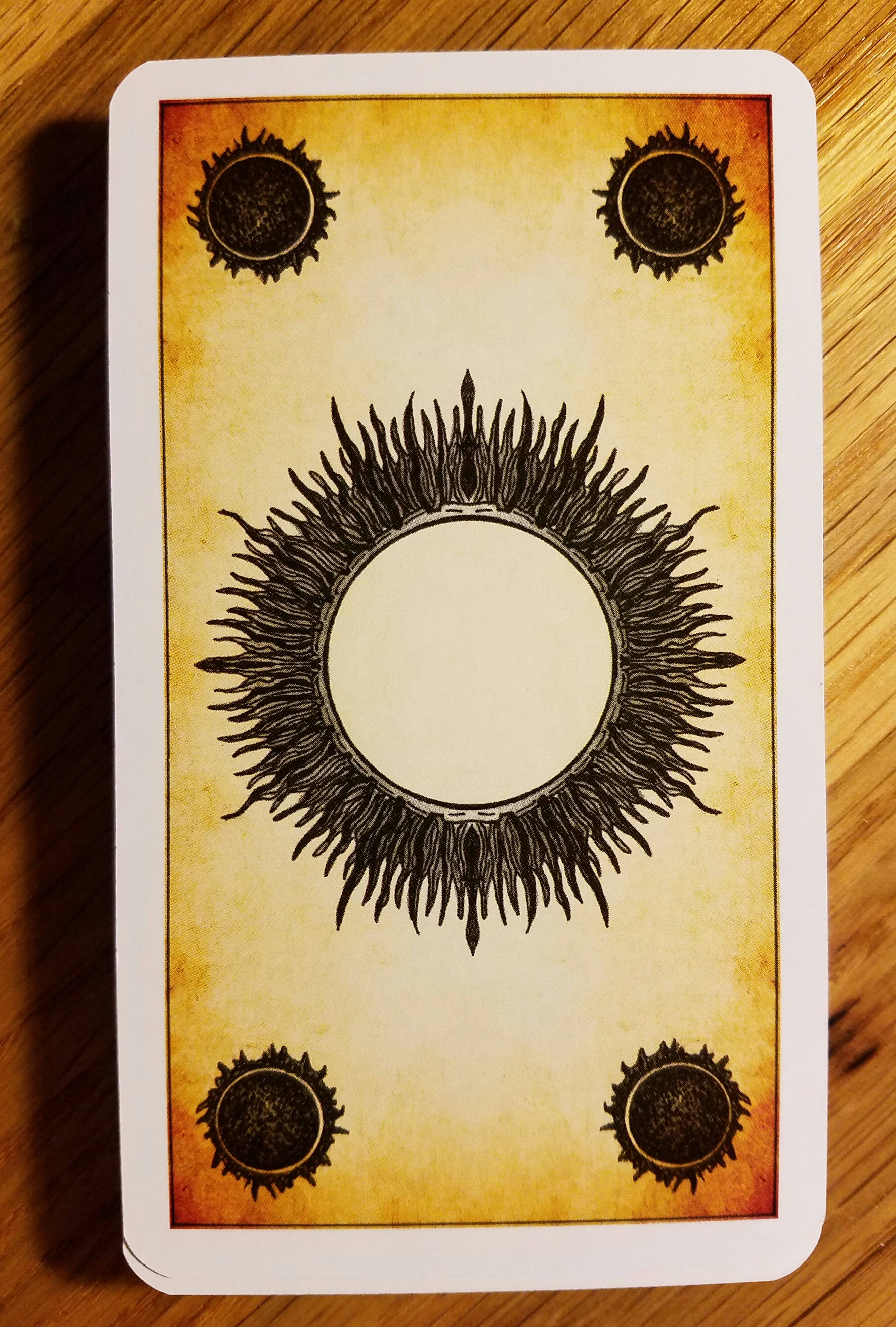
The Dark Tarot, reversible back. What called to my attention from this deck were two things, the suit of wands and the court cards. The court cards are descriptive, and many of the characters seem to be draped in lush fabrics that gives them a regal air. Reminded me of the Minchiate cards. The minors are all pip-style, or not illustrated, but this is where the suit of wands especially shines. There is a wonderful sense of interaction, differentiation, separation and merging that plays out within this suit that really brings the story to life. Unlike the Marseilles Wand pips, the wands here interact viscerally. The color of intruding or opposing wands differ from the others, directions change, and there is a real sense of watching a story unfold as the wands interact. Adding to this is the fact that the Ace of Wands starts as a thick, rustic, tree bark being firmly held upright. I must admit, the suit of wands is a suit of contention for me, sometimes I have trouble reading it clearly, but with this deck the suit shines and the story clearly plays out.
 The Dark Tarot, the Court cards.
 The Dark Tarot, Wands suit.
Benebell Wen did a great review of the deck over on her site, she posts more pictures. In this review of mine, I just wanted to highlight a couple aspects of the deck while also talking about my interaction with the deck.

The Dark Tarot, deck interview. I used this deck for a couple weeks, plus I also did an interview spread and all in all, I must say the deck is very straightforward and clear. In the interview the deck highlighted its practical and fiery aspect. The opener card was a wands card, fitting. Two knights followed, the lovers, ending with the 9 of coins. There is a sense of escalation. This deck is about opening up, about pinpointing logistics and clarifying what is unclear. It is direct and nonsensical. Not one to wallow in the emotional aspects of life. Throughout my time interacting with and using the cards the readings were always clear and the messages were explicitly laid out. I really like that about this deck.
Here are a few other cards that I found striking.


You can view the rest of the cards at the site. As always happy reading.
-


Hello, I decided to do a deck review with Le Tarot Noir by Matthieu Hackiere. I have had this deck for a couple months now and I have used it quite frequently. I have to start off by saying it is a Marseille style deck, therefore the pips are not illustrated. I know there are a couple reviews out there of this deck but I decided to add my two cents about this beautiful tarot. It comes in a box, with a decent sized book and the edges of the deck are gilt in gold color. Also, for those that read reversals the backs are not reversible.

The book is in french, it comes fully illustrated and there is very good information on the Trumps, covering one page each with descriptions and interpretations. The book binding isn’t all that great so the pages do start coming off rather quickly after opening it.


The cards are big but surprisingly supple and easy to shuffle. The way I shuffle them is by dividing the pack in two and taking each pack and dividing it again and shuffling the smaller packs. Then I put both packs back together and overhand shuffle (I think that’s how it’s called) then voilà! I have had no problems shuffling this way and I don’t have large hands. Here I show some of the Trumps. Le Mat is quite beautiful, his expression is so naive. Le Bateleur is showing all four legs of the table as opposed to the traditional TDM style. L’Ermite is striking to say the least, the effect of the stripes surrounding the lantern truly creates the illusion of the card being illuminated. Le Pape is grave-looking and two sheep dressed in clothes look up at him a bit terrified. In general, the air of the deck, the colors and the people depicted are somewhat ‘Gothic’ looking, a tad dark, somber and bizarre. But this doesn’t detract from the traditional core of the deck, it is at it’s heart a true Marseille deck. The colors used are dark hues and shades of red, blue, orange, green and black.


Here are a couple more Trumps, Le pendu has a very peaceful face and the robes of La Force are elegant and fluid. Le Diable and the unnumbered card 13, which is Death, I do appreciate that they left the card unnumbered, are amazing cards. Playful and vibrant. L’Etoile is so graceful. Le Soleil is one card I would have preferred in the traditional style with the two kids or people playing in front of a wall as the sun beams down on them. This sun card is more like the Smith-Waite version. At first that put me off a bit, or confused me, but it has slowly grown on me with use.


Even though the pips are not illustrated the detail of the different suits are so elaborate that the pips shine as works of art as themselves. A slight turning of the leaves, gradation of shades, the inclusion of shadow really make the readings come to life. Leaves, vines, flowers, petals abound.


I also appreciate the use of white space. Yes, the cards are rather bigger than normal tarot size but the white space gives the cards more depth, and they are very useful for ‘pathworking’ and ‘journaling’ given their detail and depth.
Lastly, the court cards. These are full of sombre and peculiar personages done in the traditional Marseille style. The attention to detail, especially in the facial expressions holds true throughout the deck, both in the Trumps and the court cards. The faces are eerily expressive both in their demeanor and gestures.


Truly, I feel the amount of thought and work put into this deck is comprehensive, the theme is consistent throughout and it feel as though I am being pulled into a bizarre and otherworldly land created by someone like Tim Burton. This is an honest Marseille deck with a playful heart. I really enjoy using it. I was thinking the other day about the deck and the seasons and I though this deck would go very well with autumn, given the colors and the style. I ordered it online and the deck, form what I found, is a little hard to find in the US, I ordered it from outside the US. I hope you enjoyed my little review and if you have the chance get the cards and use them, they will not disappoint.
Happy reading.
-
A book review.

Towards the Art of Reading by Camelia Elias I have mentioned on here previously that I was reading Camelia Elias’s book Marseille Tarot: Towards the Art of Reading, published by Eyecorner Press. I just finished the book and found it so refreshing, that I want to share a little review of it in this space.
The book is about storytelling with the Marseille Tarot. How to create stories that speak to the querent and that consequently reveal our “blind spots.” It starts with laying down the foundation, how to construct stories, how to ask the cards, and where to look for more information. She provides excellent outside sources to complement our tarot journey, from Alejandro Jodorowsky, Enrique Enriquez to the writer Italo Calvino. She doesn’t delve into the logistics of determining the future and how to ask the right question, that is merely up to the reader and what she/he feels comfortable with. The Tarot is such an expansive language that it can encompass all these nuances, we should not worry ourselves with the minutiae. It is truly up to the reader.
The Tarot is a visual and poetic language that enables us to respond to an embodied situation presented in the cards. It’s the best kind of learning. And often the wisest.
The Cunning-Folk Method:
Useful stories that rests on the premise that a pack of cards can be seen as a tool in describing that which we have no words for, but which we would like to see crystallize before our eyes.
She applies traditional folk methods to reading cards, based on cartomancy, that distills this passed-down-through-the-ages knowledge in the art of telling a story by looking at the cards lying on a table.
A good portion of the book, about half, goes into detail about the Trumps and also uses real life reading situations to contextualize the meaning of the Trump. The interesting part here is where she presents in a very common-sensical manner of interpreting the card in combination with another card. For example: Le Pendu
With Le Pape (The Pope)= A mystic

Jean Noblet Tarot de Marseille Majors only. With Lemperance (Temperance)= Yoga instructor

Jean Noblet Tarot de Marseille Majors. With Le Diable (The Devil)= Underground spy

Jean Noblet Tarot de Marseille Majors To me, this is inspiring. The possibilities inherent within the cards are truly endless, versatile and magical.
With the suits she doesn’t go in depth into each one, she basically applies the cartomantic rules of making logical inferences from the pips and that is all. As she states:
Essentially, we always go from tension to release. And that’s basically all. One is a little, ten is a lot. Unity and division, contraction and expansion, and far and near optical observations.
With the batons we construct , with the swords we fight and dig, with cups we celebrate and drink, with coins we barter and buy. From here on out, we make inferences based on the number and the surrounding cards and voila! ça suffit. This might seem a little vague but when you get the cards out and start playing around with them it starts making complete sense. Also, keep in mind that the most important part to any system is consistency.
Towards the end of the book she gives the basis for the French Cross while also delving into the nuances of the simple three card spread with a top and bottom card and ending with the logistics of a reading/querent situation. How to read for others, etc. All in all, this is an excellent book. How Camelia Elias weaves a story that is both evocative and pertinent is truly inspiring. In my humble opinion, I am not big on reading how-to books, yes I read the LWB tarots come with but in general I don’t delve too much into reading a lot of how-to material. I don’t like being told what things mean, I like getting there of my own accord. This book is so much more than a How-to book on reading the Marseille tarot, it is a magical book on how to see the cards in a more subtle light, how to create stories that speak to us and that take us further than our present moment. It is as the title states, a book on the art of reading. I wholeheartedly recommend this book for a different and stimulating approach to reading the cards.
*Deck used: Jean Noblet, Jean-Claude Flornoy restoration.
 Natalia Lee