• Cards: Ace of Cups

    Heavy shifting and big transitions have been underway in my life recently. It seems fitting I initiate this new foray into another suit with the Ace of Cups. When I began these card explorations I didn’t have a set order as far as suits went, but I seem to have been influenced unconsciously by Jodorowsky’s The Way of Tarot because I began with the swords and now I move unto the cups. By the way, it’s a really good book.
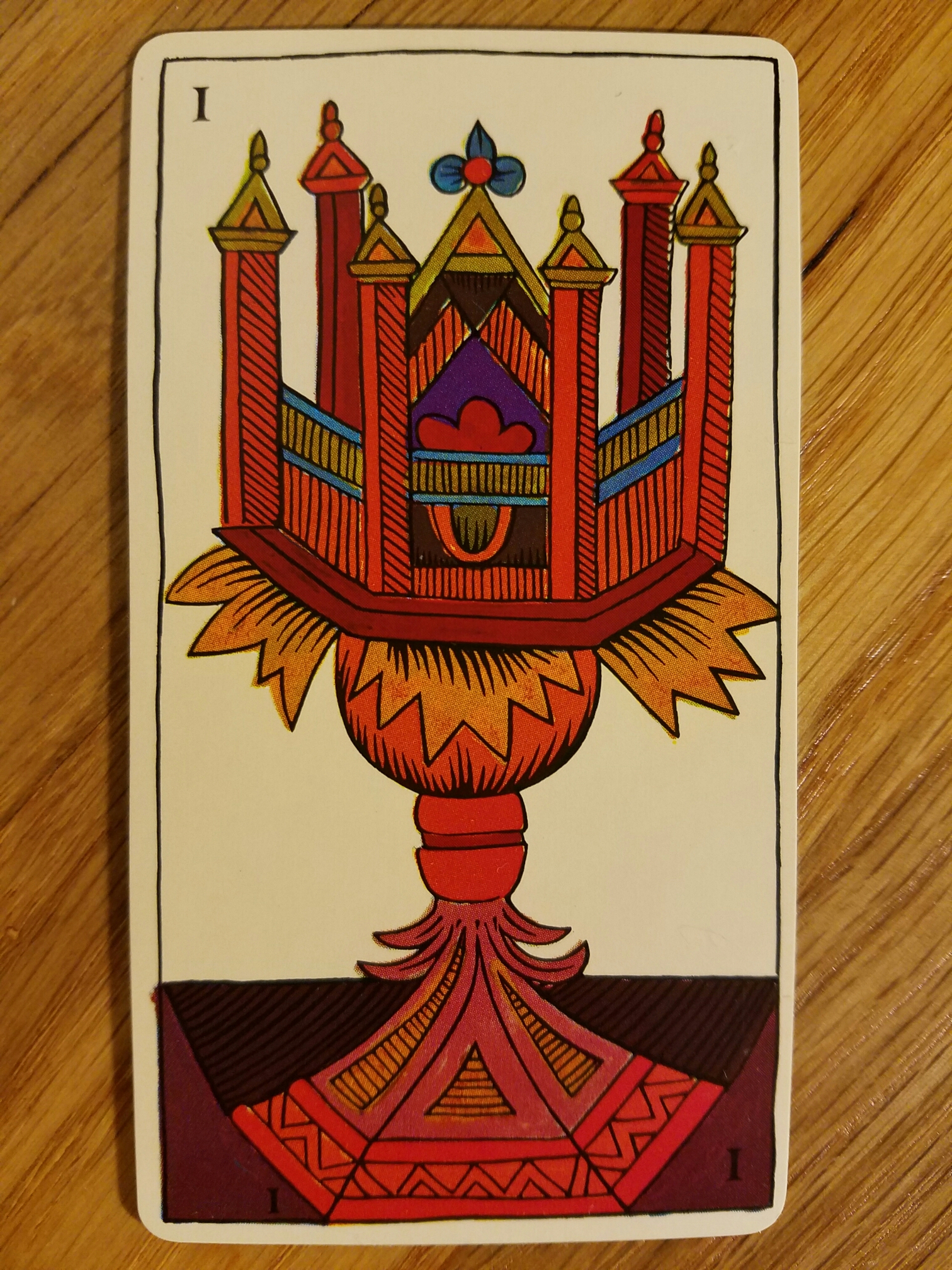
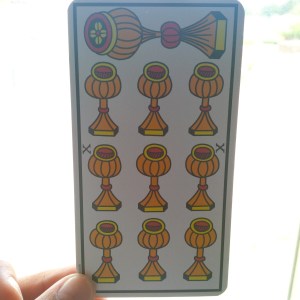
    The Spanish Tarot by Fournier

    As I enter into this suit by way of this cup I feel grounded, and I am reminded of a house, of the heart of the home, the hearth. The pillars enclose and keep safe what is precious inside, the heart. The stem is thick and sturdy and the cup’s base rests firmly on the ground. There is no toppling this cup over. An orange, fiery glow emanates from the circular pillars, this reminds me of a fire. Along the lines of “keep the fire strong and the love deep.” 

    This card emanates much power  and affirms the strength that resides when we follow our hearts, when we care and nourish our inner world, our sentiments. When this card pops up in a reading, I generally see a good fortuitous omen in it. A new sentimental spiritual begining that is going to ground and strengthen our home and our hearts. Or it can even be read as a call to pay attention to what we hold near and dear, to nurture and care for that and those.

    As summer is in full swing, this card reminds me to look inside, to care for my heart, to heal and to keep close and cherish those few I hold dear. While the madness of the outside world continues to rage as it always does, the politics, media and ego of all that sizzles and crackles out there, I am reminded to keep an eye inside always.

    I might do card combinations as I delve into this suit, but with this one I’d like to keep it simple. I hope everyone is enjoying their summer so far. As for me, I have recently moved and am currently building my little nest somewhere new and very exciting. Also, I have made a new deck purchase which I might share later on, and I will be doing a review of a gifted deck I recently received.

    Happy reading, as always.
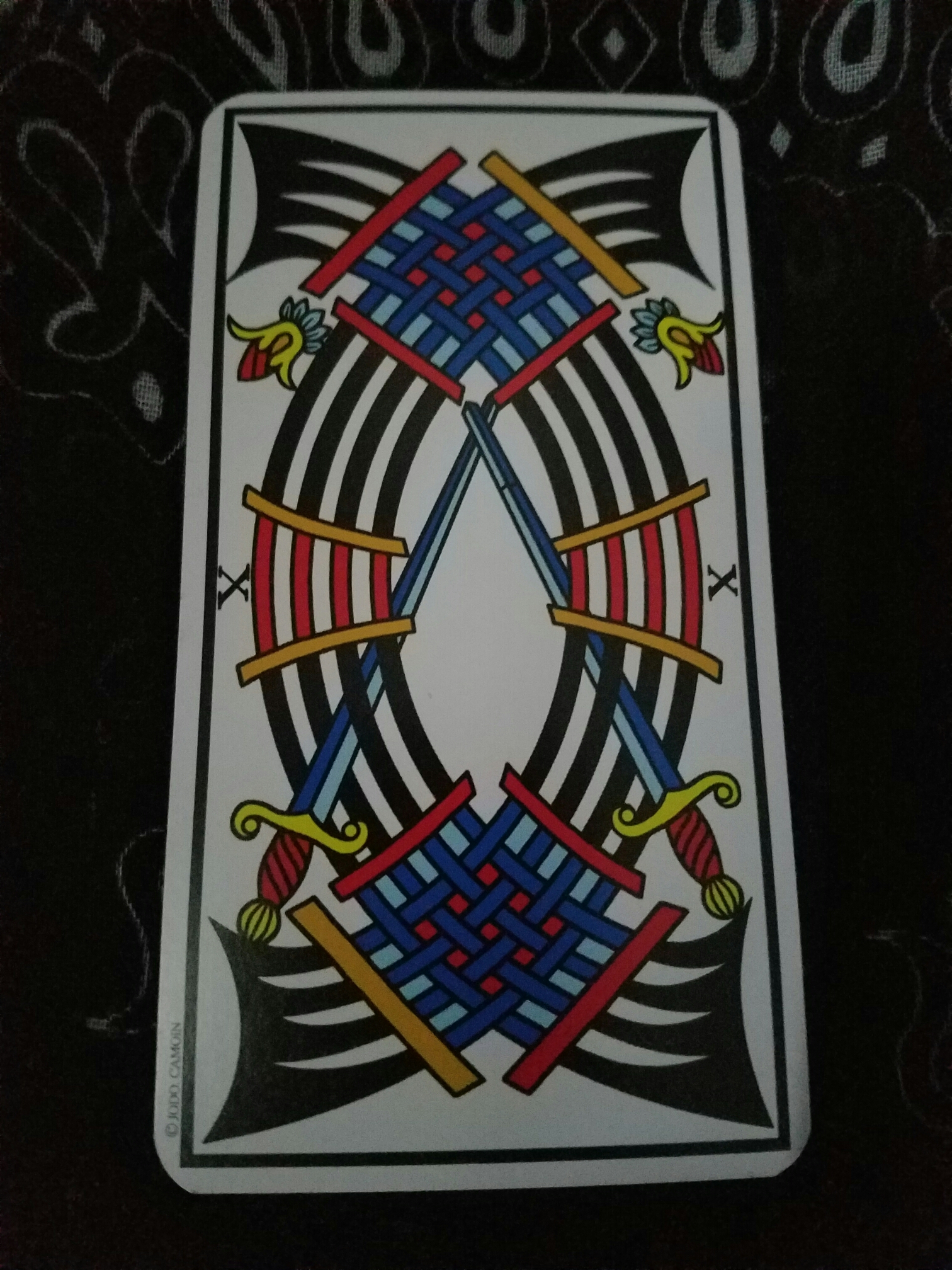
  • Cards: 10 of swords

    For the last card of this suit, the final 10, I will not be using another additional card from the Majors. Instead, I will look at the card from two perspectives.

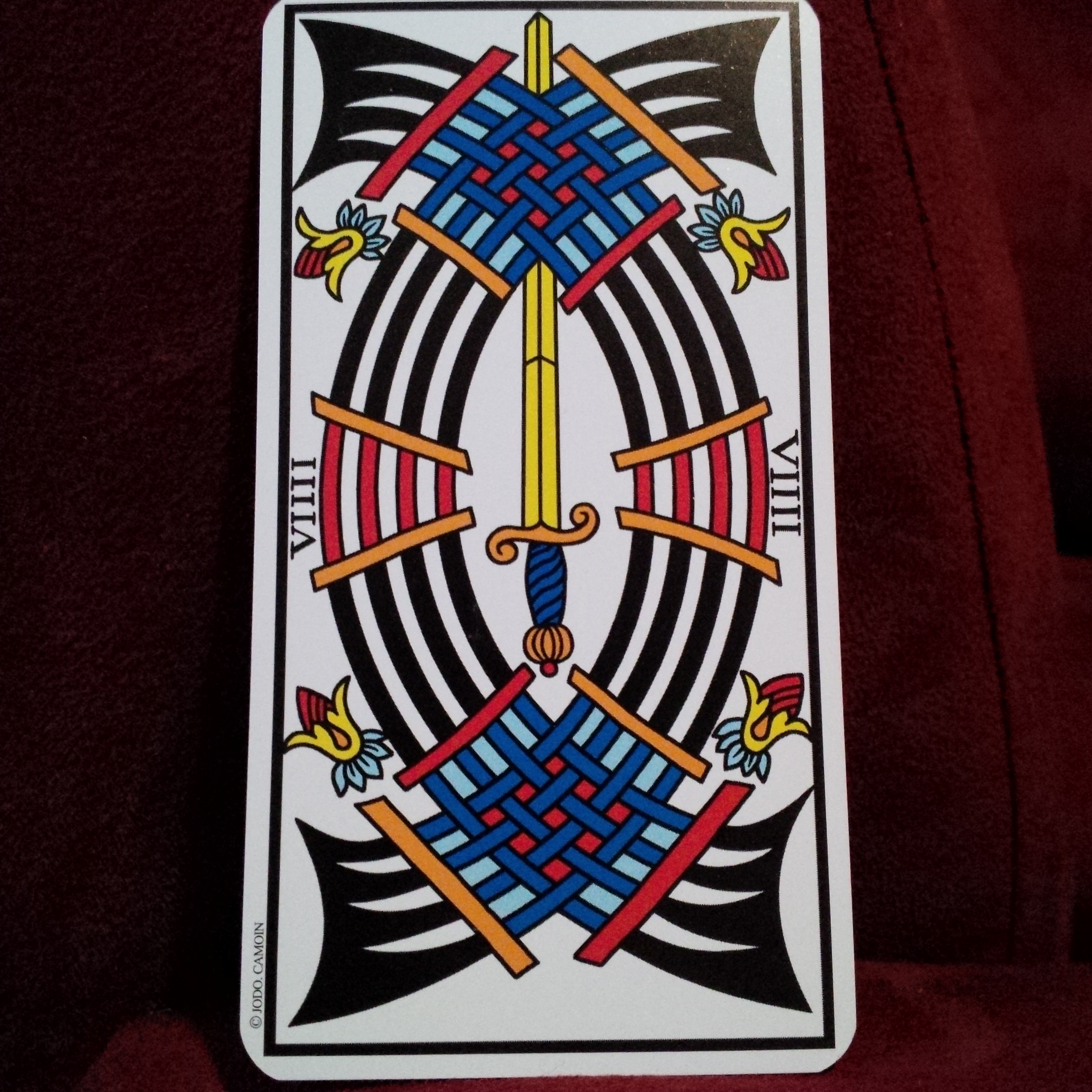
    Camoin- Jodorowsky Marseille

    Defeat. Exhaustion. You have reached the end of your tether, two options are available now, find the strength to break out of the cage and move outside, or be completely defeated and give up. When I look at the orientation of the two swords striking each other within the web of swords I think of a battle lost. One sword is broken, the other is not. Both swords come into the fray from between the blades, this is severe complications. The struggle has become so convoluted and intertwined, it is a veritable paralyzing web. This struggle has led to defeat, and in its most extreme case, death. As with all death there is irretrievable loss. The sword that is not cracked is slightly longer than the other, making this one the victor. There is a duality at play here. Of two opposing things, ideas, people, essentially the same but also different, fighting for supremacy. This fight has been long and arduous and the injuries suffered are evident.

    When I think about key 13 of the Majors, the unnamed card, which is now known as Death, I think about the hint of a new beginning, the blank canvas that follows death. This blank canvas, plain and unadorned, holds the promise of a new reality and new creation.

    From another perspective I think: truce. A truce that is forced because you no longer have the strength to continue fighting. You are injured and it shows. You have been defeated. The swords cross each other at the tips, so there is an accord to discontinue the fight. There is an agreement between victor and loser. Seen this way, I don’t think so much about death but about losing the battle and having to retire to tend to your deep injuries.

    This is a battle that has been raging on for some time, and you have been in the fray for far too long. This is the final culminating moment, when there is no more battle left in you. You are forced to stop and you are forced to quit.

    As with all journey’s end, there is a transformation, at least all journeys should end in transformation. Well, this 10 of swords ushers in a new suit, another exploration, a new beginning.

    Happy reading.

  • The god of gateways: Janus

    Last week I had a series of one card draws, spanning three days, and for those three days the same card came up. The 10 of cups. When I look at the Marseilles 10 of cups, I think of excess and completion in the realm of the heart, the hearth, and in the home.

    IMG_20160702_112257
    Camoin-Jodorowsky Tarot

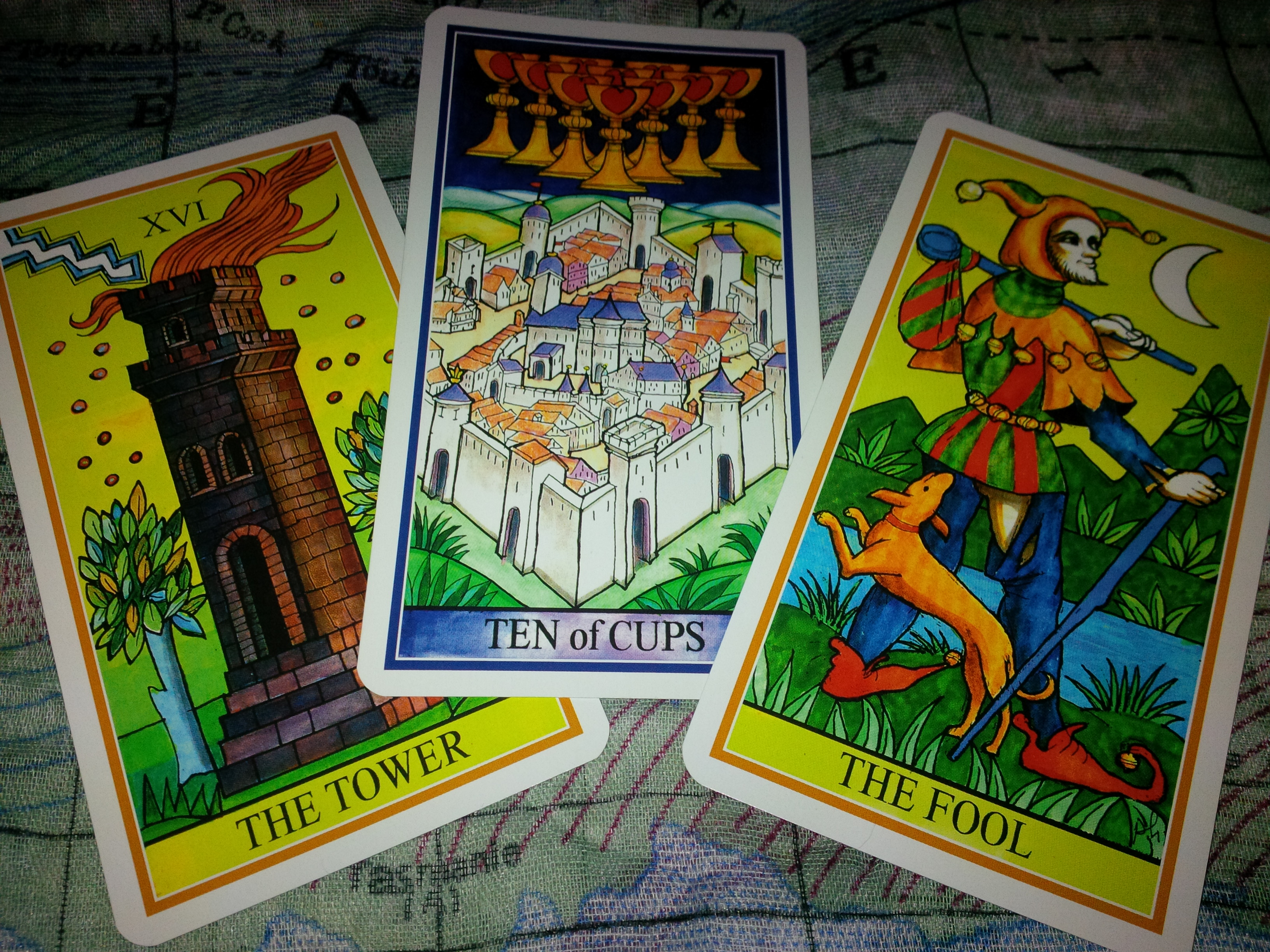
    Receiving the same card for three days puzzled me. Although, by the third day I decided to pull out Dame Fortune’s Wheel and see what new card would come up. Unsurprisingly, the 10 of cups shows up again. In this particular deck, the illustrations are Etteilla’s interpretations of the pips, no matter, the reading is still the same, a solid hearth, a united home, completion. I decided to pull an extra card and the guileless fool shows up. Hm, interesting. Things get further complicated when I pull out a shadow card, the mighty tower. Now, I look at this, perplexed. How can these two additional cards contextualize the 10 of cups that keeps showing up?

    IMG_20160706_210814.jpg
    Dame Fortune’s Wheel by Paul Huson, LoScarabeo.

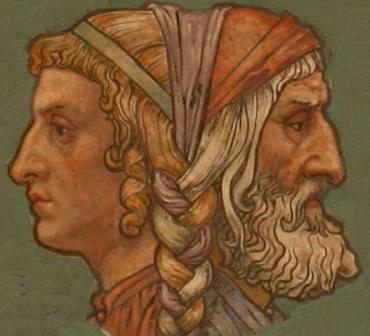
    Seeing these two drastically different cards straddled by the 10 of cups really left me pondering about my life, the moment, the past and the future. As the day wore on I came upon a name that sort of struck a cord with me, Janus, the Roman God Janus. He was the two-faced god of gates, doorways, entrances and exits, beginnings and endings. He was honored at all beginnings, especially at the beginning of the year, and was generally a household God. He is one of the few, or the only god, that has no Greek counterpart in the Roman pantheon. Any two faced mask is considered a Janus mask. All the gates and doorways were dedicated to him. During time of war, the gates were left open as it was thought of as a favorable omen. Also, deference was paid to him during the important times of birth and marriage. Here is a depiction of him.

    janus-2
    Source: talesbeyondbelief.com/roman-gods/janus

    As I look at the picture, think about Janus, and consider gateways, I recall that the 10 of cups is a fortified city with many gateways and the tower has one big doorway. Meanwhile, the fool walks away from these, hopeful, looking up wide-eyed at the waning moon.

    This is a moment of endings and beginnings, fitting as I have recently relocated. Such a compelling god, Janus is, even more so when I consider he is a household god, and the cups suit is in the realm of the house and the hearth. I recognize this intertwined constellation of significations as a call to honor the ending, the chaos and mess that was left behind. The flaming tower that is struck by lightning. In so many areas of life, as one embarks on anything new, there should be a recognition of the past, of whatever is left behind. And with this recognition there should also be a firm movement towards what is new, with a vision of establishing something better, more elevated than what was before. Janus reminds me of this, the duality of letting go and the pain of doing so yet also of the hopeful embrace of what lies ahead. The promise of the 10 of cups, the complete and fortified home. The fool is the neutral element, reminding me what my outlook should be, willing and free, daring and brave, while also hinting at the need for proportionality and measure in this bold spread of cards.

    Finding Janus, a god I knew nothing about, just when I stared blankly at the persistent 10 of cups really puts it all into perspective. I humbly take this lesson with me as I continue walking.

    On a last note, soon my journey with the suit of swords will be up. If you have been following along, look out for the last post on the 10 of swords this week.

    As always, happy reading.

  • Cards: 9 of swords

    IMG_20160701_204610
    Camoin-jodorowsky Marseille

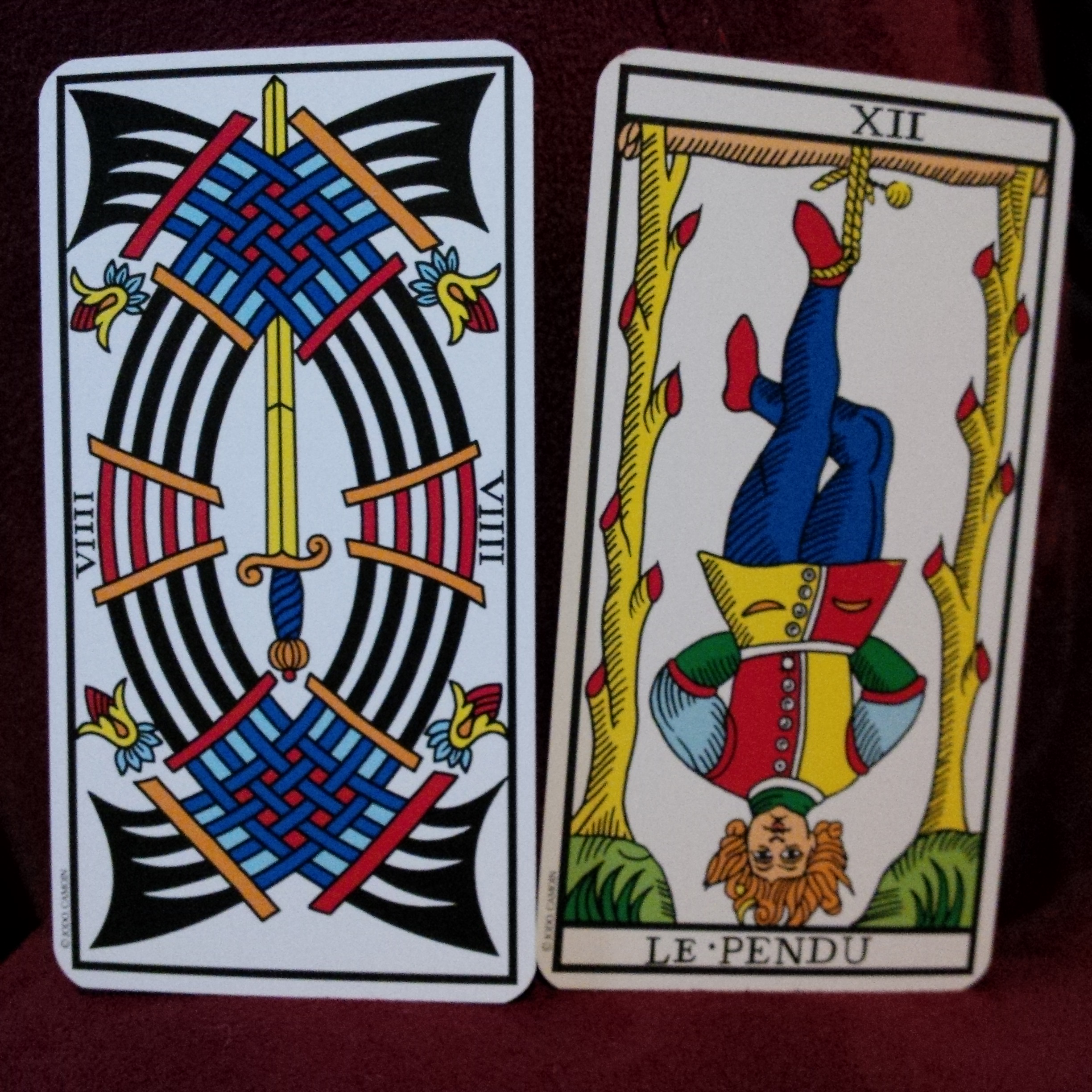
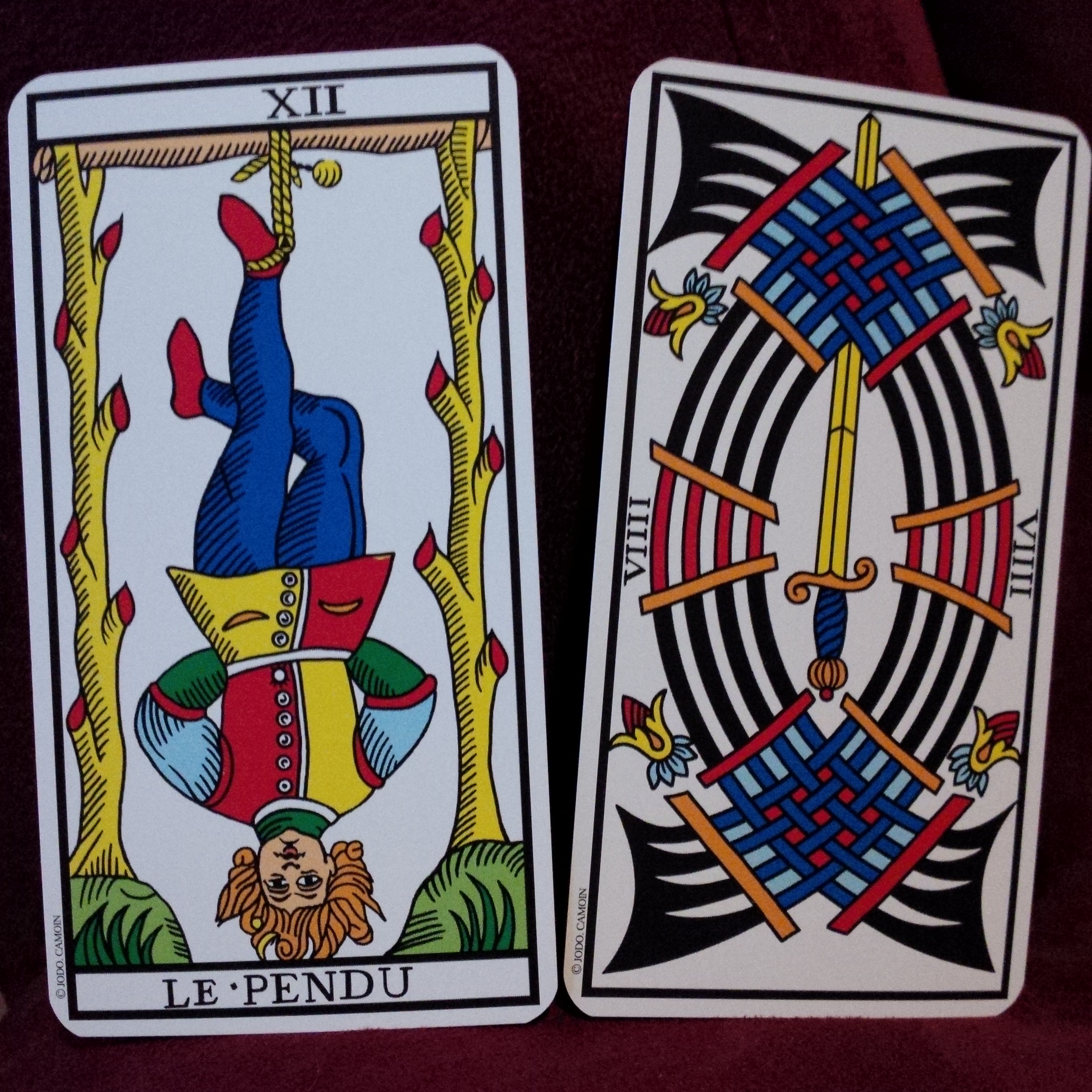
    When I think about the number nine I inevitably and unavoidably think about the hermit, key 9 of the trumps. In this particular number 9, with an excessive amount of swords lying in opposition and the center sword piercing the hilts, I think about the negative aspects of the hermit. Alienation and mental vexation. This is an example of too much inward leading to overwhelming stress. The negativity of excessive mental exertion, lost in your own world and alienated, incomprehensible. Furthermore, the single sword striking upwards sports a crack on the blade, accuracy and reason is no longer possible with a damaged sword. One cannot fight with a broken sword, one will lose.

    IMG_20160701_204831
    Camoin-jodorowsky Marseille

    Paired with the Le Pendu and the striking symmetry of both cards is palpable. The pair of 4 swords lying in opposition become the two columns that hold the hanged man. The middle sword is the man himself, immobilized. The mesh of hilts with the single sword intermixed is the top branch from which the hanged man hangs. Le pendu visualy drives home the message the 9 of swords alludes two. This one cannot do anything, tied and alone. His pockets are empty, he has no more moves. Neither does he have power.

    IMG_20160701_204903
    Camoin-jodorowsky Marseille

    If I switch the cards around, I am lead to read this pairing as the consequences of the hanged man’s inertia and over thinking has lead to his impotence and inability to act. Instead of proactively doing, he wasted his time debating, doubting, thinking. This has led to the broken sword enmeshed in the hilts, unable to be put to action.

    I have recently added two more decks to my collection. I’ll see about reviewing them at some point. One is Robert Place’s Alchemical Tarot renewed 4th edition, which I have wanted for some time. I really respect e work of Robert Place. The other is another heavy weight one, Dame Fortune’s Wheel by Paul Huson. Both are beauties and I definitely look forward to sharing them on here.

    Happy reading.