Category: Cyprianic Cartomancy

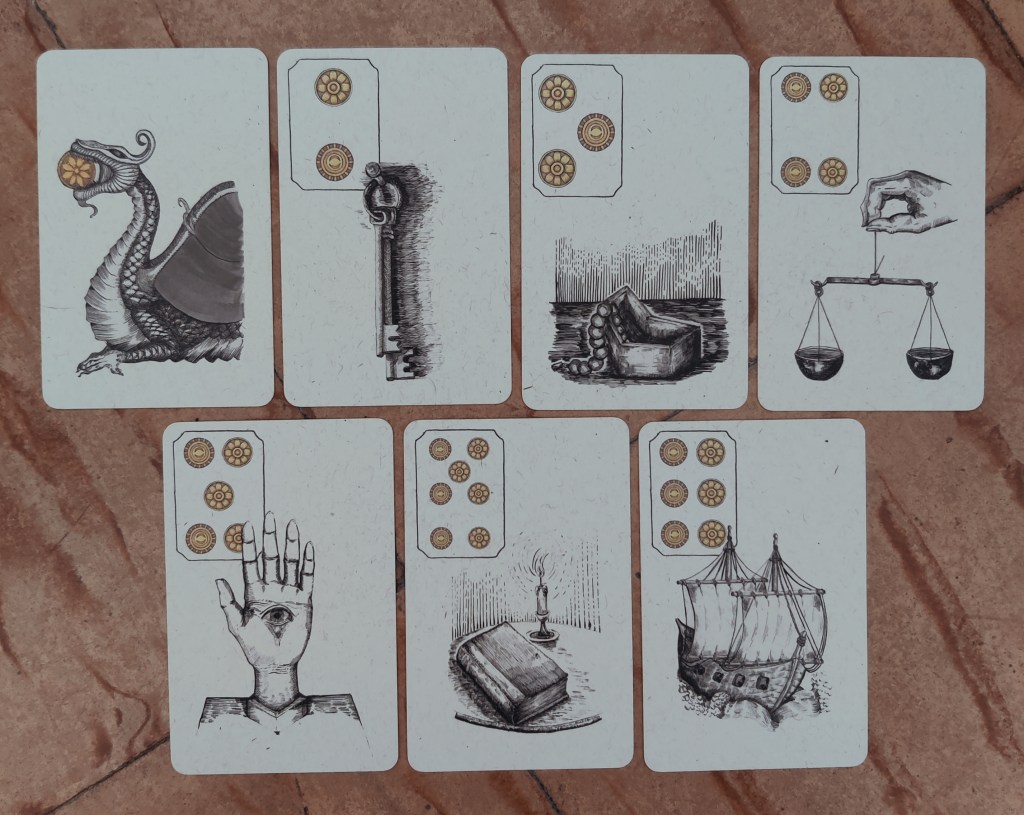
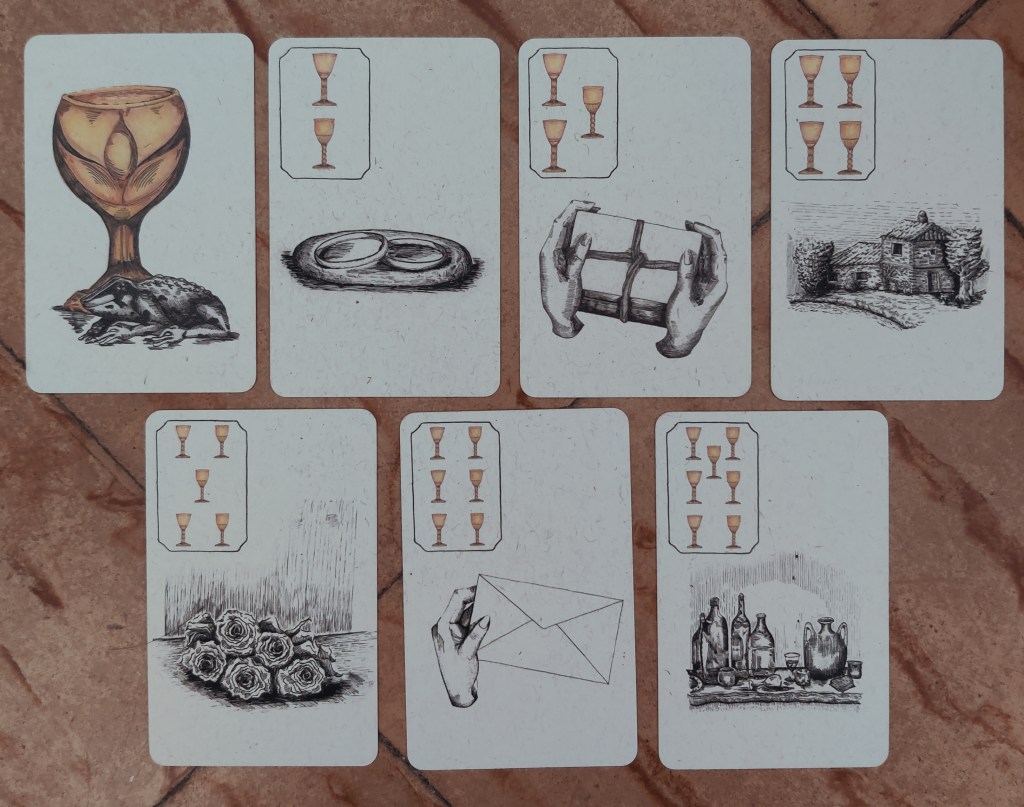
  • Previously, I spoke about the suits in Cyprian’s deck, mapping their stories and context. Now I want to turn to the keys, well, what I mean to say, keywords. If you take a look at a Lenormand or Fortunetelling deck, each card typically has an inset playing card, an illustration, and a word that goes with the illustration. This is what I will be sharing here but specifically pertaining to Cyprian’s deck.

    As a caveat, I will say, these keywords point to the illustration, but as we play with spreading the cards to answer a question, you will find these keywords play with their designations and meanings in relation. So a bouquet is a bouquet, until in a reading with other cards, it becomes good news or a proposal. Yes, this is a bare-bones example.

    CupsBatonsCoinsSwords
    1FrogWolf dogDragonHawk
    2RingsSunKeysScissor
    3GiftMoonPearlsSwords
    4HomeCoffinScalesCross
    5RosesCurdled Seas(Seeing) HandTower
    6LetterPathsBookCave
    7FeastShipwreckShipHeart

    As you will note when looking at the cards, the illustration often describes more than what the keyword indicates. For example, the 3 of swords with the illustration of two swords crossed, hilt up, points downward, stuck in the sand. These two swords have reached a standstill, they are not in an aggressive position. As always spreading the cards and reading them in conversation always entails a looking at what’s going on on the table while also aiming at responding to the question.

    The Courts

    Speaking of the courts, in this deck I envisioned and aimed for non-hierarchical and, perhaps, subtle distinctions within the courts. I wanted to focus on age and directionality, where each person is looking at or directed toward. So in each suit there are three people that make up the court, there is a youth, the lady, and the man. The youth is the person which embodies the youthfulness of the suit. The lady and man form the more mature aspects. Just because they carry their suit, whether it be batons, coins, cups or swords, does not mean they are family units necessarily.
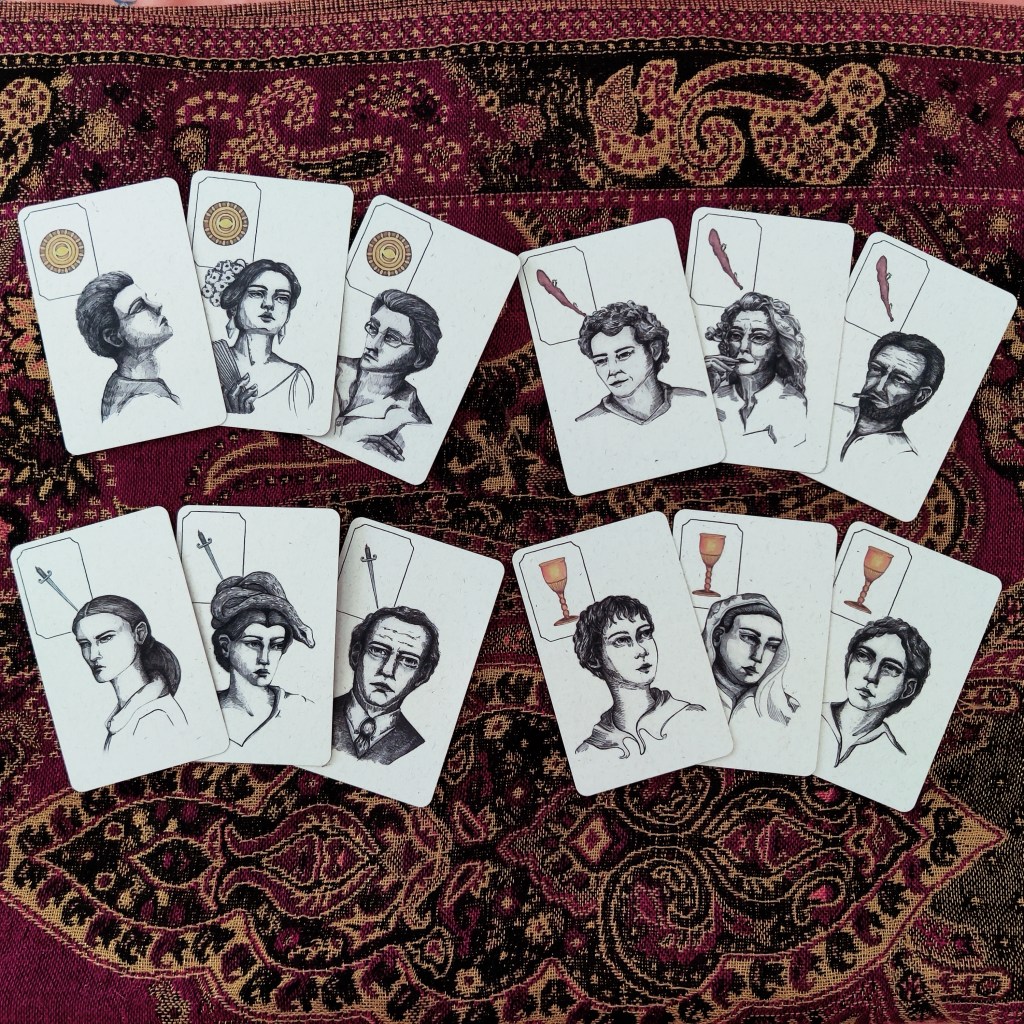
    The courts in their suit arranged from the youth on the left to the man on the right.

    Youths are smoother in tone and unadorned. The ladies on the other hand have distinguishing adornments on the head, and as with the coins and batons, they hold something. The men likewise, something more accompanies their pose, whether a cigar, glasses for better sight, a proper suit or just the marks of age and sleepless nights. Other than these subtle notes, they are people, no self imposed hierarchies evident other than age.

    And so the full deck is composed, from 1-7 and their courts. Simplicity was aimed. The desire of the deck will conform to its reader, and vice versa, perhaps a wandering traveler, or a hermit; numbers were eschewed in favor of pattern seeing, crowns removed in favor of tone and directionality. It is a deck for conversations, candlelight readings, and nocturnal preoccupations on daylight.

    The last piece I have to say on the deck will be on the finicky area of temptation, which I will write in another post.

    Saint Cyprian’s deck of cards published by Hadean Press.
  • This year I had the blessing of having my 3-year creation, a hand drawn pack of cards, published by Hadean Press, Cyprian’s deck of cards. The shipping for the decks has begun, and I’ve been in conversation with several people about the same. Briefly, the deck comes in a tin case, for ease of portability, with a small little pamphlet I wrote inside, which includes an historiola.* I kept the pamphlet and descriptions for the cards minimal, because I wanted the reader to engage with the cards on their own terms, within their own context, that is the reader in their context with the cards and the world they paint. Yet. I’d like to expand a little on the cards. This piece here will serve as a complement to the cards in the deck.

    As mentioned in the booklet: “The illustrated cards sit within a narrative of an imaginal landscape, which is both rural and vaguely urban.” This is to say that that the cards arise within a particular imagined terrain and together they tell a story. Namely, each suit paints a different part of this terrain, the climate, flora, fauna, peoples, the locality, and the aesthetics.

    Starting from within, the suit of cups discloses and elaborates on that which is “within;” the home, the inner world within 4 walls, the hearth. Therefore it talks about matters close to the heart, blood, water, love, emotions. All the images contained in this suit occur within the home, the four cups.

    In contrast, the suit of batons paints to world outside these four walls, outside our comforts, and stability. It is the outer world, the skies, the seas, the land, of phenomena that is on a grander scale to our individual human lives. It points toward matters that lie beyond our own individual human agency, of wedding plans dampened because a storm has hit the coast. Of unexpected encounters beyond the boundaries of comfort, and discovered cave treasures. There is variability in this suit. All the images in this suit display happenings in the outer world, what a person encounters outside their house.

    It all starts to mesh, weave together, with the suits of coins and swords. Both these suits dance in two worlds, the world within the four walls, the home, and the world outside the comforts and security of home. As I say in the booklet, “The transactions, commitments, the gains and losses, the adventures and misadventures, risks, favors and disfavors.” These suits can be thought of as the mediators between the inner and outer, both in a material and a metaphorical sense. Here the images will be mixed, both occurring within the house and outside or around the house. We find matters of work, the daily doings, comings and goings. The illustrations are situated within both a small and a big. Objects that can be taken outside, places found outside the home, I guess one could consider these two suits as liminal.

    As for scale, in keeping with the contrast of both inner and outer worlds, that which is found in the home is illustrated through smaller objects, which can be held close to the body. The fully outer dimension (batons) is beyond an individual’s grasp, it speaks of the living cosmos doing it’s living, where we find ourselves navigating different places. Comfort and security is not the focus here.

    Lastly, I want to mention an obvious or perhaps not so obvious detail, numberings and keywords. It is my particular preference not to have numbers in cards, and yes that includes playing cards, that is when I’m using the deck for telling fortunes. At first instance, that is as soon as I lay down the cards, I prefer to look at shapes and patterns arising from the cards on the table when I read them to answer a question. If it happens that I need to know quantity I can always count the suits on the card/s. So I opted to keep the insets unnumbered. Same goes with keywords.

    To begin tying the knot on this first part of talking about Cyprian’s deck, I will add a few more words. There are many ways of acquainting oneself with a card deck for fortunetelling, both a long and a short way. We can make our way about the cards, looking for patterns, and building from there a bigger picture, seeking to construct the greater meaning behind the deck itself.

    When I look at the card meanings in the Cyprianic booklets, I find that what is cohesive, or patterned about them is that the fortuneteller constructs the meanings for each of the cards from their context out. That is, within whatever context they live in and how they engage with the tools presented in the deck, batons, spades, etc. The reader brings with them what these tools mean to their understanding of the cards. Meaning always arises out of context, so in a paradoxical way, card meanings are arbitrary. Yet they are also not arbitrary because these are the meanings that arose through engagement(relation) and this is the understanding the fortuneteller and the cards cohere around. Each fortuneteller brings their own experience, worldview, context, and landscape, the world they live in, to the table.

    This is why when taken as a whole, the Cyprian booklets on cartomancy reveal a personal view of the cards meanings, ever-changing, with only a few recurring meanings through some of the suits. Since I am first a storyteller, I had a desire to conjure a deck with a cohesive inner story, one which would play out in 40 cards, the Spanish brisca. One that brings these tools into a more tangible narrative within a landscape, a place.

    I will pause here for now while I think with the second part of this elaboration of Cyprian’s deck.

    *A note on the historiola, this little story is important. In an intimate way, this deck is a work of time enchantment. Meaning, I sought to conjure a Cyprianic deck from the lost annals of time. To emplace a deck that maybe existed and bring it into contemporaneous hands. It was a work of creating a portal of time to conjure this deck and bring it to life anew. So the historiola is deeply linked with the deck, it’s intimate and hidden story. This deck is an act of treasure hunting and finding.

    ~Deck used is the prototype for Cyprian’s deck.

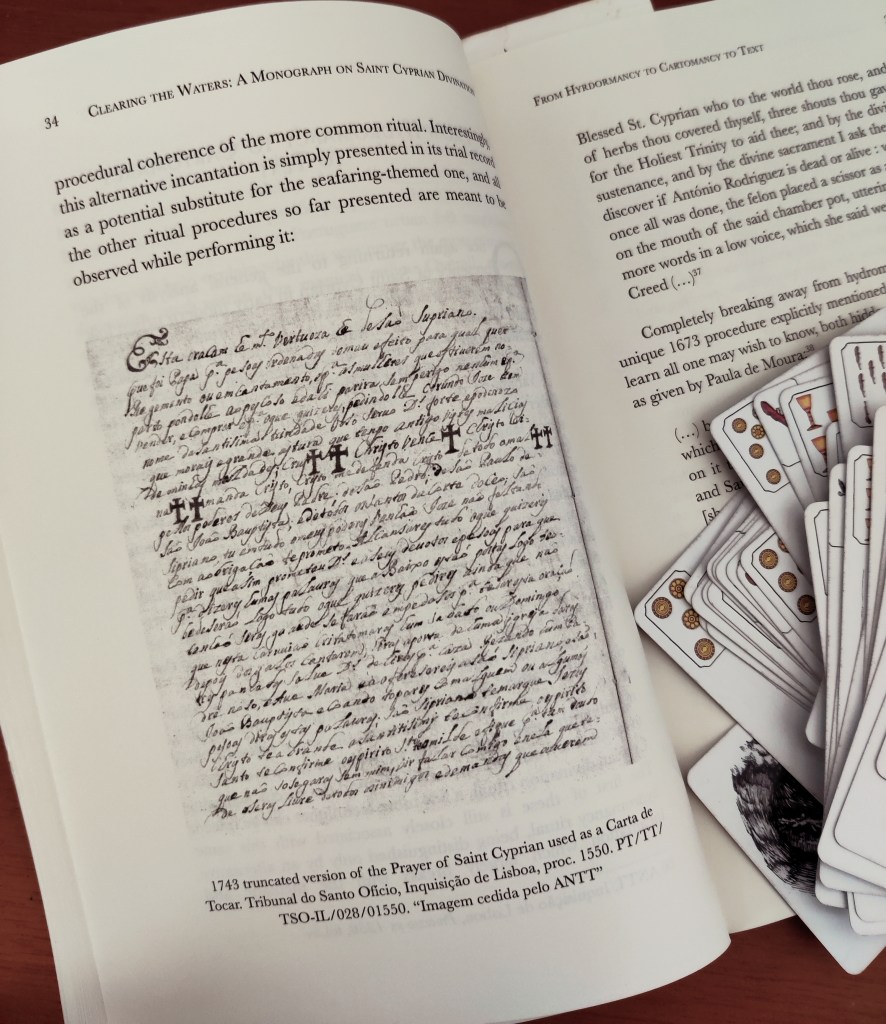
  • Recently, I sat down and read one of the latest publications from Hadean Press by Jose Leitao, Clearing the Waters: A Monograph on Saint Cyprian Divination From the 17th to the 19th Century. It is a compact book, 142 pages long including the index, that explores divination through a Cyprianic lens, especially filtered through the iconic historiola:

    St. Cyprian,

    Seven years the sea thou roamed,

    To learn news of thy lady

    Seven [lots] thou threw in…

    Thy luck thou took out right…

    I ask thee now my dearest miraculous Saint,

    That thou discover this for me.

    (pg. 15, Leitao)

    On the practical specifications, the book is divided into two parts. The first being the monograph, or the exploration of Cyprianic divination methods both via inquisition records and through the published Cyprian books, and the Appendices. The font is well spaced and easy to read, and the book includes both a lengthy bibliography and an index. It is more or less trade paperback size, slim, and easily portable.

    The first part offers a thorough study that allows the reader, especially one interested in divination and it’s changes through time, a look into how Cyprian divination methods shifted and morphed. Focusing on hydromancy and its offshoots, like favo-mancy (divination with the fava beans) and reading playing cards.

    Through the lens of this historiola, and its use in hydromancy, the landscape wherein these practices (or doings) flourished unfolds. Which to me feels it did so in between, or amidst, a sort of threshold between rural living and the growing urban milieu. I will quote here from the book regarding hydromancy and its attendant historiola:

    Noticeably, the majority of questions addressed in this form of divination tended to deal with the determination of the health status, survival, or fidelity of traveling or seafaring men. In this way, it filled a very specific purpose within the extensive arsenal of the early Portuguese urban folk magician, which could help explain why this was never the most common divination used within this magical milieu. Overall, general questions on love, wealth, or any other mundane preoccupation could be much more easily addressed by any other form of divination, and this one, given its clear seafaring motif, was likely relegated to questions concerning seafaring travelers.

    (pg. 32)

    With the changing tides, and from the variability of procedures and incantations associated with divination, both including and circling around Cyprian among other popular Saints within the Iberian (and consequent transatlantic) landscape, it is not surprising to find that the incantation of Saint Cyprian roaming the sea seven years transformed to envelope more of the growing urban terrain. A sort of expansion and inclusion, wherein the commonality of divination through playing cards came to reach more ground. Like a rhizome entangling and reaching outward, and growing and flourishing in different and particular ways.

    One key aspect of the book that stands out for me is the translation and inclusion of details on inquisition records and the methods described therein, reaching outside cartomancy and hyrdromancy. For example, there is also a look at divination with fava beans, and another for seeking voices, “the search for answers to a question based on random words heard on the street or during specific religious ceremonies” (37).

    Toward the back in the appendices, one has a look at specific cartomantic methods and examples taken from the Book of Saint Cyprian. One also finds a deeper look at the different inquisition records in dual language format, Portuguese and it’s translation into English.

    In totality, this little book contains a treasure trove of methods and procedures, along with a rich monograph exploring the transformations of Cyprianic cartomancy through a changing landscape. Unfolding for the reader the rich soil wherein many of the now contemporary methods grew and flourished. As an historical document that delves into a unique area of inquiry it is invaluable, and as a practical book it is an excellent resource for any diviner, cartomancer, and magic practitioner.

    A couple personal notes: I find it curious how this particular seafaring incantation came to circulate around Cyprian, how water and water divination comes to perambulate around the saint. It also reminded me of “La plegaria del naufrago” frequently prayed in spiritist circles here in the Caribbean,

    Torna tu vista, Dios mío, hacia esta infeliz criatura

    no me des mi sepultura entre las olas del mar.

    Dame la fuerza y valor para salvar el abismo,

    dame gracias por lo mismo, que es tan grande tu bondad.

    Si yo, cual frágil barquilla, por mi soberbia halagado,

    el mar humano he cruzado, tan sólo tras el placer;

    déjame, Señor, que vuelva a pisar el continente,

    haciendo voto ferviente de ser cristiano con fe.

    Si yo con mi torpe falta me he mecido entre la bruma

    desafiando la espuma que levanta el temporal,

    te ofrezco que en adelante no tendré el atrevimiento

    de ensordecer el lamento de aquel que sufre en el mal.

    Y si siguiendo mi rumbo he tenido hasta el descaro

    de burlarme de aquel faro que puerto me designó;

    yo te prometo, Dios mío no burlarme de esa luz

    que brilla sobre la cruz por el hijo de tu amor.

    ¡Oh! Tú, Padre de mi alma, que escuchas al afligido

    y me ves arrepentido de lo que mi vida fue.

    Sálvame, Dios mío, sálvame y dame, antes que de cuenta,

    para que yo me arrepienta en el tiempo preciso. Amén

    Colección de Oraciones Escogidas del Nuevo Devocionario Espiritsta (English translation)

    In my view, I can see how a divination method and incantation specifically targeted for the seafarer can transform, given the transatlantic movement within and around Iberia, to encompass a more diverse milieu, and used to seek answers beyond the realm of the seas. If one takes living as a voyage upon the seas, and we each as seafarers in the seas of life, then it is easy to perceive how the various forms of the incantation transformed to include more methods, including the cards, and hence addressing a wider variety of life questions.

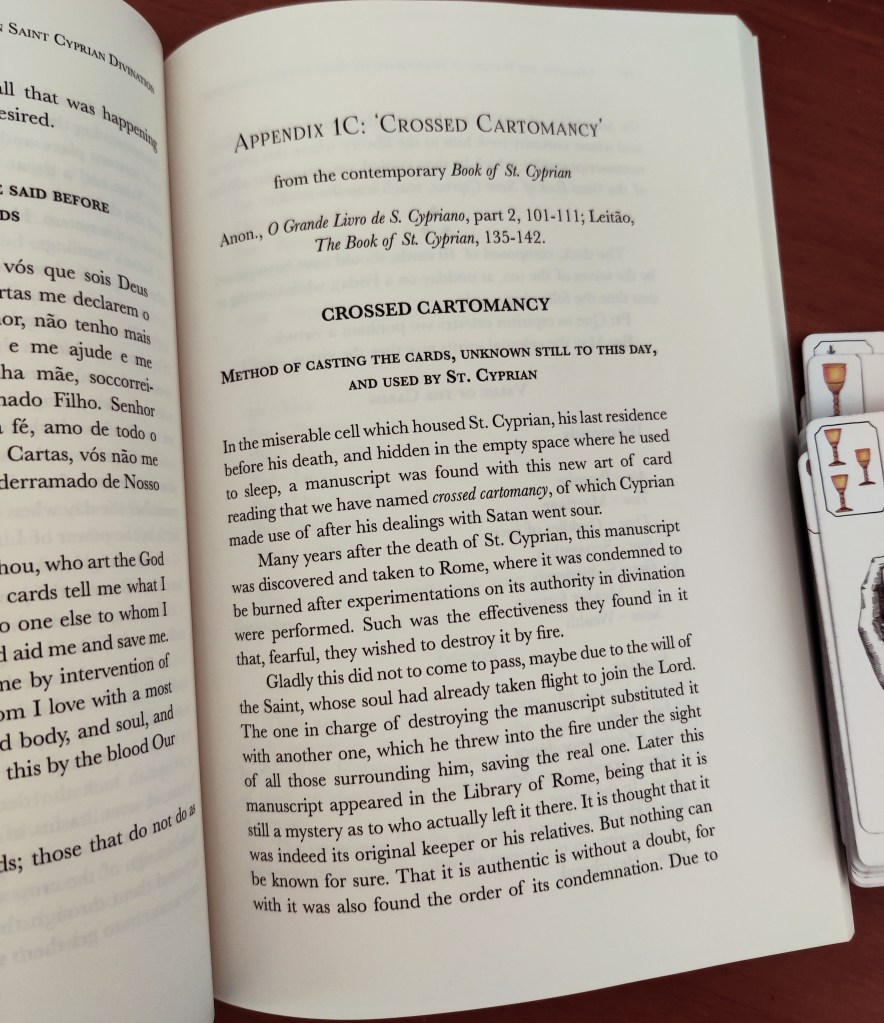
  • It is that time of the year again, September, the month I like to focus on St. Cyprian and St. Justina, as their feast day is in this month. Today as a matter of fact. Seizing this opportunity I’d like to expand a little on crossed cartomancy or what can alternately be termed Cyprianic cartomancy. (For an introduction please go here). I’m going to start with words from Jose Leitao, in an introduction to one of the pamphlets found in Opuscula Cypriani.

    Cyprian-derived systems of divination or cartomancy are complex, variable and fluid systems which, through subsequent publications and rearrangements, find new forms, significances and meanings. This instance should not be considered an inferior pastiche, but actually how Cyprian literature and divination systems function and are generated at each new interaction.

    From a practitioner’s perspective, such an instance underlines how, with each new step in the march of this material throughout history, new systems are meant to be born and synthesized. One does not need to really concern oneself with keeping the purity of the system, because, if the analysis of this pamphlet and all the others present in this book tells us anything, it is that this material is not pure to begin with.

    Toward the end of my first survey of Crossed Cartomancy I briefly spoke about an alternative spread, the tableau, this is the spread I now want to explore.

    In the 40 card tableau, the whole pack is laid out in five columns, with eight rows. The central pillar or column is sometimes called a novelty. This happens when there are no courts in this column. When a novelty occurs, the querent gets to ask an additional related question. Here it gets tricky as the rest of the cards are then picked up and reshuffled, saying the orisons, 21 are placed directly on top of the pillar, which remains unmoved, and then the remaining eight cards are spread in a cross, each hand having two cards. You will be left with three cards in your hands, these three will answer the additional question. There is no explanation as to why the elaborate process, but I think it has to do with the numbers. Rather, the meaning of the numbers in relation to the shape that is being used in the spread. The tableau is also read in the same mirroring way.

    Here are a couple images from the book illustrating the method of reading the tableau.

    One can see here that two possible ways of reading by mirroring is offered, one is starting from the two outer columns, the top card with bottom card (Ace of spades with 4 of clover), the other is mirroring columns side by side as in the second picture. To be honest, from the several examples given in the book, most are clunky at fully explaining how to read the tableau well. Moreover, what I’m interested in here is seeing what I can coherently form out of what is given in the book. Therefore we have here the 40 card deck, Ace-7 in the suits, with all the court cards.

    Naipes españoles, la baraja española.

    So we can start from the farthest two columns, reading the cards that mirror each other at an angle, whether from top-bottom or bottom-top. As an example, I will use a set of significations from Opuscula Cypriani, and I will not pose a question to the cards just read them and create a story.

    • a lover’s letter 11 of cups+2 of cups
    • sent by courier, through paths 11 of coins+6 of cups
    • is received with joy at the banquet/dinner 7 of cups+3 of coins
    • sharing good words of recuperation from an illness 3 of cups+5 of swords
    • The father, opposed to the love affair, intervenes 11 of batons+12 of swords
    • creating strife in the house 4 of batons+11 of swords
    • with the five senses (in full awareness) 5 of batons+2 of coins
    • the lady quickly determines to change plans 6 of swords+10 of swords
    • not thinking twice about severing ties 2 of swords+3 of batons
    • she determines to follow her passion 7 of swords+10 of batons
    • and with the help of a friend escapes to a church 4 of coins+12 of batons
    • affirming that bad words sour relations ace of sword+3 of sword
    • this is an opportunity to take courage 10 of cups+ace of coin
    • a novelty that allows her escape 5 of coins+4 of cups
    • She sends a courier through slow paths 10 of coins+2 of batons
    • hidden by the night with the message of promised pleasures to her lover if he meets her in the church 7 of batons+ace of baton

    I embellished a bit and quite a scandal of a story arose from the spread, I’m also not finished as I left the middle column alone, since, as per the book, this is where one judges whether the column is a novelty or not based on there being court cards. In this case, there are court cards, deeming the column a novelty.

    Novelty is not clearly defined in the cartomancy sections of the book. There is only the mention of an additional step should there be one. As mentioned above, one leave the cards (in the column) on the table yet removes all the other surrounding cards; shuffling them and laying them back down in a cross above the cards already on the table. Given that my aim here is to read the entire tableau in one go using crossed techniques, how to keep the novelty, and yet not have to do the part of removing the other cards? A novelty as per Merriam-Webster dictionary is defined as “something new or unusual.” Perhaps, if there is a novelty one could allow the querent/sitter to ask a new question, based on the reading of the other cards so far, and the answer would lie in reading this column alone. This would create a sort of closing judgement on the reading overall, a closing statement. If there is no novelty then one reads the entire tableau in one go, no new questions added. As there is a novelty here, let’s say the lady asks the cards if the lover will respond to her couriered letter with arriving at the church to sweep her off her feet.

    • indulging in luxuries, the lover 12 of cups+12 of coins
    • will receive the lady’s message, in bed with another, at a party ace of cup+4 of swords
    • only tears and heartache would the lover bring, for they are impoverished 5 of cups+6 of coins
    • being a zealous gambler and swindler 7 of coins+6 of batons

    In the end, the lover will not arrive to rescue the lady, and she will have left her home for no good reason. Since this is a straight vertical line of cards, the crossed reading would be done by reading the cards that mirror each other, starting from top+bottom and working inward.

    As this is a very straightforward approach to a crossed tableau, one can actually play with other types of decks, such as the Lenormand which has playing card inserts.

    Maybe Lenormand by Ryan Edward published by US Games, 2016.

    The key to following this method is in laying the tableau so as to have an odd number of columns, nine for lenormand, and five for a 40-card deck. This would allow for there to be a column that stands alone after pairing the others in reading them.

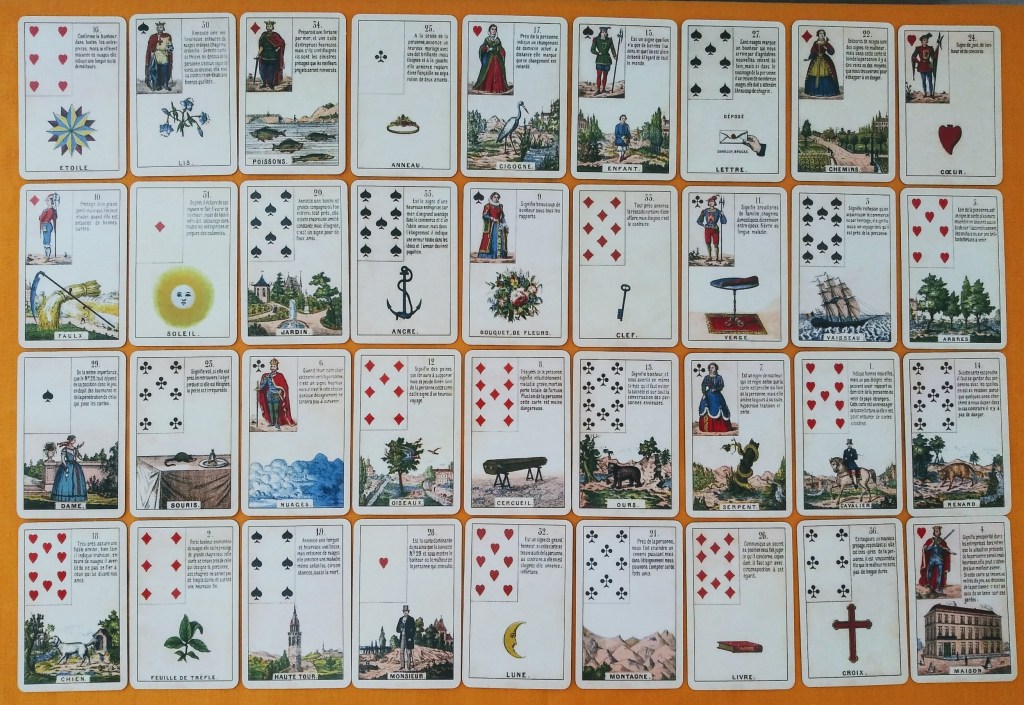
    Caitlín Matthews’ Daveluy Lenormand Deck c.1860, reproduced by thecartomancer.bigcartel.com, 2020.

    The way I see it, Cyprianic cartomancy or crossed cartomancy is about seeing across things, for looking at the corners that frame and reading from there toward the crux. From the edges you put together arbitrarily distant points, making your way to the center, the heart of the matter.

    There are other considerations I’m thinking about in relation to playing with this tableau and keeping to a cross reading. In the end, it is about finding the threads that you can work with. In the example I gave above I used the significations from the book, but you can use your own significations, what matters is arriving at the heart with the answer. I will add if you are in the market for a book on reading playing cards, a very good one I recommend, with an excellent survey of playing significations, and ways to use playing cards for divination and magic is Professor Charles Porterfield’s A Deck of Spells: Hoodoo Playing Card Magic in Rootwork and Conjure.

    May all your divinations alight on the heart of the matter at hand.

    Icon by Biso, Saints Cyprian and Justina. Icon a gift to the church St. Kiril and Metodi, Slivnitsa. From Wikipedia, 26 September 2020.
    • Jose Leitao, “Opuscula Cypriani.” Published by Hadean Press, 2019.

    ~~~