We begin in a hall like a cathedral full of echoes, enclosed by high stone walls. There is a cup, a breath disturbs the waters of this upraised cup, prayers are intoned. Within all is holy. Beyond, a sword stabs the earth, sinking deep and disturbing the soil, echoing the words, “the earth gives and the earth takes away.”
Next, the breathe speaks with utterances of love and desire, and a tipped cup spills into another, coaxing a third to birth. While the hand that gripped the handle pulls the sunken sword, standing in a clearing with a sigh of relief as the frenzied moment passes. “Now let’s make our way through this forest.”
Seeing eye to eye is a matter of negotiation, discerning through exchange, a temporal dance. A construction, a reconstruction, a formulation and an articulation of definitions and significations. A play of words and body, re-created and re-arranged. The art of form expressing itself through temporal movement entwined with the voice. Walls and fortifications built around need and mediation, the tension.
Suddenly a hush descends, the silence of recognition for the word symmetrically expressed. The word and the image dance. The sound of equilibrium. The flesh moves within this frame, inhales, exhales.
Then the great doors groan open, outward flows the nave, an axis mundi in motion. With this opened course, the heart and the body moves, the mind following. Where places unknown, a labyrinth yet to be voiced, lie unseen.
Diamonds, cups, grail, scepters, swords, sticks, coins, daggers, branches, leaves and hearts. Things, all things we use, tools for the hand and the flesh to encounter. Except the heart, the heart which we always carry inside, yet on occasions, we find it spilling outward in bursts or trickles. When the axis mundi tilts, these Things slip from our fingers to fall in a clatter at the threshold, a cacophonous array at our feet, complex-ifying the exit, entangling the flow. With this a brigade of thoughts invade the mind, what to take and what to leave behind. Locating desire the fulcrum of the quest. Enough!
The stairs appear, that were always there, winding endlessly up and down, down and up, above, below. Ways, roads, paths and courses, winding outward beyond the reach of our sight.
Between the tower and the star, the fool stumbles onward, a pack full of fallen tools gathered along the way, resting on his shoulders. From a little to a lot, and often gathering in between stops, the inhale and the exhale continues. From one, the many stumbles out in brazen nakedness, a coagulating web of movements, forms, and omens. Signs of things that are, are not, will be, or evanesce into the mass of all else. The expressive self, em–placed, mirrors the sign, mirrors the body, mirrors the sign, in circles we go. To end and begin anew. The snake swallows its tail.
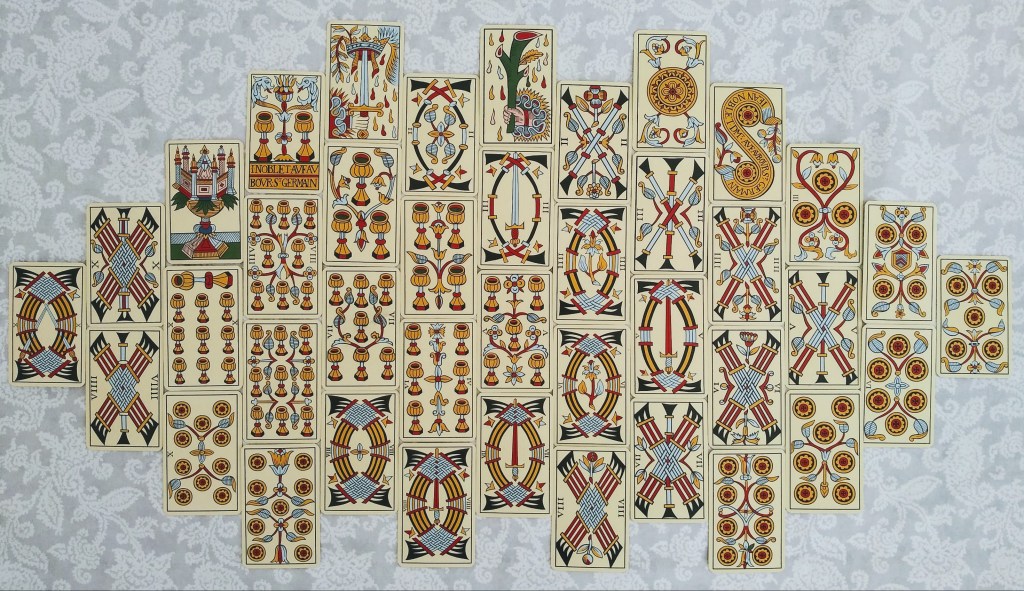
Jean Noblet Tarot de Marseille, reproduced by Jean-Claude Flornoy, editions letarot.com, 2014.
When I see the pips, the elements do not come first, instead, as I mentioned in the opening of this series, their phenomenological virtues (qualities) comes first. By this I mean their tangible physical life applications and the processes arising out of their applications and uses, and what is mirrored in the cards at play.
In other words, a cup does not stand in for the abstract element water initially. A cup is a cup, and how we ascribe elemental meaning to the cup arises out of our own experiences of cup, chalice, drinking vessel.
Instead of diving into what each suit is notelementally. Let me dip into what they are once more, swerving into their elemental connotations. Let’s first define element as per Merriam-Webster dictionary:
1. any of the four substances air, water, fire, and earth formerly believed to compose the physical universe; the state or sphere natural or suited to a person or thing.
2. a constituent part; a distinct group within a larger group or community
Going back to cups, a cup is a vessel, concave with a deep center so as to allow for the holding of liquid. A cup holds and contains. It is held close and just as it contains it shares, as from its deep center where the swirling liquid rests, when tipped over it falls in-to an open mouth (in most cases). The actions that accompany cup give it a quality in relation to and in service with liquids, with liquid as sustenance, something that nourishes, replenishes, satiates. The cup itself is the medium through which we experience the liquid inside. In this sense it is receptive, open, and enjoining, in that it joins together, the more cups sharing and drinking, the merrier.
A sword is a sharp blade that pierces, cuts, and divides, it is cold, hard, metal. It wounds and causes blood to flow. It is held far from the body, pointing at others in combat, or for protection. In other words, it keeps others away from our body and that which we protect. Swords denote separation and death. As a sign of war, it underlines analysis and calculation through the framework of best plan of attack to conquer. Victory through strategy and might.
A baton is a wooden stick, some are polished others are more rustic. The more rustic ones are stacked to build things, whether home or furniture to facilitate living. Other batons are polished, and waved as a sign of authority and power. On occasions, batons are used to bruise in defense against an other. Batons are also held far from the body, they are heavy and blunt. Denoting raw strength. And, I can’t help but repeating, sometimes many batons together are a forest.
A coin is round, shiny, and held very close, in the pocket, in a purse, our a pouch. Exchanged for goods and put into circulation for gain. Coins are shiny and round like our eyes which often get entangled with lust for a thing sighted. Greed and avarice are a possibility just around the corner. One is good but many is best. They are a metal made warm by our touch, and because we keep them near to our bodies, and not just our bodies but our thoughts. Our thinking is often preoccupied with how to make more coins and keep more on our side.
So what about their elements? The suits in their element are articulated through the lens of how we experience and use them. Elemental connotations are filtered through the alembic of the body. If element is defined as the “sphere natural to a thing, which itself is a part of a greater whole, then one can assert that each of the suits have particular characteristics described through their use, and composition. Yet as part of a whole, the suits themselves interact with the greater part of the rest, intermingling amongst themselves in their descriptive and perceptual potential. When reading the pips from this stance, the categories are kept loose and rely on how the body reacts to and uses the tool(s) itself(themselves) while always in relation to the question. Hard categories can be restrictive, and calcifies the suit in question in relation to the others and to the reader. Creating strict boundaries that categorically separates the object as tool from the abstract symbol.
Meaning arises through play.
Swords are not stand-ins for mental gymnastics and thought-processes. Swords are a weapon first, and our own experience of sword takes us to its meaning at the moment of reading. All the tools presented in the pips, such as swords, cups, batons, and coins, involve thinking. Different ways of thinking. How we think with defenses, war, and protection; thinking with value, money and wealth; thinking with joy, the heart, and those near; thinking with authority and order.
Nonetheless, let us swerve for, a moment, into the elements. This is the common arrangement of the elements in the minors, albeit not in this exact order:
Swords= Air
Batons= Fire
Cups= Water
Coins= Earth
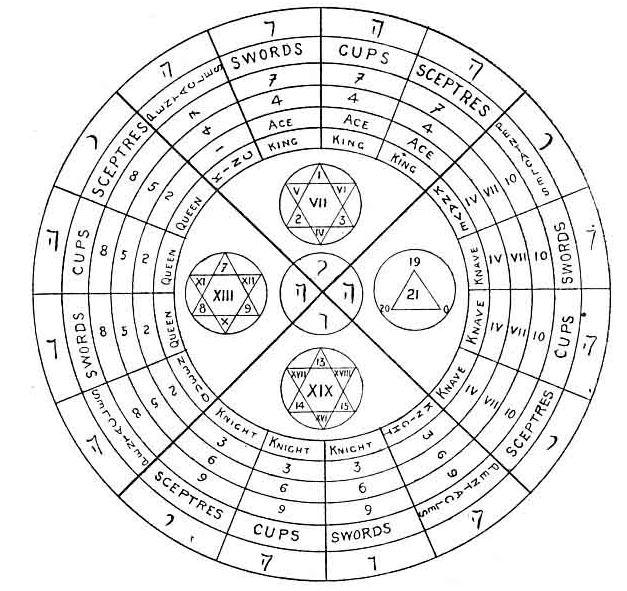
GENERAL FIGURE OF THE CONSTRUCTION OF THE TAROT, SHOWING ALL THE AFFINITIES, Tarot of the Bohemians by Papus, translated by A.P. Morton, 1892, from Sacred Texts Archive: https://www.sacred-texts.com/tarot/tob/tob09.htm
When seen from this angle, of the classical elements, roughly put, air is the intellect, fire the passion or will, water the emotional and sacred, and earth the material and objective. When seen from this range, a symbolic, neoplatonic, symbol set is superimposed upon the the 56 minors. All of which map conveniently, although with varied alterations or interpretations depending on who is doing the descriptive coding, to cabalistic and astrological frameworks. These frameworks are fit into the kircher tree, and the tetragrammaton: Yod He Vau He. Through this superimposition the minors and majors acquire an overarching esoteric quest and narrative through which the tarot reader then inserts the question at hand. From this perspective the suit of swords becomes air and describes intellectual, mental, gymnastics. Batons describe the pursuit of passions, power, glory, and enterprises. Cups the realm of emotions, the heart, and sacred psychical explorations. Coins, in turn, the material realm, money, resources, and possessions. This of course is reduced in scope for brevity’s sake. † What this achieves is a hard or rigid categorization of the minors to a specific narrative.
The point I’d like to spotlight is that one can also arrive at a rich tapestry of forms, movements, and meanings with another type of displacement, and that is a phenomenological one. Wherein we engage the suits through our bodies, through our own experience with what we see on the cards. In contrast to having a narrative already categorically complex encoded in the cards, the narrative created with the cards is one we engage with spontaneously and in the moment of asking the question and laying down the cards. Gauging how uncomfortable, or vulnerable swords make us feel in relation to the cards and the question. How weighed down or even ambitious the batons move us toward a vision. The cups, how indulgent, and the coins how frivolous or calculating in our goals. Cups and coins can be seen through desire dynamics that are sometimes opposing, and at other times complementing. Although truthfully, desire weaves itself throughout the whole pack as it also weaves itself through all our living. The adjectives can expand outward from here. How much of one thing weighs on the surrounding cards, or how little? What is moving, what is staying put? What is being cut, pushed, bought, invested in? What is being sensorially, and heart-fully explored? Through all these mirroring and perceptual dynamics we explore the poetics of the body through form and movement.
In other words, the suits in their element is found in the poetry of the body engaged in doing, being, living.
Spinning golden plates, that shimmer like a bull’s eye. If batons embody potential and power, coins denote power of a different kind. The power of acquisition and persuasion. Persuasion as a secondary to acquisition, in that through crafty words one can persuade the other on the value of a thing.
Not so long ago, actual coins where more of an active part of daily life, a tangible value system. Jangling in our pockets, the coins came with us wherever we went. We transacted with them, and often hid the excess from prying eyes. With these coins in our pockets, we invested in hopes of higher returns, and acquired things, re-positioning our place in society. Golden shiny and round, we kept them close to our bodies, held them in our hands, keeping them hot. In turn, these round pieces brought riches, and resources. In this way, coins mirror the cups, the more the merrier.
Image by katkaZV from Pixabay, Halic Castle.
A notable aspect of the coins suit is that they embody the potency they disseminate through the holder (the person that has many coins) and those that this person comes into contact with. In other words, the suit embodies both what we do with the coins, how we use them, and how they affect and effect our lives. To have many coins is to hold the potential to gain or take possession of. The weight of influence. Navigating in a sea of desires, we hone the ability to discern how much of these desires we are able to grasp, and how far we are able to go, it is in this milieu that we arrive at the weight of influence. We shift our material influence over the world around us in relation to the resources we hold in our hands. How much influence you or I carry depends largely on how much coin we each carry.
Some of the more subtle elements of the suit are comforts, luxuries, bookkeeping and accounting. It is good to note that this suit also denotes analytical articulations, deductions, and mercurial thinking.
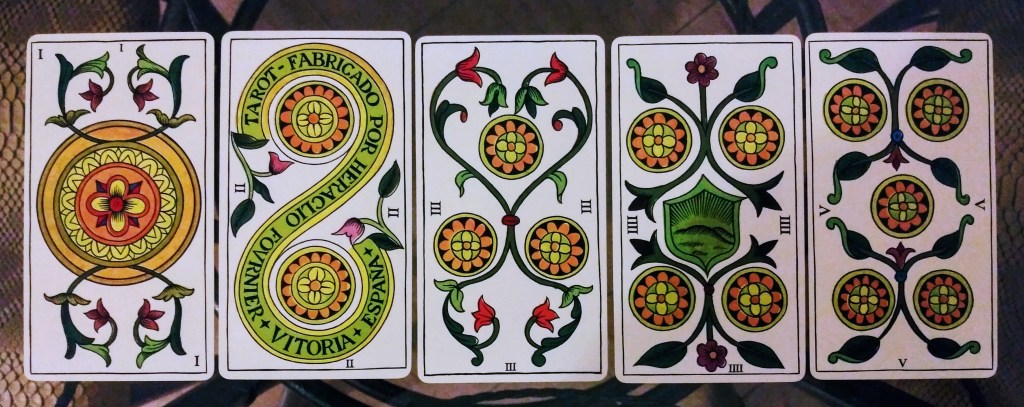
The Spanish Tarot published by Heraclio Fournier, Spain.
One is a plate of opportunity, a chance at turning luck into profit or favor. Two is giving definite form to opportunity, by contract or agreement. Three is progression through the investment of time and resources. Working towards a goal with the aid of astute calculation. Four is building the funds. As always, fours denote what is foundational. Here we find that the weight of influence is established over matters. Moreover, a coat of arms is at the center of the four coins, the base upon which legacy is built. Five is a returning to our body, indulging in luxuries and what we covet. Five of coins holds the question of desire, what we want and how we can get it. Aspirations, fancies and indulgence reign.
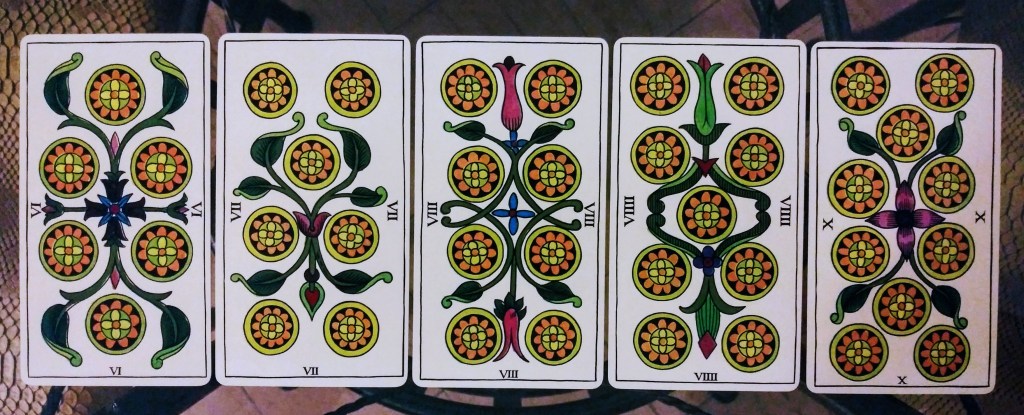
The Spanish Tarot published by Heraclio Fournier, Spain.
The Six is when the flow of opportunity given, opens outward into different and varying routes, or paths. A good omen. Expansion and movement. Seven, as with all sevens, has us stuck, a plateau has been reached, an interruption perhaps, the entrepreneurial spirit is momentarily quelled. Division and strain divert cohesion.
Eight is reorganization. All the eight coins in perfect lines, equidistant and in equilibrium. After the pause, we reorganize, re-frame, and then keep going. Outside help and input is brought to bear here, fresh eyes to see what there is to see and where the potential for growth can be found. How much coin is available, and what can be achieved with this? Nine is fruitful, as the work put in in the previous phase generates its due promise. Ten is the culmination of all the work. Or it could just be a lot. There are many coins here, many spinning golden spheres. Fortune, and tangible prosperity.
All this talk of resources and money glosses over the details. These golden disks are more cunning than they let on. Fiery, mercurial and quick, like money, slippery if handled unwisely. It can be the cause of headaches and pain if avarice seizes the heart, or greed grips the fingertips. Coins are held close, and also exchange hands. Alluding to a cold (not close to the heart) and calculating fire, shrewd. We discern the value of a thing and howmuch in value translates into howmany of coins.
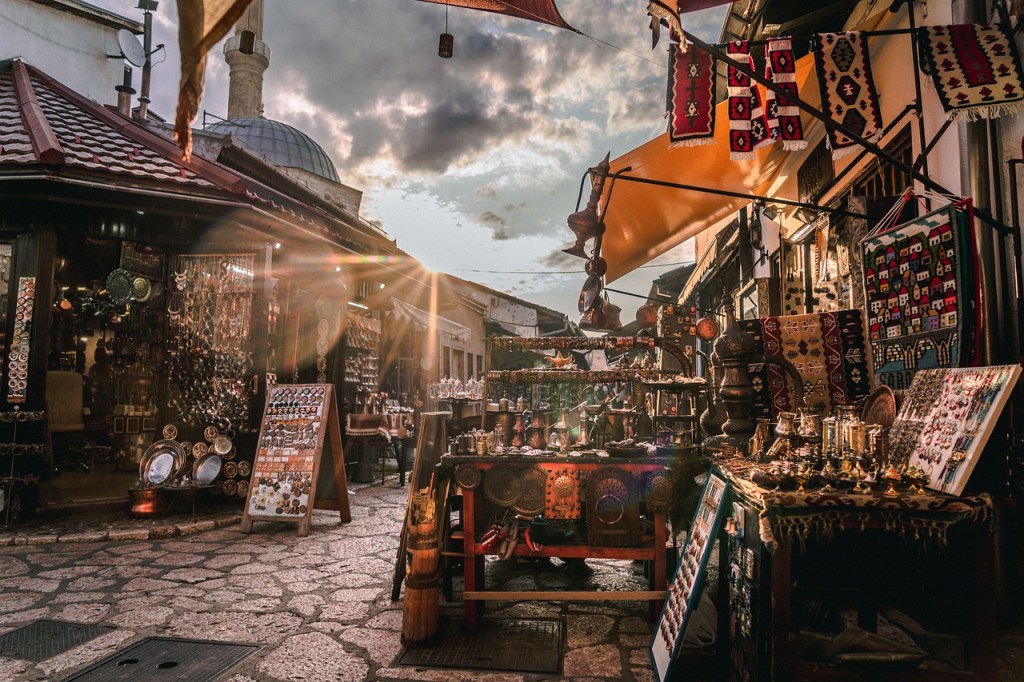
A market, image by Chris Spencer-Payne from Pixabay.
I take my jangling bag of coins to the market and enter into the fray, holding the coin bag close to my body and piercing with my eyes into the value of things. Here I arrive at the crux of the coins. In essence, the suit elaborates on the material value of things vis à vis our desires. What we want, what we can get, and where within this tension we situate the value.
Mirror, mirror, which Trump do I see reflected in the suit of coins?
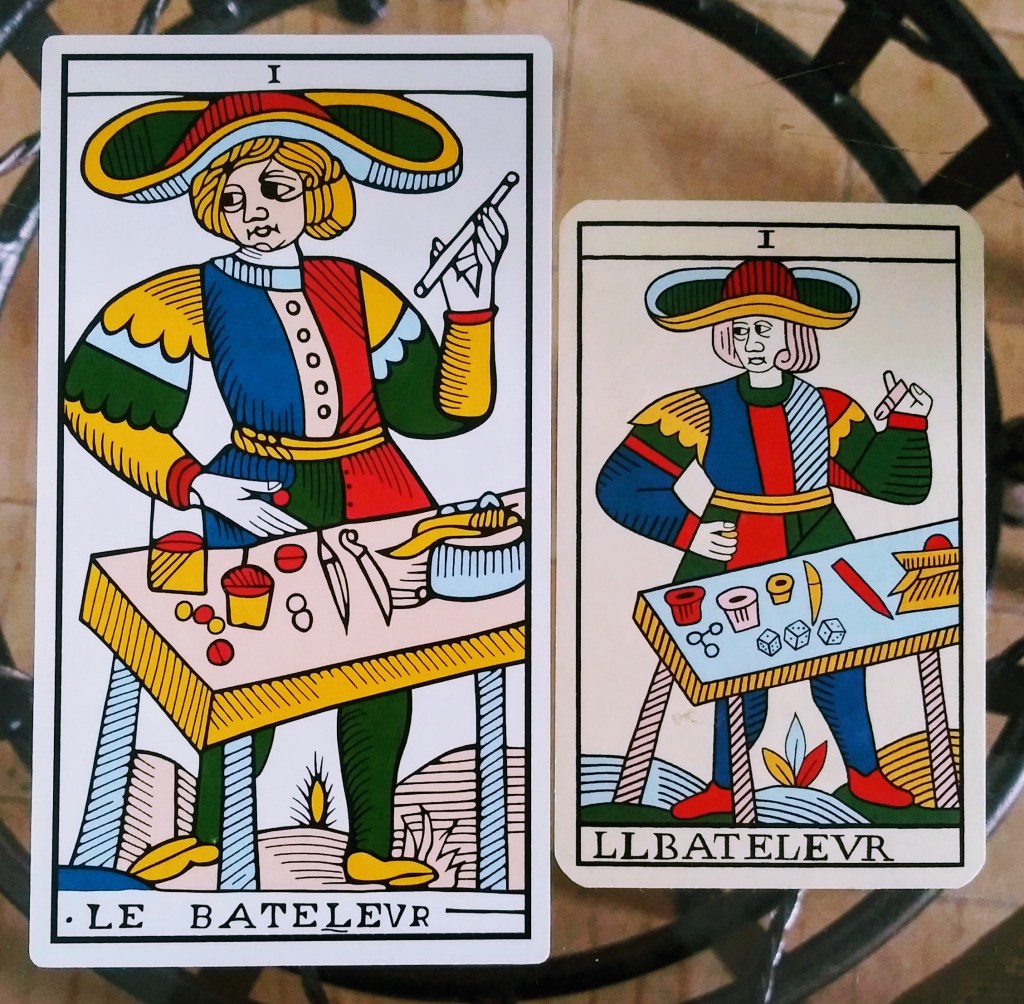
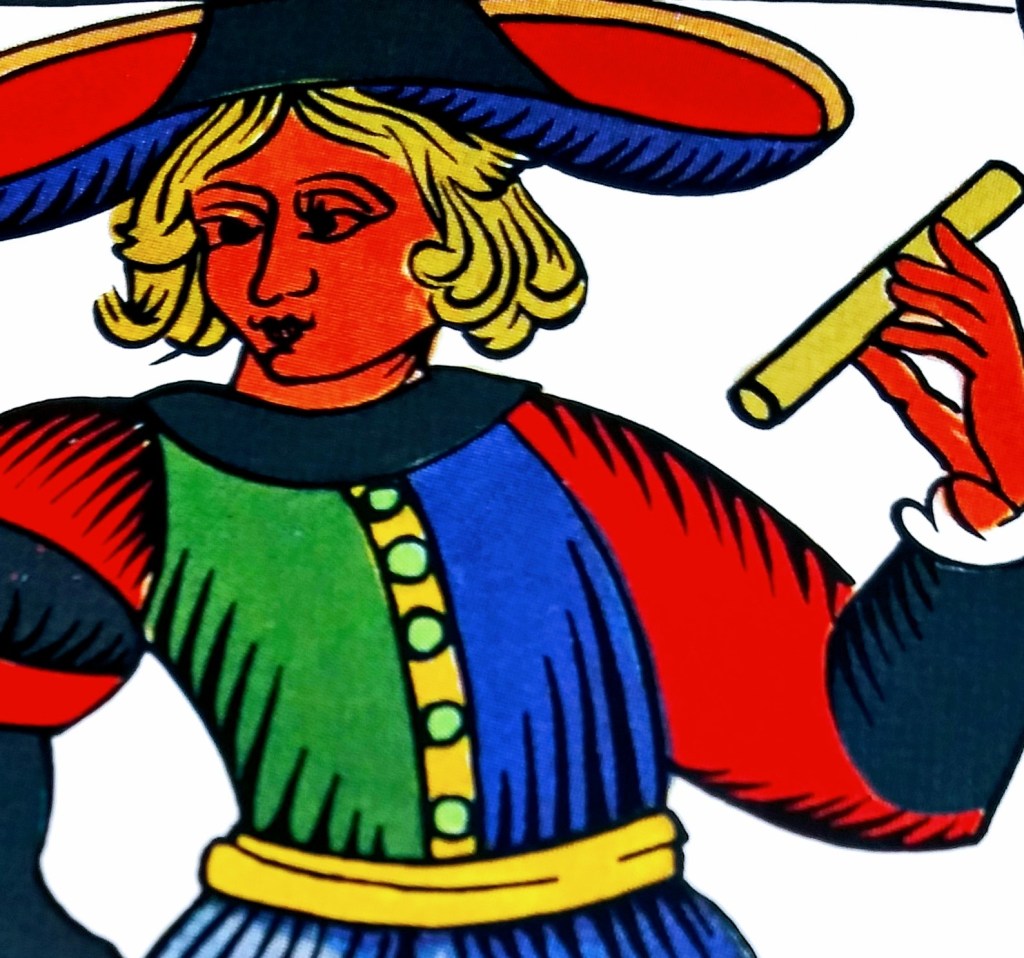
Sly and cunning, le bateleur skillfully negotiates possibilities with onlookers, the curious, the lost, and the wandering. Le bateleur applies with razor sharp wit the right words and actions that persuade. A masterful artist of calculations and expressions. This very bateleur knows just the right points to hit, revealing only what is necessary for the moment, and nothing more.
Here we can take a look at one of the traditional depictions of this character:
Left: Tarot de Marseille Jean Dodal reproduced by J.C. Flornoy, editions le-tarot.com, France, 2009. Right: Tarot de Marseille Jean Noblet, reproduced by J.C. Flornoy, editions le-tarot.com, France 2014.
The crafty bateleur stands at the table, tools displayed, one hand raised and the other lowered and close to the body. This person clearly reveals only what gives weight to his/her influence over others. Colorfully dressed, with an overly large hat to tip down and veil the eyes when the situation demands it, and an expression that lets nothing pass unnoticed. Then there are other alternate depictions:
Left: Pointner Tarot, Ferd. Piatnik & Söhne Wein, 1974. Right: Fantarocco di Franco Anichini, published by Modiano, Italy.
However le bateleur is approached, this character cobbles for us worlds upon worlds of possibilities, pulling on desires and repositioning value accordingly. The suit of coins hold these same possibilities just there, at the beginning, will the bull’s eye of the Ace.
~~~
∆ If you’re catching this post series midway, Animating the Tarot Pips, the introduction along with a master list (with links) of the installments can be found here.
Force. Tension. Expansion. Like a massive tree trunk with roots running deep, arising out of the earth and reaching upward to the sky, so the baton presents itself vibrating with life. Made of wood and wielded with power. I position myself with the baton in hand like the Ace and I have a plan. A plan to give shape to what I carry yet unpolished.
Image from Pixabay.
Like trees in a forest, batons proliferate and stretch out in a verdant web. When batons in the wild are encountered one initially inserts the body amidst the trees, then comes the taking and deconstruction, in order to transform the tree and its branches into something else. Herein enters labor. A tree is a tree until it is transformed by hands, through sweat, labor, and the domination of the wood. This wood deconstructed becomes home, chair, table, utensils, tools, instruments, church pews, stairs, among many other things. In this way batons have multiform potential.
As one or many labor over the wood or woods, there is a plan afoot, a goal in mind to coax out of the unpolished material.
A plan + Labor (Time) = Accomplished work.
From another angel, baton as stick, either staff or cudgel, carries with it connotations derived from its use.
From The New Oxford American Dictionary, digital.
It is a sign of leadership, order, and as mentioned in the above definition, authority. It is an active tool, since wielding a baton is to do so deliberately, brandishing it, or holding it up high into the air to direct. Batons like swords also protect, keeping what is unwanted at bay. They are capable of hurting, since one can hit with a baton and bruise the body.
Because the baton embodies different functions depending on how the body engages with it, the suit of batons carries acquired dynamic qualities. Ones that are closely linked with labor, as the body exerts itself to wield a baton in different situations. From building things and objects to directing, or holding as a symbol of power.
When looking at the suit as a whole, their weight and density lies heavy, especially as they proliferate. As a thing that can be made into homes and buildings, objects for everyday use, and tools, there is a sense of imposition. Batons impose themselves even as we and our ideas do the same upon the wood.
Out of the four suits, batons stand as the structurally formidable. Forming edifices small and large wherein we are faced with their spatial quality, as in, how much space the stacks of wood take up.
Starting with one, it is upheld like the sword, yet exempt from the cold austerity of steel, the wooden baton holds potential. Two enters the picture, and we can now begin to labor toward a mutual goal. Then the invested hard work is paying off as three appears, opening the road for what is taking shape.
5 of Batons, The Spanish Tarot published by Heraclio Fournier, Spain.
With four, as with all fours, the foundation is laid like a table, or a home with four walls that offers protection against the outside world. Fives are the heart, the core that holds the foundation. Yet at its most basic, fives are the fulcrum wherein the stacked batons exert their equilibrium. Exercise, physical mobility, and movement are subsumed here.
The sixes open a way down the path. Between the confrontation of the four and the five, the six provides a path onward. The seven is the true breakthrough, the unforeseen revelation that puts a momentary pause in what we are trying to build, or directing into fruition. The solutions comes in the shape of the bigger picture, context, via the eight of batons. In the eight we are able to witness what was previously up until now unformed, for here the full shape of the thing itself is encountered.
Nine takes the context and gives it flight. What was being built has expanded beyond the builders. It is now more than the sum of its parts. With nine and ten the transition of exhaustion and overwhelm begins to set in. Ten says no more, too much, full stop.
Yet batons are more versatile than their numerological constraints from 1-10. One can also consider the machinations of labor in relation to power. When wielded, the wielder holds a symbol of authority, integrating the power of influence over a group of others. There’s the maestro conducting the orchestra, or the police officer carrying it as a symbol of both protection and violence. Moreover, just as these particular applications of baton exerts its power on another, so the other, those below this position, exert their agency upon baton through the breadth and depth to which the baton as tool can be used in everyday life. Such as mentioned previously, the capacity of building for oneself home, tools for use, for comfort, for play, and for protection. Let’s look at some examples of baton wielders from the tarot pack outside of the suit itself.
The Devil, The Spanish Tarot published by Fournier, Spain.
Batons figure prominently within the context of the 78 cards, as opposed to the other suits. From walking sticks that help guide the way and balance the body in motion, to kings and queens overseeing their kingdom from a vantage point, and then there are the tricksters.
We come back to trees, from which batons are taken. Trees that reach without ceasing below and above. Expanding, withstanding, laboring in their particular cadence, non-human, but intricately entwined with human activity. Just as trees extend their branches and their roots, so batons extend their myriad functions as they interact with human life.
Why accomplished work? Because the use of batons is closely tied to accomplishing an end goal, a physical end goal. Transforming one thing into another thing through the exertion of labor and time. Hence why typically in Marseille Tarot context the suit of batons is the suit of the laborer, the worker. As Jean-Claude Flornoy states in the little booklet that accompanies the Jean Noblet Tarot, “Batons are those who produce and construct (peasants and craftsman).”
To mirror one the 21 Trumps…
The Spanish Tarot published by Heraclio Fournier, Spain.
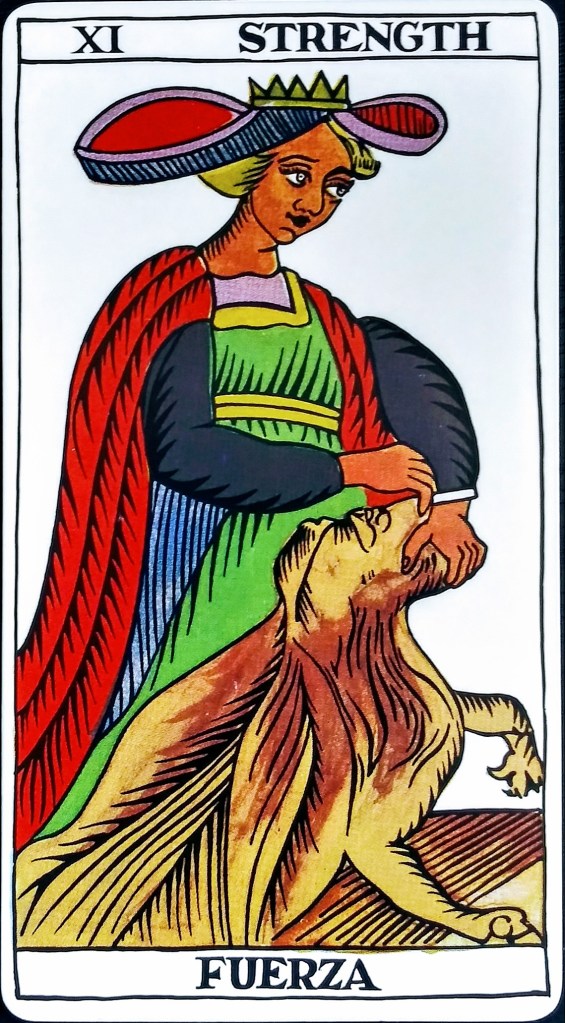
A cloaked woman wearing a wide brimmed hat topped with a crown, and flowing robes opens the mouth of a lion. Her hands venturing into the mouth, fearless, while her face is set in a sly expression of competence. Strength proves her mettle and is victorious in the act. No other card in the pack embodies the dimensional quality and power of the batons like the 11th Trump. Portents of manipulation and force reveal themselves in her performance. She labors and asserts her power through accomplishing the taming of the beast.
The suit of batons is one where the mettle is tested against the vicissitudes of fate. It is a test of power, of physical capacity, and of competence. Strength deploys these functions in the gesture. The taming of the beast is one of consistence force. Batons are a physically active suit, repeating, laboring continually, sweating, for the end result. Strength embodies likewise, the lady with bulging arms and big hands maneuvers with steady force the mouth of the lion, opening it without having her arm ripped off. Where swords are active in cutting, dividing, and killing. The swift cut. Batons with steady applied force achieve the desired outcome, it is not about cutting but about displacing, shifting things into different forms.
~~~
∆ If you’re catching this post/series midway, Animating the Tarot Pips, the introduction along with a master list (with links) of the installments can be found here.
† Deck used: The Spanish Tarot published by Heraclio Fournier, Vitoria, Spain.
* Jean Claude Flornoy quote from the little white book with the Jean Noblet Tarot de Marseille reproduced by Jean Claude Flornoy, editions le-tarot.com, Marseille, France, 2014.









 Natalia Lee