In this part of the world it is Spring, the trees are starting to bloom quite beautifully and the flowers are peeking out of their bulbs. It all looks very beautiful to be honest. Having moved from the eternal summer of the Caribbean to these northern lands not too long ago, it is quite a sight to see spring waking up the flora from its winter slumber.
Given all this beauty I thought it fitting to begin with the suit of coins. The dynamic suit of exchange, cunning, and perspicacity. My approach and vision of the suit is quite simple, what do we do with coins? We hold them in our hands, invest them so we can acquire more, use them as exchange for other goods, save them, you get the gist. So following this train of thought, this suit is about how to apply our mental capacities in order to accrue benefits, it is about money and exchange, and growth. Also, since how we use coins(money) rests in our tenacity for discernment, then this suit also indicates mental prowess. Simple and close to nature.
Coins denote intelligence, often indicating learning, the growth of knowledge, expansion of the mind. I personally to not attach to the cards any esoteric underpinnings, and this includes the use of the classical four elements of fire, earth, water, air, at least not in their symbolic understanding. Here the coins are associated with heat, or fire, in that electric energy sense. I am thinking circuitry, movement, rapidity. Coins are quick, we use them, and (hopefully) together with our mind so that we can get the best results out the investment, purchase, or endeavor. Additionally, coins within my framework, belong to spring, budding and growth.
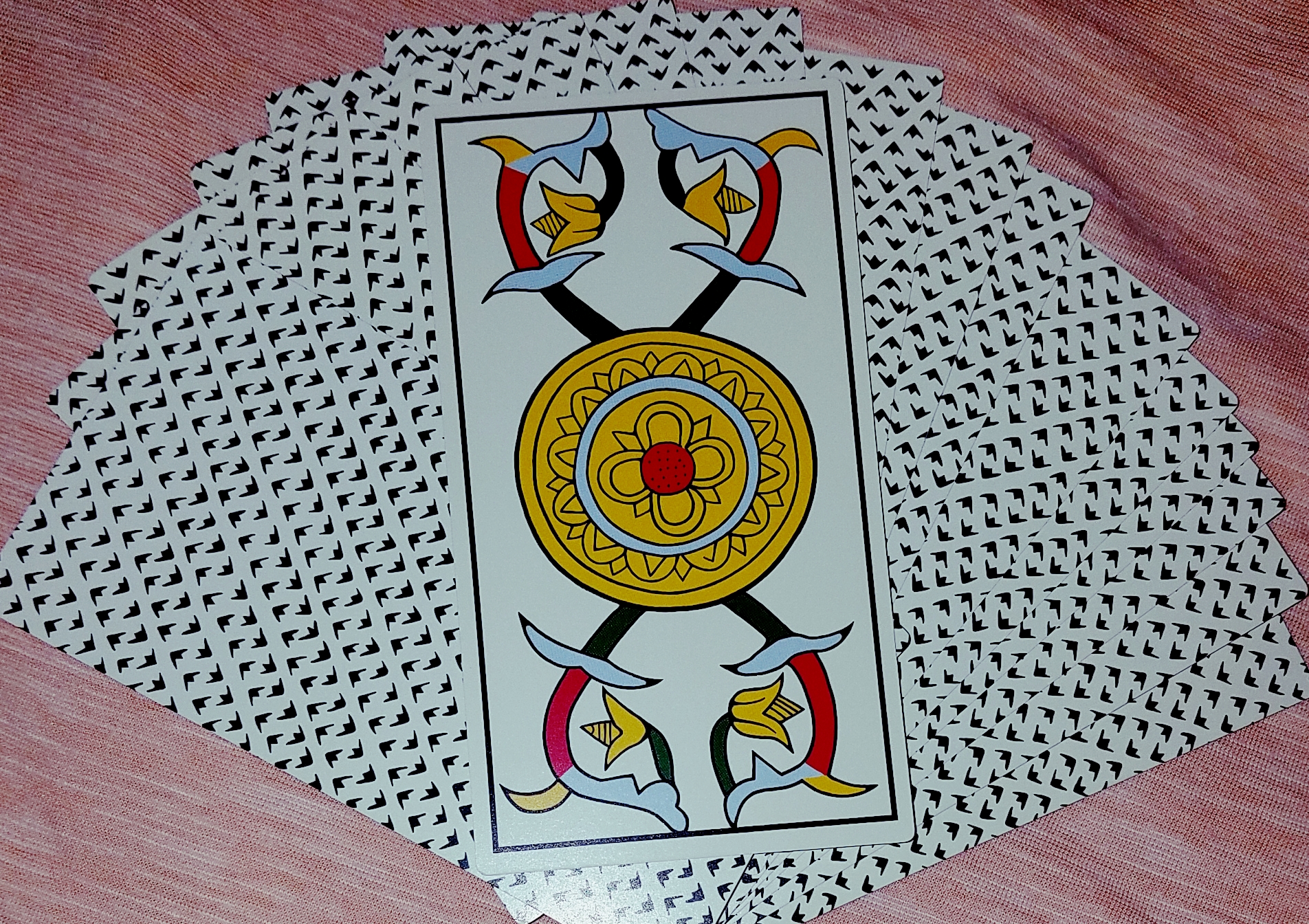
Tarot de Marseille Jean Dodal reproduced by Jean-Claude Flornoy, Editions letarot.com, France, 2009.
With the Ace of Coins in particular, the beginning, all I see is luck. An idea has struck and luck is on your side in applying that idea towards generating growth, planting the seed. As always, the reading of the card depends on the companion cards around it.
As the buds flourish and summer looms close, what lucky winds are blowing your way? How is Lady Fortuna favoring you this season?
This post will be brief, much like the Ace of Coins. I hope you are finding favor this season and that the winds blow to your advantage.
This is inspired in many ways by Nicholaj de Mattos Frisvold’s “Ifá: A Forest of Mystery,” the stories of Loki in “Myths of the Norsemen” by H.A. Grueber, and particularly in Frisvold’s interview with Gordon White on his podcast, Runesoup.
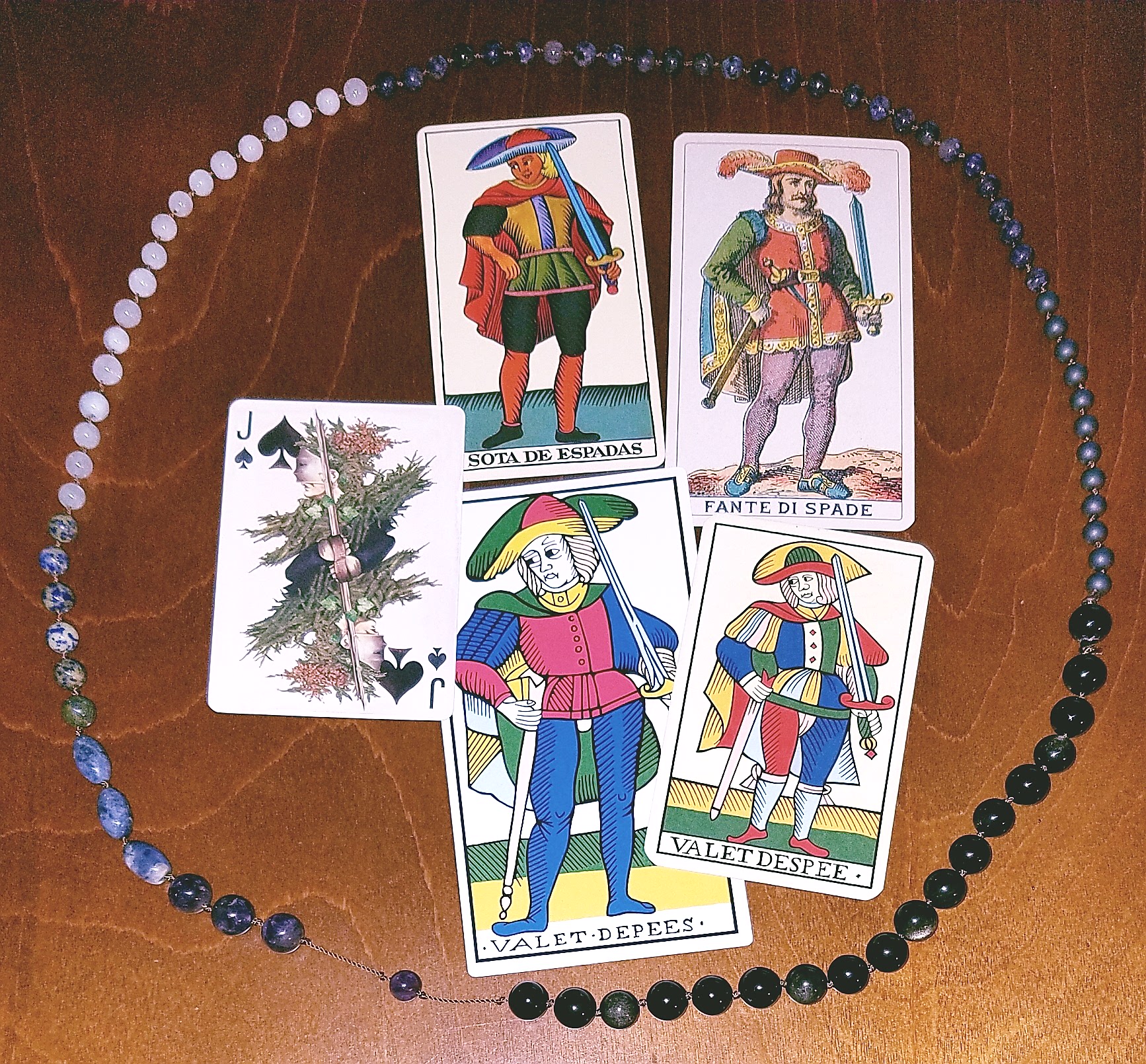
It all began as I looked at the sly expression on the page of swords in the Marseille Tarot decks I own. In traditional cartomancy, this fellow indicates dark forces, deceit is afoot, treachery, or a dead spirit roams about. When looking at the suit of swords from a magical perspective, this card indicates the witch’s fetch. (For more on the suit of swords from the perspective of the magical journey, take a look at this PDF I wrote on the suit). As I look at this guy, I am strangely drawn to that sneaky expression and I wonder what he hides.
Decks (Clockwise from the top): The Spanish Tarot published by Heraclio Fournier, Spain; The Ancient Italian Tarot published by LoScarabeo, Italy; Jean Noblet Tarot De Marseille published by Jean-Claude Flornoy, France 2014; Tarot de Marseille Jean Dodal published by Jean Claude Flornoy, France 2009; Uusi Pagan Playing Cards, by Uusi, limited edition.
Incidentally, I am also reminded of the pervasive darker forces of nature. Needles to say, I can’t help but reflect on the state of the world at the moment. We live in polarized times. It seems we have forgotten and disconnected from the cycles inherent in nature and in us. Hence, we vacillate between extremes, confused and scared.
Let’s stop for a moment and look at all the cards on the table, we have much less control than we may want to admit. I will start with Loki, god of fire, chaos, in Norse Myth. I sense there is something latent in these definitions that deserves a closer look. Often descried as evil, he is either looked on from a binary perspective of good and evil, and limited to a shallow construction(personification).
Once upon a time there was a giant and a peasant passing time and playing chess, while betting on who would win. The giant declared that should he be victorious, he would come and claim the peasant’s only son. The giant won and promised to return the following day to claim his prize. The parents where scared and knew they could not outsmart the giant. Hence, they implored Odin for aid. The God answered by coming to earth and transforming the boy into a tiny grain of wheat, which he hid in a large grain field, declaring that the giant would not be able to find him. The giant Skrymsli, however, possessed far more wisdom than Odin imagined. On the following day, the giant arrived with his scythe and began mowing the field of wheat until he took hold of the particular ear where the boy hid. Upon hearing the boy’s cries of distress, Odin snatched the kernel from the giant’s hands and returned the boy to his parents, stating that he had done all in his power to aid them. Skrymsli obviously felt cheated and announced he would be back the following day. This time the parents implored the God Hoenir. The God answered by turning the boy into a fluff of down, which he hid in the breast of a swan. When the giant appeared, sensing the misdirection, he went straight for the swan and bit off his neck. He would have swallowed the boy had not Hoenir taken the fluff of down away and restored the boy to his parents. He also told them he had done all he could to help. Skrymsli threatened he would make a third attempt for his rightful prize. Desperate, the parents called upon Loki, who carried the boy to sea and hid him in a tiny egg, in the roe of a flounder. After doing this, Loki found the giant on the shore, intent on going fishing. He insisted on accompanying the giant. The giant went fishing with Loki, and happened to catch the identical flounder where the boy was hidden. He proceeded to open up the fish and examine the roe. Loki watched carefully for his chance, and snatched the egg away, whispering to the boy to secretly run back home, passing through the boathouse on his way, and closing the door behind him. The boy did as he was told, but the giant caught on and began pursuing the boy. Unbeknownst to the giant, Loki had placed a spike in such a position so that the giant’s head went straight into it, and he fell to the ground. Seeing him helpless, Loki cut off one his legs, but through sorcerous ways they began to join back together. Master of guile, Loki cut off the other leg and threw flint and steel in between the severed limb and trunk, obstructing any further sorcery. The giant was slain and the peasants were forever grateful to Loki, considering him the mightiest of the heavenly council. (Myths of the Norsemen, 219-21).
I can’t help but recall at this point the importance of the darker powers of nature. Wherein the wily and cunning forces reside. Understanding these sinister and uncomfortable aspects of life opens up the flow of possibilities, and forces us to place our selves outside of fear. The crooked shadow forces bring a necessary tension into the creative vortex. It is fitting here, to further contextualize this story of Loki, that I speak of the òrísá Ògún.
“Ifá reveals that at the beginning of time, when Ayé became an ensouled planed, spirits came from the right and the left. Of these spirits, 201 came from the left and are associated with strength and malefica, whilst 401 came from the right, representing benevolence and good fortune. From the left, the side of strength, only one òrísá came forth, and this was Ògún. The remainder of the spiritual forces coming from the left were spirits detrimental to human well-being. These are considered to be the necessary arsenal of defenses available to Onilé, with Ògún serving as a stabilizing force amidst all these spirits of obstacle and grief.” (Ifá: A Forest of Mystery, 27).
After all this, what do I mean to say? Namely, and in a roundabout way, that it is the tension between these two opposing forces that generate change and movement. This is seen in nature and its cycles. Moreover, character is forged, tempered, refined and shaped within this rhythm. The strength of Ògún is need to balance these “detrimental” forces, and these do not adhere to the pronunciations of good and evil, this polarity is merely something that is, that exists. The key lies in our approach.
The world is infinitely more dynamic than good or bad, black or white, this or that.
If we remember the rhythm, stay attuned and in sync to the rhythm, we will realize that the sinister aspects of life are unavoidable, whether frightful or not, they are a part of the kaleidoscope that is living. Accordingly, we can approach situations where the unavoidable manifests with a detached and clear understanding. We henceforth learn to navigate the patterns of what is, we learn to reside in the flow of the dark, when cunning is necessary, as well as in clarity, when light and transparency is needed. In the end, these are just words describing what is seen and unseen and the forces that permeate our created reality.
Jean Noblet Tarot de Marseille edited and reproduced by Jean-Claude Flornoy, 2014 edition.
May we always have the strength of Ògún on our side to temper our darker natures, those inside and outside. To help us understand the cycles and their workings so that we may build in ourselves better character and resilience.
I return to the sly page and discern his vitality, and the necessity of residing within the flow. Aware that the key to all situations lies in our approach. As these are my own observations, feel free to comment away…
~~~
–Ifá: A Forest of Mystery, Nicholaj de Mattos Frisvold, Scarlet Imprint, 2016
–Myths of the Norsemen: From the Eddas and Sagas, H.A. Guerber, Dover Publications, New York, 1992.
I recently had family visiting, hence my writing absence. The visit was welcome and expected but nonetheless exhausting, fitting as I am going to be closing the suit of cups with this post.
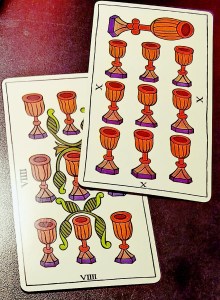
The 10 of cups is unequivocally a card that denotes plenty, enough, or a lot. When I look at all those cups, it is so overwhelming that the 10th one topples over, spilling its contents. A perfect example of how these past few weeks have been for me, from the arrival of change that the visit brings is born satiety. A perfect shift from the 9 to the 10 of cups.
The Spanish Tarot published by Heraclio Fournier, Spain.
In traditional cartomancy, the 10 of cups is also a card of journeys. Understandable given its position as the culmination of the suit, denoting a transition into something else, something new. As with cartomancy, it really all depends where the card lands in medias res. Generally, as cups highlight water, the journey is over water, covering a long distance by boat.
Closing this suit, I am reminded of communion, of sharing, of community. As cups are generally best when shared, no matter what their contents, that is, wine, coffee, juice, the heart, emotions, tears, love. This is an intimate suit that conveys kinship, harmony, and serving. As I think back on the recent visit of family, highlighted by everything else that goes on around me, both in the public and private sphere, I practice the letting go of stale waters. I embrace fellowship and let go of the excess. I acknowledge the welcome visit and the sharing, while letting go of the pettiness and the overwhelm. What use is it to me to retain it, wallowing in putrefaction? What use is it to anyone? Perhaps that is the intimated lesson in the toppled over cup (the 10th cup), the art of letting go, learning to let go so that other things can enter and begin anew.
Needless to say, as I sit in a coffee shop by myself, something I haven’t done in ages, I admit that although the visit was welcome it was also tense, draining, and a bit frustrating. Then I tip the 10th cup over, purposefully, letting the contents spill out and disperse. Instead of swimming in a pool of stale water, I just let it go.
I don’t want to wade in this post for too long, I am keeping it short and sweet. But perhaps, leaving you with one last question, what cups need to be toppled over in your life?
As this is also a space for my personal explorations, this post will be somewhat intimate.I was raised in a psychologically and spiritually restrictive environment. Even though I was endlessly curious and loved to read, my musings and mental aerobics could only go as far as my spiritual upbringing allowed. It took years and distance to break free and detach myself from that mentality. In all honesty, it also took a lot of heartbreak and disillusionment, and strength. When I decided to pick up the baton again and start exploring spirituality and spiritual modes of thinking, it was with an extremely critical and derisive eye. Always doubting, questioning, denying. I still question too much. As I have gone about this roundabout journey of finding answers to my spiritual questions, I seem, as of recently, to have landed back on a doorstep I thought I would never touch.
In searching for my myths, for the narratives that speak of my culture, I have landed on an exploration of Catholicism and its folkloric manifestations, specifically Caribbean and Spanish. I hold on to my trepidation as I retrace my steps and attempt to reach out towards my ancestors. See, when I broke free from my upbringing I wanted to get to the core, to the essence of what connects me to this planet, to all the beings in this planet. I wanted to step outside of monist modalities, outside of linear master narratives, and find the source, reconnect ancestrally, if you will. I even venture to admit that I have decided on a cultural and environmental mythic structure that resonates with my core. Now how did I end up looking at the saints and Catholicism as well? As I am sure many know, throughout the colonization of the Americas heavy “synchretization” was involved, gods and ancestors took on the form of saints so as to disguise the continual worship of the older religions. This is true in Santería, Vodou, and Candomblé, among others. There was an enmeshment that occurred that added a rich complexity and nuance to the observance of the Saints.
I don’t want to get too involved in this topic, as this is my personal experience and narrative at the end of the day, but as I explore the saints now I find myself understanding what all this means. They are ancestors, ones which I can form bonds and relationships with, and explore further spiritual complexities that are perhaps out of my singular reach. They (I say they as a general term) can be protectors, guides, aides, and communicators, helping me tap into concepts and ideas. This is somewhat bizarre for me, to grasp these concepts, because I was raised to look disdainfully and disapprovingly at saints, at idols, at anything outside of the trinity. Even though my grandmother had a huge altar of saints in her kitchen, which she attended to religiously, but my mother never let me enter that world. I never understood how all this worked, and now it seems like I am beginning to grasp the intricacies.
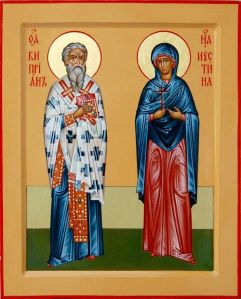
I am merely reading and learning at this stage, but I feel this huge sense of having come full circle. Funnily enough, I started this whole search for my culture, for my identity because I have always felt like an island sailing lonely in a vast sea, with no concrete sense of belonging. Am I Caribbean? Am I Spanish? Am I black? Am I American or Hispanic? I know a lot of these classifications are pointless, the essence of it all is that I am a human being, but truly a part of me longed for some sort of culturally ancestral identification. As I grew in my spiritual education I came to a standstill when I felt the call, the push, to find that connection. I needed to know where I came from. This whole search has led me here, to the folkloric manifestations of Catholicism, or “folk Catholicism,” if you will. I peak into this big archive of history, and I am at a loss for words, unbelieving but finding a sense of having arrived at my goal. I keep playing with my cards as I read on Saint Cyprian and Saint Justina of Antioch, thinking of transformations and the many ways to seek knowledge and connection. Suffice it to say that one never stops evolving and growing, and as I continue in my spiritual search, I remember to keep my mind open and my disposition ready.
Saint Cyprian and Justina of Antioch, artist unknown (I was unable to find it).
My next post will end the journey of the suit of cups, as new paths open and lead to deeper oceans.
 Natalia Lee