• Spreads as cartography

    Tarot spreads as a cartographic map

    I am exploring of late how the eye wanders around a given shape. This idea was first introduced to me by Camelia Elias through her teachings in Radiant Reading and also here. It is something most of us card readers already do, except this particular approach is an openly intentional one which focuses on contemplating the cards, instead of designating meanings for each position. It is about letting your eye wander around the layouts you use for spreads without positional restraints. Which in turn, intensifies and unlocks the potential to see and visualize the interplay of the cards, allowing you to immerse yourself in them as they interact with their movements, their tensions, and their releases. In this way, it is very much both an art of contemplation and the art of mapping gestures, shapes, and momentum.

    A spread, according to its dictionary definition, is about expansion, opening up, distribution, dispersal. Hence, and in my layman words, a card spread is about laying out possible routes, expanding on a specific question. Looking at the different angles.

    The French Cross

    Here we have 3 cards in the center with one card above and another below. If you let your eye wander around this landscape you can see several things. Now again, I dive into all this from a state of contemplation. First, the flanking cards can be seen as directional emanations. North, South, East, West. Or from an elemental angle, earth, fire, air, water. Radiating inward towards the one, or outward from the one to the directions. When viewed this way, the center takes on an almost grand overarching quality. As if taking in, receiving from all the fours corners the 4 distinct powers or forces. Inversely, the center is expanding in specific ways towards these directional forces. Whichever card that lands in the center is the culmination of all the 4 emanations.
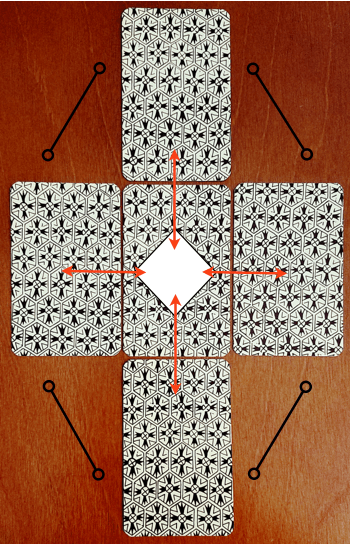
    The French Cross Jean Noblet Tarot de Marseille
    Jean Noblet Tarot de Marseille reproduced by Jean-Claude Flornoy, 2009.

    Second, and closely tied to the first, the flanking cards can be seen as key points in time. Like a clock-face, each one turning around the center. Or vice versa, the center acts as an influencing force within these specific time reference points. This can speak of subtleties taking shape in these positions, subtleties that reflect the central card. It is interesting to note that this is a recurring mythic shape, equidistant, balanced, and circular. One that speaks of the iteration and placement of the self, the center, in moment and time, and its extensions. Using this perspective, one can read the flanking cards as a circular movement while the inner card is fixed.

    The Diamond
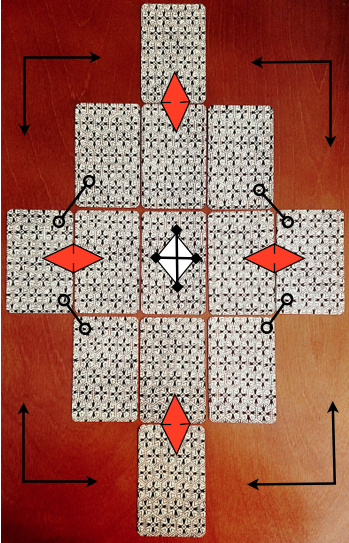
    Jean Noblet Tarot de Marseille, Diamond spread
    Jean Noblet Tarot de Marseille reproduced by Jean-Claude Flornoy, 2009.

    This is the french cross but with additional flanking cards, or a square of nine with the four directions as reference points. It can be read starting from the cross outward, above being the upper influences, divine or spiritual, below being the earth or grounded influences. The two corners can easily be associated with the elements of west and east and its derivatives.

    Additionally, each side can be read as mirroring the other, two sides of the same coin, from above/below, east/west orientation. Reading it as the magical square with directional influences, it is very useful for seeing how the square is placed in situ. The moment contextualizing the tableau, locally. The square itself has the potential of revealing the varying subtleties of a situation, especially (and in my personal opinion) a spiritual one.

    The Magic Square
    Jean Noblet Tarot, Magic Square spread
    Jean Noblet Tarot de Marseille reproduced by Jean-Claude Flornoy, 2009.

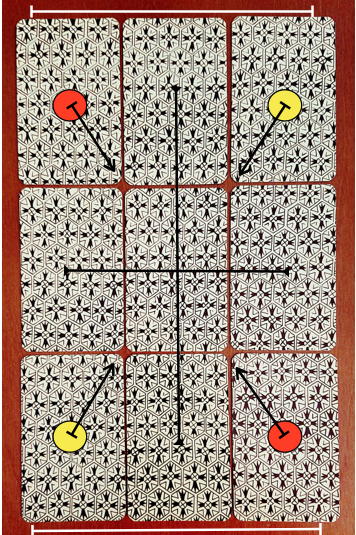
    A miniature tableau that speaks within a condensed tapestry of the diverse facets connected to an individual and the question. I call it the magic square, it can be called the square of nine or simply the square. It is quite possible it has many other names. As to the why of the ‘magic,’ I believe that has to do with the symmetry of the spread and the number of cards, nine, which is in itself, according to lore, a magically significant number. The same perspective as the previous layouts apply, as far as how to contemplate this spread. I tried to find a way to make circular markers but when you look at this square, you can imagine a circular rotation as well, interacting fluidly among the outer cards, clockwise. When the cards are outspread, and you begin to see action and context, the approach I speak of can be more clearly experienced. Because it is in action that the contemplation of the cards really takes full effect. The corner cards have the potential to mirror each other while the center speaks specifically about the individual or querent. The square expresses progression and forward motion.

    Playing with diverse spread shapes, sans positional meanings, opens the imagination of the reader, as one enters into the conversation with the cards. Similar to reaching into a tapestry, walking into it, interacting with it, and allowing the forms to speak freely. Moreover, the approach refines our awareness. This reminds me of the first time I learned to appreciate and understand modern sculpture.

    A few years back, while in New York City on vacation, I went to the Whitney Museum during it’s free visitor day, a quiet autumnal evening. I can’t recall the specific day. I wasn’t sure what to expect, as I had never gone before. There was an exhibition from a contemporary sculptural artist whose name I cannot recall either. It was an exhibition on the geometry of the body and its environment. Geometric shapes and minimal colors dominated. I remember thinking, “oh great, the type of art I don’t like,” and setting my expectations low. As I walked around the room, looking at the shapes, the fluidity of motion between them, the tensions, oppositions, the engagement and connections, something clicked inside of me and I understood the essence of what was being portrayed. Stripped of all artifice, colors, and distractions, this is the interaction that lies at the essence of ontology. It was quite a philosophical realization, as I renounced my initial statement and let myself be taken in by the art and the moment. I was understanding shapes in motion, gestures that oppose and attract. Despite the cold (an adjective I add to describe my initial unfeeling reaction) geometric shapes on display, I began to witness the warmth, the life within that spread outward as the story of the shapes moved through each piece. I saw my body in these geometric shapes.

    Likewise, this contemplative approach to reading a spread of cards has the potential to offer revelations of all kinds. Unfurling routes, practical directions, and prospects.

    Give it a try yourself and see where it takes you.

    ~~~

    La Maga Tarot

  • Cards: 5 of Coins

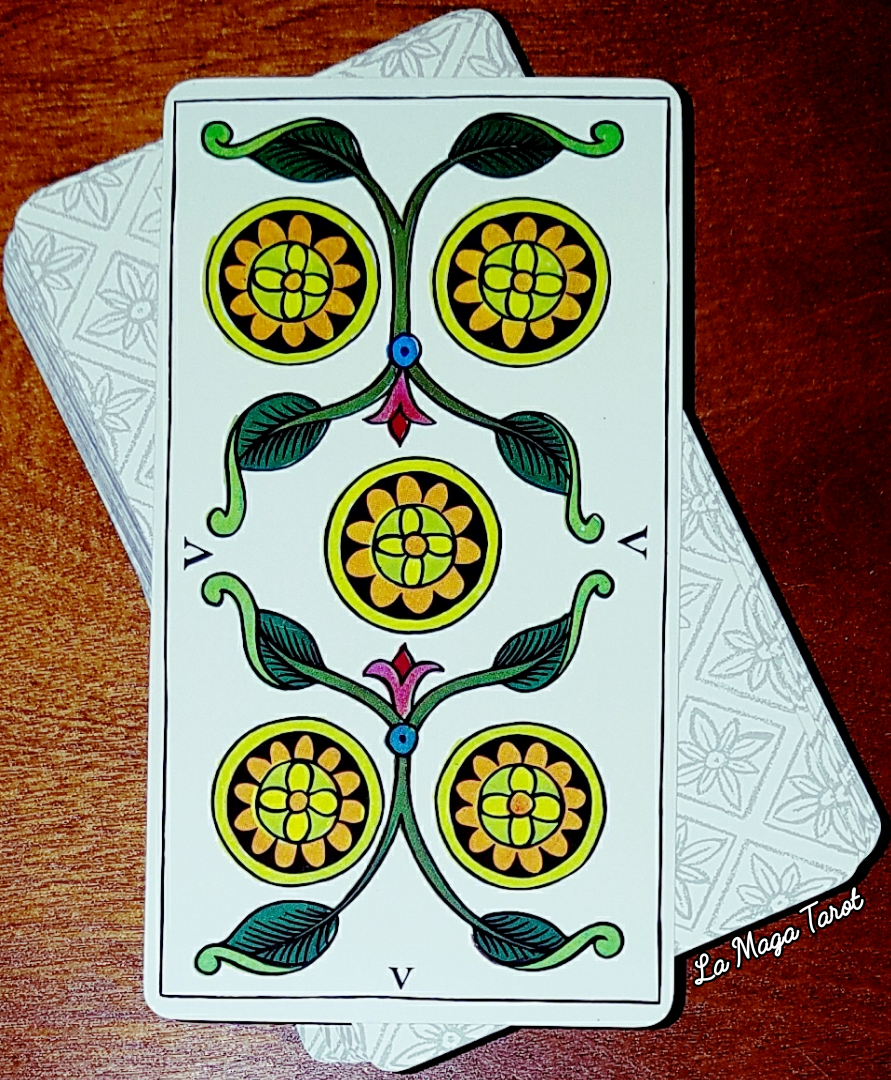
    We arrive at this juncture in the middle, the 5 of coins. A solitary coin encased within flowering leaves and two open buds above and below. The heart, the center, the core. There is an emphasis here in the center, the excluded, as the four coins around it are balanced and stable. A seed perhaps, an investment in a new opportunity. The coin is money and the center strikes me as reminiscent of the heart of the matter. Fives in general, within the cartomantic framework, are related to the body, and this is because we have five limbs. So naturally, the fives speak of the body.

    The Spanish Tarot 5 of coins
    Deck is The Spanish Tarot published by Heraclio Fournier, Spain. The picture is taken by me.

    Typically, I see this card related to indulgences, spending and unbalancing your (stable and square) savings to indulge a bit in things desired. How do we spend on ourselves? How do we invest in our bodies?

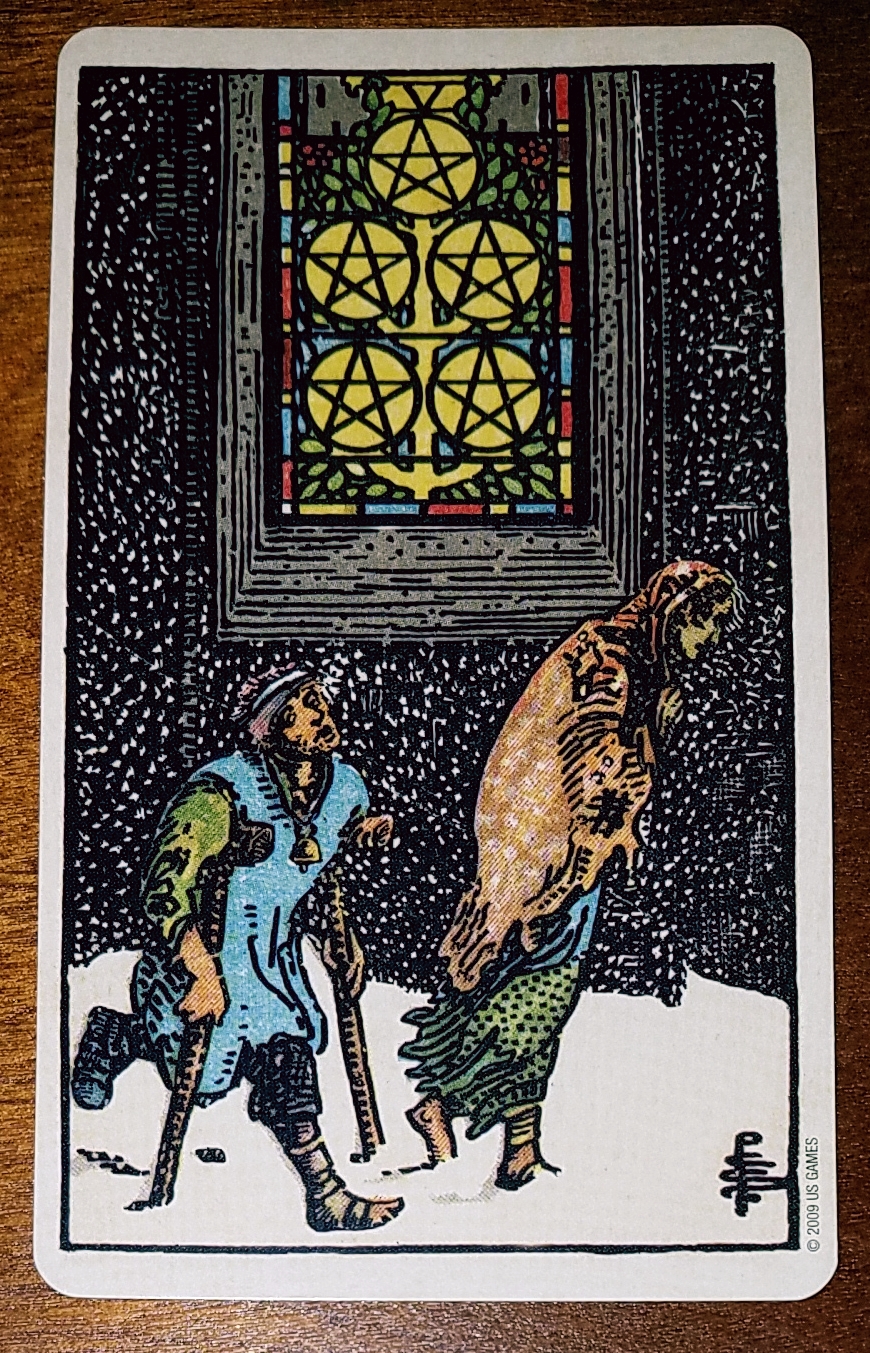
    It is interesting to note, for the sake of comparison, that the Rider Waite-Smith Tarot depicts this card negatively. There is loss and instability as the balance of the four is found destabilized by the 5th pentacle. This can be speaking of exclusion, poverty, loss, sickness. In the Tarot de Marseille 5 of coins we have a balance that highlights the center. This presents quite a dichotomy as one is outwardly constrained and lacking in harmony while the other, the TDM, is geometrically balanced. In a roundabout way, both deal with the body, what resources we have to provide for ourselves, how we invest or not in ourselves, how we care for ourselves.

    Smith-Waite Tarot Centennial Edition, 5 of pentacles
    Smith-Waite Tarot Centennial Edition, published by US Games, 2009.

    As the year approaches its halfway point, it is good to reassess these questions midway.

    How are you managing your resources, and accordingly investing in your self?


    La Maga Tarot

  • The Yes and the No

    I read yes/no questions because I make no distinction from one question to another, they are all questions and I ask the cards all manner of questions. The way I see it, nothing is fixed and as we move about our lives we are constantly making decisions and changing the realms of possibilities for ourselves. Outside of all paradigms, change is inescapable, just as death is inevitable. Reading the cards for the yes/no question can uncover interesting possibilities, helping you consider different routes which the tarot is excellent for. First, because it can frame the answer against what you want(desire), whether it is the answer hoped for or not. Secondly, it is interesting to see how the answer unfolds. In many ways, the answer is already contained within the question, between the lines, it is only a matter of unlocking it.

    The basic recipe is:

    Black suits (swords and batons)= no

    Red suits (cups and coins)= yes

    With a caveat:

    Always read with the question in mind, context is what you will be looking at first. When you read with context, the yes/no is not always as clear cut, or red and black. Here is where your personal understanding of the suits comes into play.

    For example:

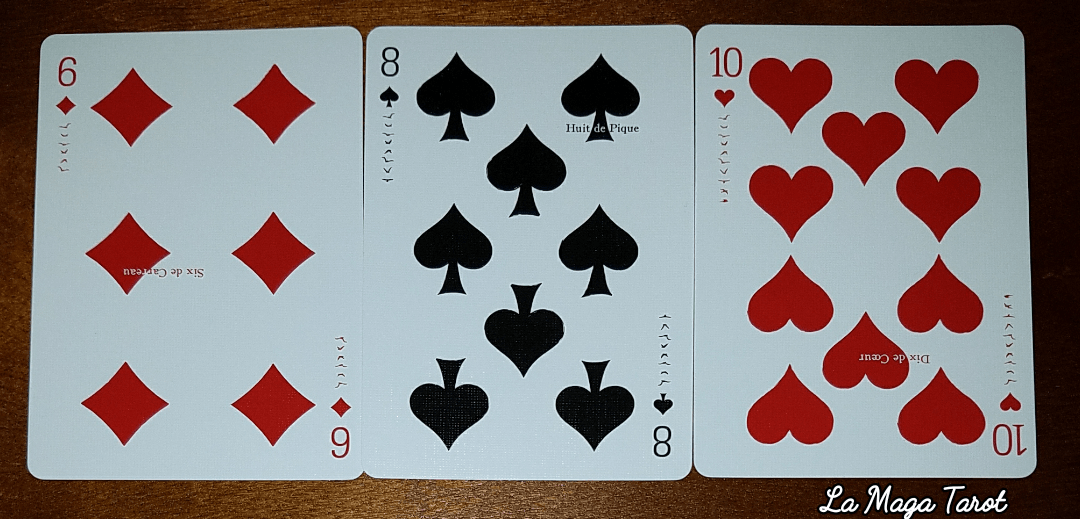
    Spiritual questions lead me to see how swords(the magical suit) and cups(the spiritual suit) interact. As swords delineate the magical journey and cups taps into the flow and the heart, watching these two interact can better elucidate whether the question is a yes or no.

    Voltige Playing Cards
    Voltige Playing Cards designed by Henri de Saint Julien & Jacques Denain Distributed by The D&D Playing Card Co.

    Love readings are more direct, staying close to the rule of red and black. Since the red suits indicate heat and love, if there is no red, or the red is encased within batons or (worse) swords, then there is no love.

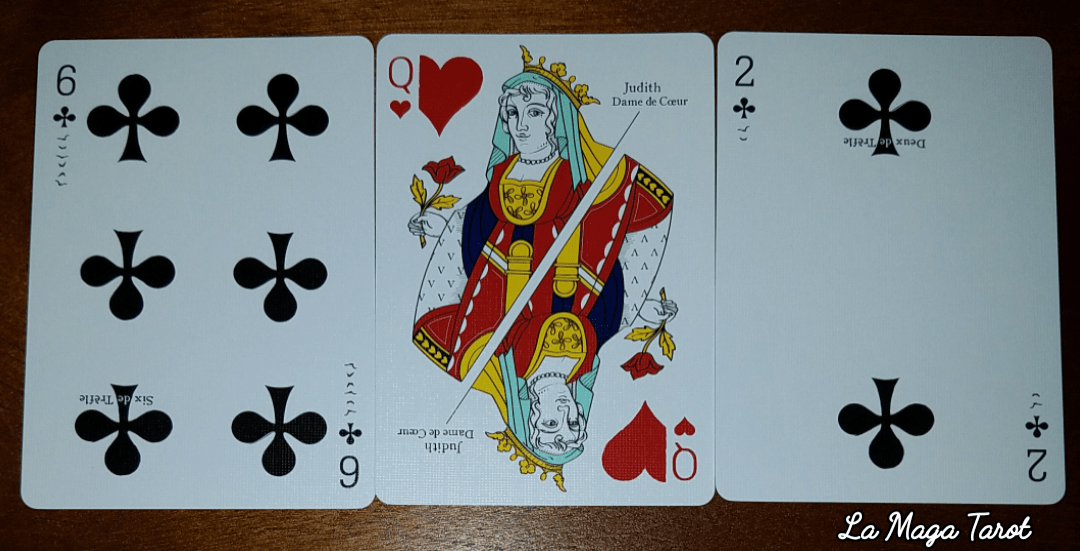
    I associate coins with money matters, money requires work, which is batons. For work/career/planning related questions I am immediately tuned into how the coins and batons interact.

    Voltige Playing Cards
    Voltige Playing Cards designed by Henri de Saint Julien & Jacques Denain Distributed by The D&D Playing Card Co.

    Here we come to another point, what happens when the question is about spirituality but no cups or swords come out? What if Majors pop into play? Well, the way I see it, our best tool in reading the cards, always, is our vision and the context, what we see happening and what the question is. Not our repertoire of meanings. How are these cards interacting? If batons show up in a question about spirituality, well how do they contextualize the question itself? More work (lots of batons), heaviness, detachment (less batons)? What are the cards around it doing? Are there court cards around? How are the Majors interacting with the minors? With force? Guidance? Direction? The elegance and potency of reading cards lies in its ability to hone our skill of seeing. How we are aware of what is around us, and how the elements around us interact. The goal with card reading and awareness is arriving at that point of detachment, being able to see what is happening without muddying it in guesswork. Where we are able to extricate ourselves from cultural/societal norms, and are hence able to witness the natural flow of interactions, between people, concepts, and nature. When we are able to tap into this awareness, then card reading flows, because we remove our self (our fabrications and notions) from the equation and read from our seeing. When approached this way, card reading is an excellent exercise that can be transmuted into many other facets of life, how we interact with others, how we approach our problems, and our goals.

    At the moment of posing a question to the cards, the formulated answer starts turning the cogs in our self as we see how the cards interact and create tensions. How do the cards make up feel? What is verbalized from what we see is divination. Therefore, it is best to keep it simple, keep the question direct, and always think about what is possible within the realm of what is reasonable/logical.

    For most of my cartomantic endeavors I stay away from using positional spreads. For yes/no questions, a simple 3-5 card throw is enough. I personally prefer odd numbers so 3 or 5 cards is the way to go.

    Also, it is good to note that yes/no questions are good for when you are working with spirits, or spirit work.

    I hope this has given you some food for thought, or at least led to cartomantic explorations.


    La Maga Tarot

  • A question of agency

    I rarely, if ever, get entangled in sharing my thoughts about the goings-on of the world around us, especially the political-cultural upheavals, swells, and movements. This is not out of lack of caring or disinterest, it is instead out of my feeling of impotency.

    Because of this, I frequently find myself thinking about the concept of agency, where is it and how does one embody/enact it? Keeping these questions in mind, and with relation to our contemporaneous times, where is our true agency located?  Is it in our daily routine? Our little rituals? In the validation of our repetitive jobs? Consequently, how do we employ/enact our agency in the age of sanitation, and control, and emphatic order?

    Take death for example, it is something apart, other, mostly ignored until it is impossible to do so, and in most cases dealt with in a sanitized setting under the controlled environment of hospital rooms, funeral homes and gated cemeteries. Furthermore, we generally shun speaking of death, of its inevitability, of its pervasive role in our daily lives. We do not search nor kill our own food, it is instead neatly arranged for us to purchase and consume. We strive for perfectly manicured, weed-free lawns. We arrange our lives within an encasement of control and order, keeping away what does not fit neatly into this given pattern. Everything is done and ordered for us. In the same vein, we see our political manifestations and struggles against the system subjected to the same sanitized formulations. I think about this often as I am aware of my impotence. As I look on at the political, environmental, and human rights struggles, I cannot help but wonder about our own agency. Does it lie in our community protests/marches? Does it lie in our involvement in cyber forums or in activist groups? How does one produce change within a rigid system? I say all this out of my own musings, not out of an expectancy for an answer. I hold a few particular views on power and violence and change.

    Following this trail, I can’t help but think of Oedipa Maas’s plight as she delves deeper and deeper into the Trystero enigma in The Crying of Lot 49, by Thomas Pynchon. Wherein she looses her grounding, her sense of self and context as what she unveils in her quest as executrix is a myriad reality, a labyrinth of possibilities and truths or lies, with no stable footing in sight. The quest of the self, and the construction of self in a world of multiplicity. Again I ask, as Oedipa never completes her quest, where does the revolution, the agency and power lie in our lives?

    As I sat in bed the other night thinking about these things and shuffling the cards, I decided to ask.

    What does genuine revolution (embodied agency) look like outside the paradigm of consumerism, approval ratings, order and protocol?

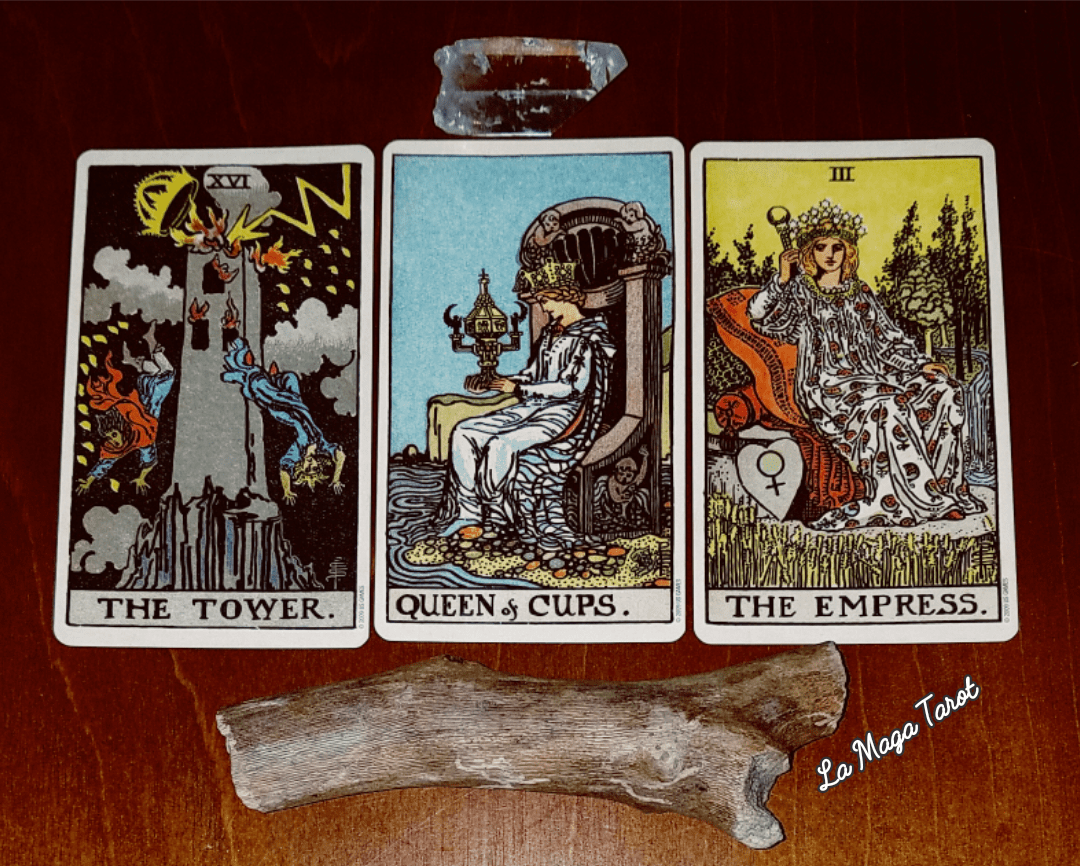
    Rider Waite Smith Centennial Tarot US Games
    Rider Waite Smith Centennial Tarot published by US Games, 2009.

    Where the blood boils and explodes, expelling the ghosts of our constructed realities, toppling the lid off our carefully elaborated selves, our self-prescribed fables null, here the power of the one who orchestrates and creates lies. True revolution lies within this cataclysmic shift of transformation, in the spilling outward of the inner. In the dethronement of constructs and symbols. Therefore, genuine agency/action lies in the liminal space between being and not being.

    There is an element here of dichotomy, of a glaring awareness of things that are as well as of the potential of things that are not. Clearly, agency lies in our daily enactments, our routine constructions of self in the face of society, culture, and state. I certainly don’t intend to cause any disruption in the traditional flow of things, if there is any purpose to these musings whatsoever, it is merely to get the mental wheels turning as I examine my life, my agency, my actions. As I seek to re-enchant my world and my perspective, I examine all the tangents and routes of my self within this monolithic architecture of reality. This is my self looking at my self as I see the swells of society around me. If anything is meant by this monologue, it is to inspire an exploration of self within and without cultural formulations. Also, I don’t intend to cover the gamut of complexity that are these interconnected yet varied topics that plague us in these modern times.

    I thoroughly enjoy reading the cards for all questions, and this was no exception. When I read the cards I don’t look for symbols of power, nor authority. I don’t search for conjured meanings nor intangible concepts. I look at the narrative, the story within the context. I look for the poetry of the images, the tensions, the movements, the swells and transitions. As I read this string of cards, I looked for the narrative of the answer inherent in my question. Evidently, the cards, in whatever shape or color they come, always point to the answers.


    La Maga Tarot