• The politics of unnamed desires

    In this one I’m going to get personal, and political. On Monday July 22nd, on the feast day of Mary Magdelene, the masses of Puerto Rico arose in a unified cry of defiance against the current governor Ricardo Rosselló. Around half a million people congealed to dethrone the governor for the level of blatant corruption and disregard for the people of the island.

    For videos, images and news articles: see this.

    This little island, Puerto Rico, subject to centuries of colonization, still a colony, rose in fury. I watched in awe as the waves of people came together under one banner, with one voice, united. But I was torn.

    First, let me tell you a little bit about my island from my point of view†. Since the “discovery“† of Puerto Rico by the Europeans, the island quickly moved into the possession of Spain, under which the land was mined into exhaustion, all the gold and riches immediately shipped back to the Continent. The indigenous people of the island mixed, died, or went into slavery. Typical story of the Caribbean right? Puerto Rico isn’t unique in this. What this island is particularly unique in, is that after centuries under Spanish rule, a mild skirmish between the Spanish and the British over ownership, the United States took over after the Spanish American War. With the Treaty of Paris on December 10th 1989, Spain ceded Puerto Rico. The island passed now into the ownership of a new head, a new banner, and a new culture. Are you seeing the thread here? Speed up a couple hundred years and here we are, still under the wings of the United Sates. At no point in our history, longer than a day, after the Europeans stepped foot on the island, has the people of the island been sovereign. If you sit and think about this fact, and about the repercussions this reverberates into a people, into the land, well, it’s quite something. It is crippling.

    Nowadays, the political stability of the island teeters between bankruptcy and imperial interests. What we have now is a web of high bidders seeking to sink their claws into the land for the benefit of the few. This web is rife with corruption, lies, megalomania, and disregard. The land itself is sold to the highest bidder, beach fronts natural reserves, forests, non human persons, all are subject to this, to corporate interests, and again, to complete disregard.

    The language we speak is not our own, it is a product of colonization, of course many other colonized people and places can say the same as well. But much deeper than this, we have never stepped out of the shadows of the greater powers. We have never flexed and expanded on who we are as a people sovereign.

    As I saw the masses united this past Monday, my heart swelled, but this swelling emotion was intermixed with the deepest and inexplicable sadness. For a people immersed in general dissatisfaction, within a landscape of uncertainty, have openly found their leaders, those who have the keys to the palace, offering nothing but disappointment. Yet, what lies behind this dethronement? What lies behind the curtain? For surely, this particular governor, caught in his own web of lies, is only a symptom of the disease, an outbreak, not the nucleus of the disease. Nipping him will not cure the disease. As the cliché goes, he is only the tip of the iceberg. Who will stand in his place when he is gone? Moreover, what can we as a people do? What can I as one do?

    Since I am a fortuneteller, I took out my cards while the march was underway and began to ask for clarity into what I could not outright see.

    • What is the importance of the protest? Locating where the importance lies, and its function.
    • What effects or possible outcomes of this uprising am I not seeing?
    • What will the outcome of the protest be with regards to the people of the island?  

    As you can see by these questions, I’m concerned with what these upwellings mean at a deeper level, especially for us as a people. For us the disadvantaged, the displaced, the colonized. For us, lost in a web of mis-identities, incapable of verbalizing our displacement, our self in the landscape. And yes, this is all coming from one person, me. Me as the spectator. But there is also me as the self living in this landscape. The me that recognizes the paradox of identity that ripples just under the surface of my own culture. Most importantly, in my perspective, there is the me in relation to the land, which to be honest, is vital when thinking about the island of Puerto Rico. The land, the non-human persons that also inhabit this place, that have no voice, the ecosystems ripped apart, the flora and fauna subject to the raping and pillaging of corporate interests.

    So what do the cards say?
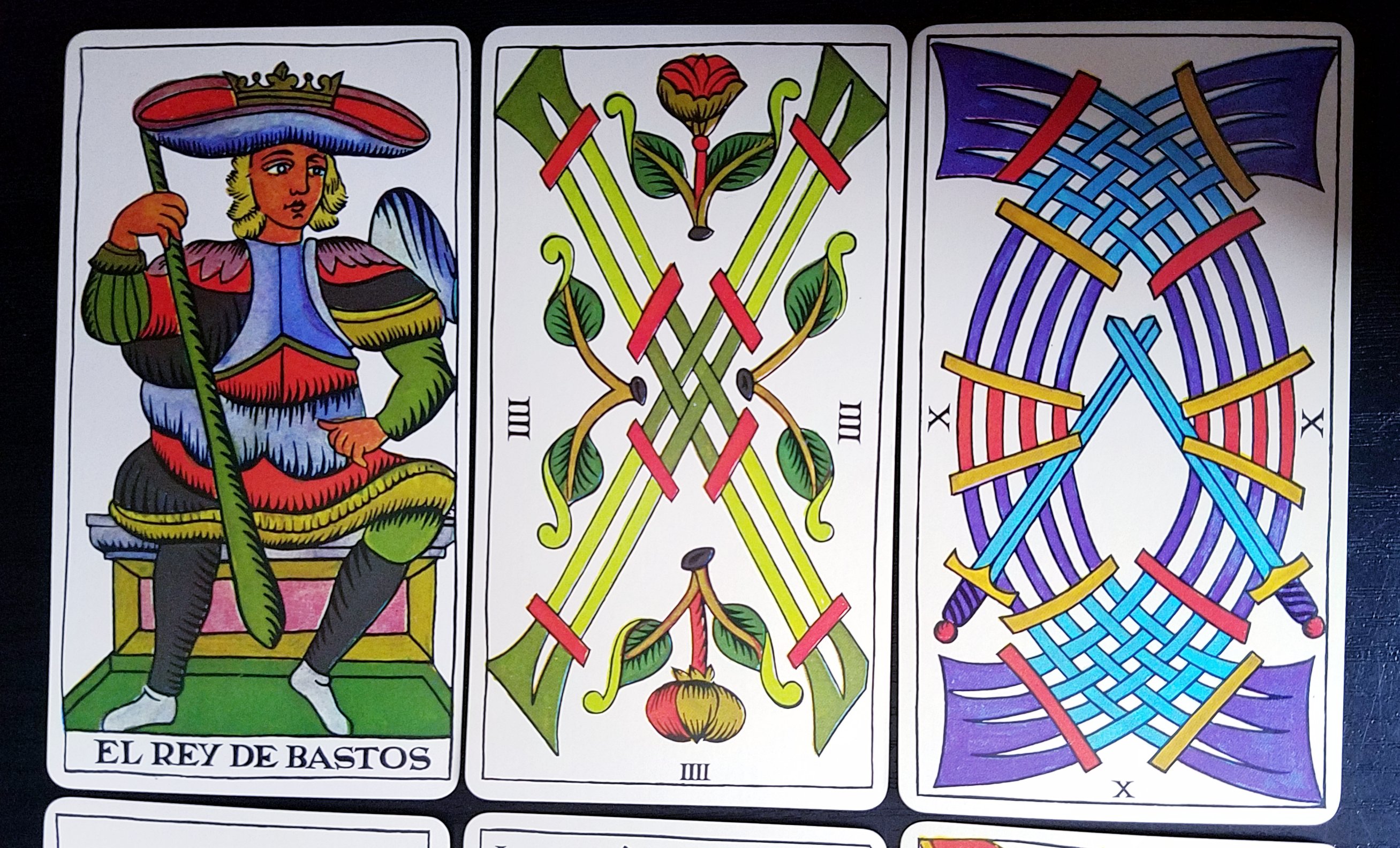
    the spanish tarot fournier tarot de marseille
    The Spanish Tarot published by Heraclio Fournier, Spain.

    The importance of the protest lies in the mobilization of forces under one act bringing tensions to a head. Confrontation and resolution. The king here is the major player, standing for the people, doing, embodying his force and capacity of shaping the moment. The 10 swords meet, confront, and resolve. There is a line of action here wherein what is vital is movement, shaping that which is unfolding, rising up and uniting to force a desired end.
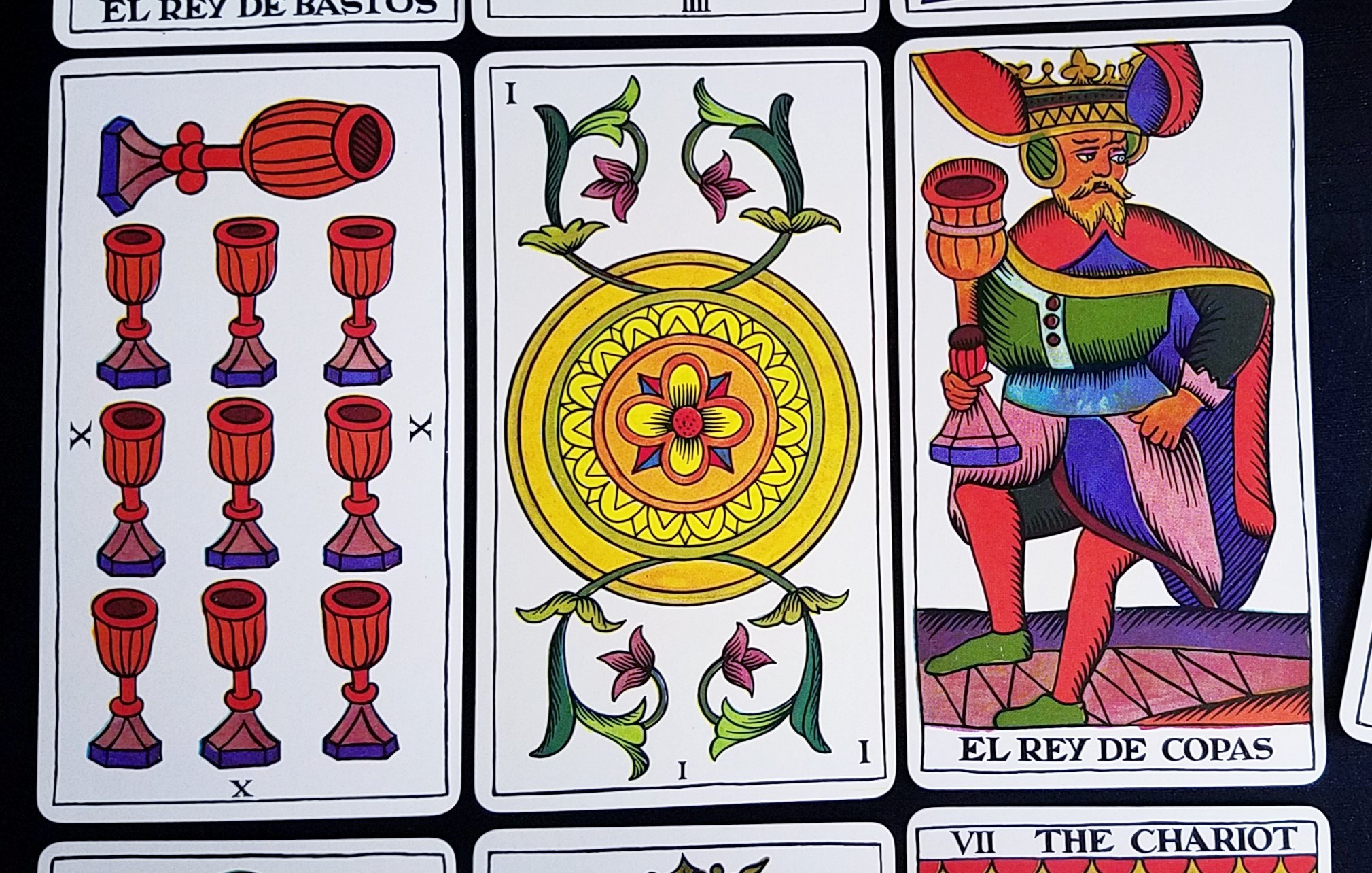
    the spanish tarot fournier tarot de marseille
    The Spanish Tarot published by Heraclio Fournier, Spain.

    Undoubtedly, these protests have as foundational the passions and the emotions. This is about desire, the expression and release of desire.  It is as if a cauldron has simmered too long over heat and is now bubbling over, spilling outward. What does this overspill mean? The plate is served, now we look at the delineations that underscore us as a people and as a nation. In a way this ending allows for something new to be birthed. We are the king of cups here, we hold our heart simmering with boiling blood, looking at divisive lines. Now we see, potentially with new eyes, envisioning horizons and possibilities. Yet. Yet. Yet. I can’t help but look with apprehension at the vines surrounding the 7th cup, which the king espies. We uncover the poison that has simmered there for centuries, then what?†
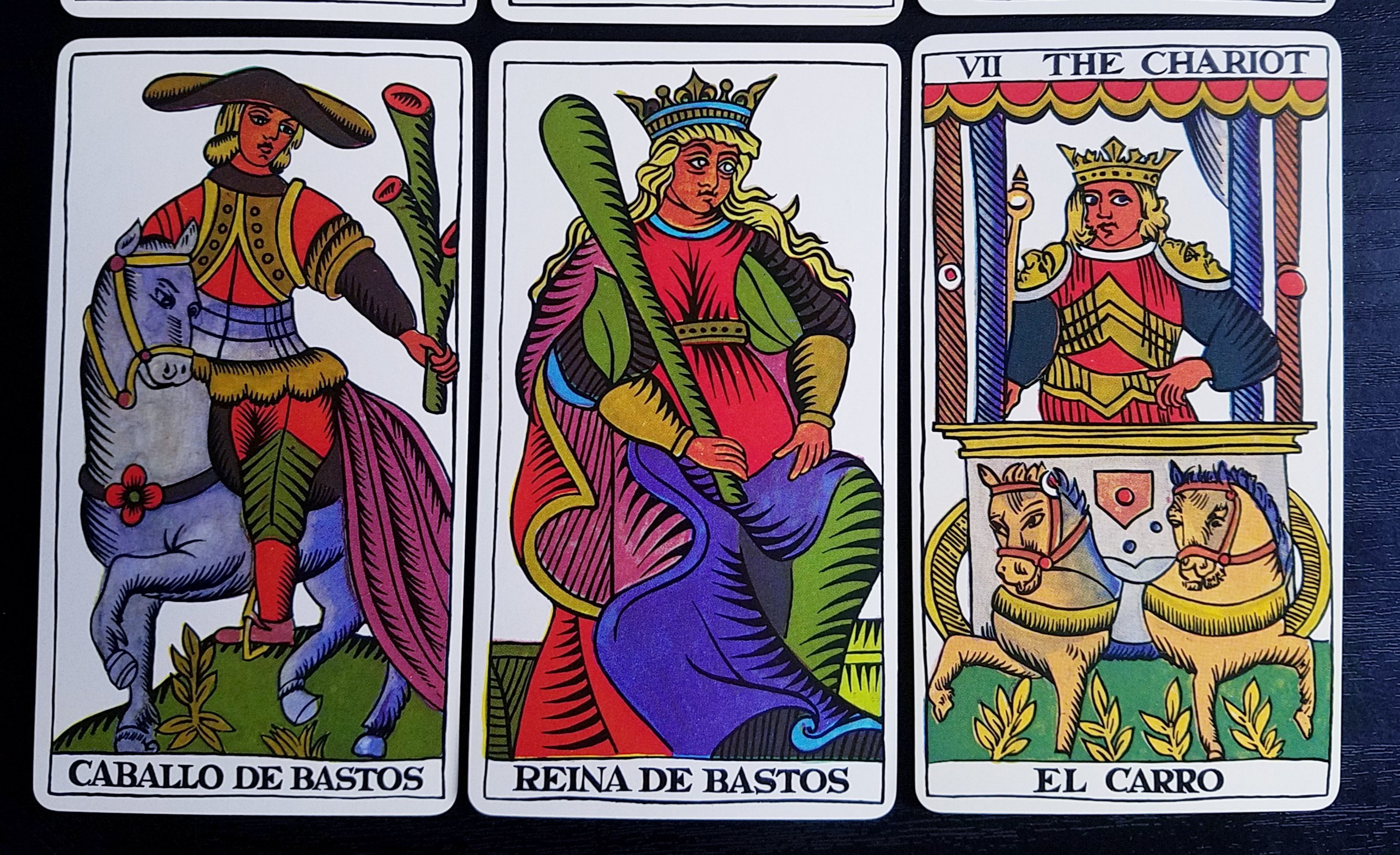
    the spanish tarot fournier tarot de marseille
    The Spanish Tarot published by Heraclio Fournier, Spain.

    The outcome of the protest brings it all back to mobility. What we are capable of doing as a collective. There is a sense of forward traction, caused by us as a collective apprehending what we are capable of doing when moving together. Yet there is no concretization in this mobility. We are moving, but what are we forming as we move, what are we creating?
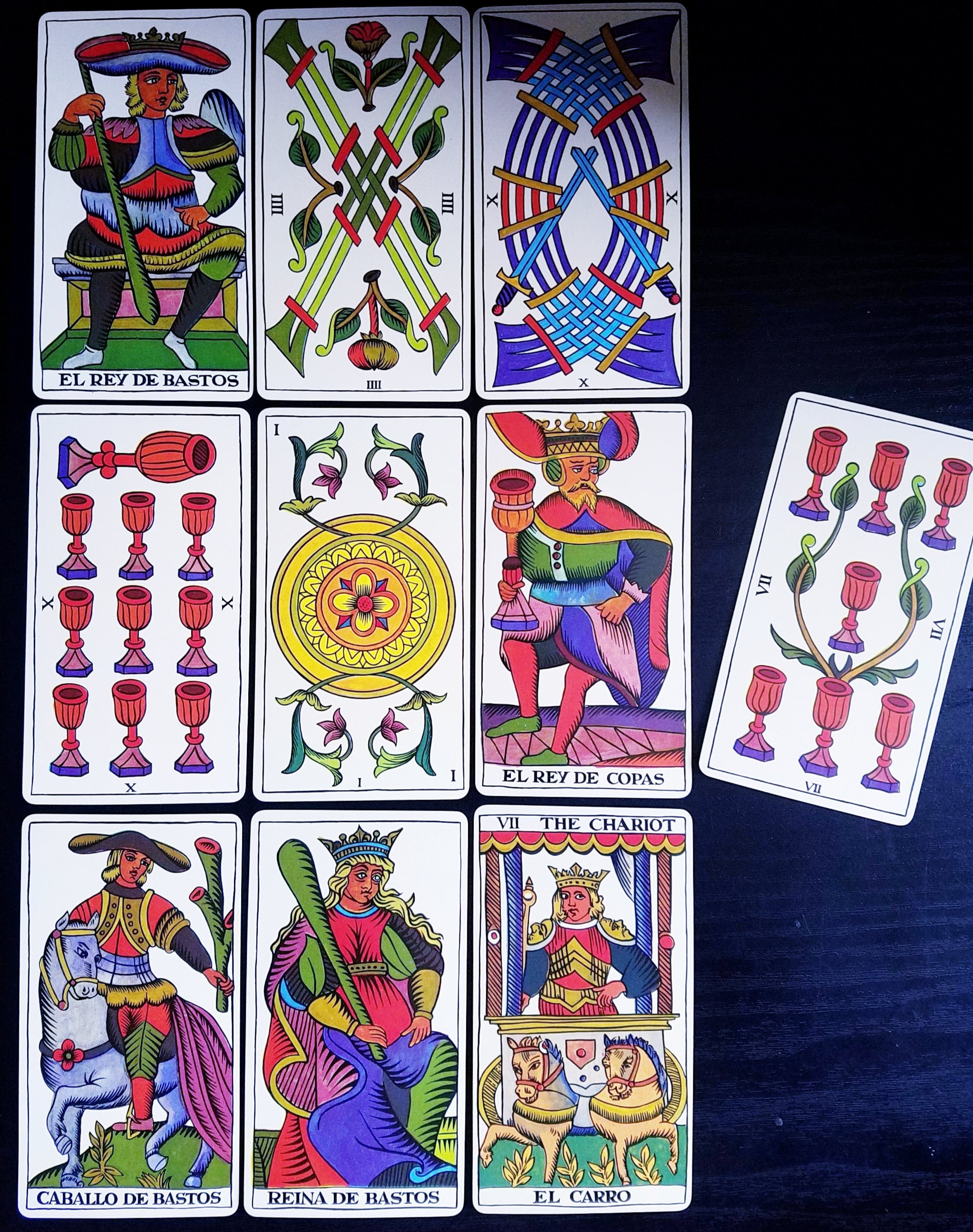
    the spanish tarot fournier tarot de marseille
    The Spanish Tarot published by Heraclio Fournier, Spain.

    A couple ending notes on this spread here, I notice that almost the whole court of batons presented themselves in this reading. A force was and is being exerted here to push boundaries and move beyond what has been established. A collective labour of pruning and clearing what is unnecessary has begun. I emphasize collective because there have always, always been those who have fought against the tyranny of imperialism and colonization, except that most have been squashed into the recesses of memory, lost in the shores of forgetfulness, killed and silenced.

    Now I want to look at something that is simultaneously occurring during the dethronement scandal. On Sunday, one of the major newspapers in the island publishes an article detailing the restructuring the use of land and of the districts, initiating a comprehensive set of land redistribution and zoning changes. This is being done by a Committee set to the task after laws set in place by this same governor in question. The aim is to make land more salable to the right kind of people. The entire project was kept relatively hushed as the public was not overtly notified. As these things go, typically the public is notified of happenings of this nature to allow for around 90 days of input and commentary. Many have already descried this move as disadvantageous to at risk areas, natural reserves, forests, you get the picture. Change the name of a thing and the apprehension of said thing changes along with it. There are always hidden moves in play, things never occur alone, disconnected.

    So why do I say all this? Honestly, my intention is not to get into the ins and outs of the politics in my island. And if you’ve read this far, you’re probably wondering what my point is here. First, I want to sift through my feelings in the middle of the polemic. Second, as this whole upwelling is not occurring in a bubble†, I want to locate agency, my self within the bigger picture. This is the land I returned to, the land that was calling me from way up there in the North where I was enjoying myself. I can certainly move onward with the narrative by deconstructing the words, and what even is this spectacle. But I don’t want to deconstruct here, I want to weave, and thread, and create, and through this creation, enchant. Extracting myself outside of these polemic narratives, I walk this land, I feel the pain of forced changes, of shameful subjugation and destruction. Yet, I also feel the persistence, and perceive the cycles upon cycles of movement. How we participate in created truths in order to keep going.

    In the throes of unrest and disillusion, one must ask one’s self two things. First, is there a desire in me to act/do something about it? If there is desire, the second question is, what is within my power to do? After these questions have been answered, then the task is to begin the weaving. Weaving as enchanting, a way of giving shape and narrative to your story in the middle of the chaos. I cannot stop chaos, I cannot stop destruction, there are insurmountable things I cannot stop. What I can do is act with what I have on hand, what is within my capacity to do. I braid my story with that of this land by looking at the micro, the local level, instead of focusing on the panorama and being shocked by the disclosed and undisclosed hands playing their part on the card table. This should go for all of us. We locate our agency within what we can do at the local level beginning with our selves and our lives as lived immersed in landscape.

    Perhaps all these protests facilitated was movement, like a teapot left too long on the stove, the water needs to spill outward and release. We are the water inside the teapot and this is us as a collective spilling outward our unnamed rages. Yet, me as a person can continue weaving stories of healing, with the land, with the flora and fauna, and with the dead. Even though the me as one doesn’t get to sit at the table where the big boys play, I still have the land, the landscape, and how my self and my body engages at this local level has potential. There is agency and power here with the me as one.

    Further reading along similar (not same) lines:

    ~~~

    †My point of view has its obvious limitations since I am no history scholar, nor am I learned in the nuanced craft of socio-politics. I am only a Puertorrican woman writing from her own experience.

    †That the island was discovered by the Europeans is laughable. As if the island hadn’t already been part of a wide network of indigenous voyaging, while also inhabited by indigenous people.

    †I pulled this card because I wanted to see what the king was looking at which was outside the frame.

    †There are plenty social/political/cultural upheavals going around, both within the US and internationally.

    Mist and Ether Natalia Lee Forty Tarot Divinatrix

  • In a forest of cards

    This summer a series of surreptitious, unexpected, and synchronous happenings unfolded with regards to tarot. Somewhere along the line, late May, I had the inspiration to get my hands on decks that presented/portrayed a different approach to my usual Marseille Tarot and cartomancy preference. Midst attempting to wrap my head around basic astrology I thought I could use tarot to help me along the way. I already had M.M. Meleen’s Tabula Mundi deck, including the decan cards, plus the black and white Hermetic Tarot. Both these decks place a significant emphasis on the planetary, zodiacal, and decanic correspondences within the 78 cards. I turned to C.C. Zain’s The Sacred Tarot whilst also reading Christine Payne Towler’s guidebook to the Tarot of the Holy Light.

    What I began was a search for a coherent system of reading planetary relationships that I could use as an added layer (when I desired to do so) when reading the cards. Upon starting, I immediately realized two main things.

    First, the planetary and zodiacal correspondences in the majors, within esoteric tarot (which is my focus here), have as a central component the Kircher Tree, its ten spheres and its pathways. The Kircher tree itself varies in organization depending on a particular tarot deck’s esoteric leanings. There’s the Golden Dawn from which stem the Rider-Waite-Smith and the Crowley-Harris Thoth. Then there is the continental milieu with Papus, Oswald Wirth, Etteilla, et al. The one point all these systems have in common is that within the framework of the 78 cards, each coheres and weaves a specific network of correspondences that stages inner transformations (mutations/movements) that contextualize the whole. It is self-referential.

    The Tarot is a deduction of the sideral book of Henoch, who is Henochia; it is modelled from the astral wheel of Athor, which is As-taroth, resembling the Indian ot-tara, the polar bear or arc-tura of the north; it is the major force (tarie) upon which is based the solidity (ferrale) of the world and the sideralfirmament of the earth; consequently, like the polar bear, called the chariot of the sun, the chariot of David and of ARTHUR, it is the Greek luck (tuché), the Chinese destiny (tiko), the Egyptian chance (tiki), the fate (tika) of the Romanies; and the stars, as they incessantly revolve round the polar bear, reveal to the earth ostentation and misery, light and shade, heat and cold; whilst from them flow the good and evil, the love and hatred, which form the happiness (ev-tuchié) and the misfortune (dis-tuchié) of men. In truth Sephora is one of the harmonies in that triad s. f. r., which united form the light (Sapher), the number (Sipher), and the word (Sephora) of the Hebrews, from the Sphere of the Universe. From this sphere, the zodiac the book which contains it, the stars the numbers and letters which explain it, the Anaks have drawn their Tara, the Gypsies their Tarot, the Phoenicians their As-tharot, the Egyptians their Athor, and the Hebrews their Thora. –Tarot of the Bohemians, Sacred Texts Archive.

    Moreover, as I mentioned, within these esoteric approaches to the tarot exist variations, a different planetary correspondence here, an elemental variation there, etc. An example of this is found, from my small collection of decks, with the Tarot of the Holy Light, a distinctly continental pack, and the Hermetic Tarot, which arises out of the British esoteric tangent.

    An example:

    Tarot of the Holy Light esoteric Tarot Christine Payne Towler
    Tarot of the Holy Light, black and white edition, A Continental Esoteric Tarot created by Christine Payne-Towler & Michael Dowers, Noreah/Brownfield, 2016.
    The hermetic tarot us games
    The Hermetic Tarot by Godfrey Dowson, published by US Games Systems, 2006.

    The point I want to make here are the different zodiacal and decan correspondences, which in turn change the elemental attributions. If you zoom in a bit you can see the planetary and zodiacal symbols in each of the cards. Tarot of the Holy Light has them all in the lower right hand corner, and The Hermetic has the symbols woven into the art of each card.

    The second, and overarching, revelation, is that what I sought had no concrete answer outside myself. Meaning, there is no one universal approach to astrological correspondences within the tarot. I knew this in principle, but now I apprehended this and understood this in praxis.

    Let’s look, as an example, at C.C. Zain’s The Sacred Tarot.

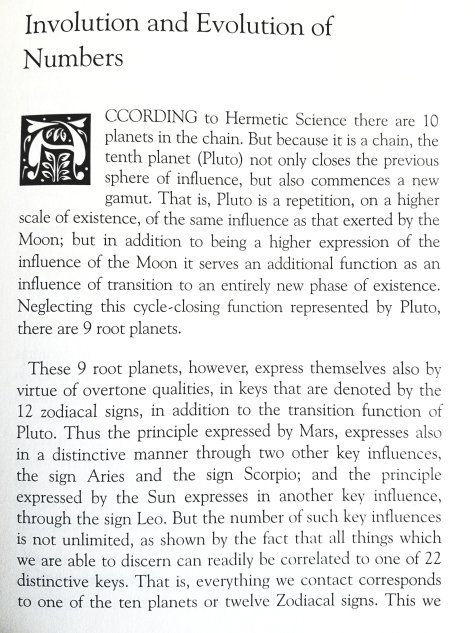
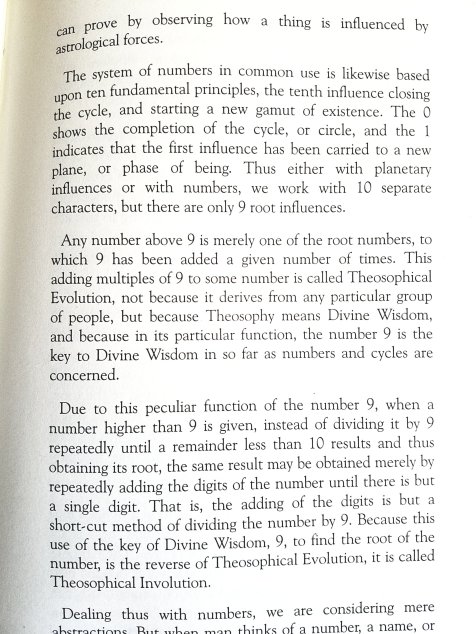
    If you notice the glyphs on top of the picture frame in each of the cards, the astrological correspondences differ significantly from what we in the tarot community are accustomed to working with. Death as Aries? The Emperor as Scorpio? Justice as Capricorn? The Hermit or Sage as Aquarius? They all have interesting points and reasoning behind the why of these associations, nonetheless. With Zain’s approach to the tarot there is an emphasis on the astrological and numerical narrative within the deck. Typically, the majors mirror their related cards, meaning the Chariot as the 7th Arcanum will be related to the 7s in the minors and the Tower will also refer to the Chariot in some way as numerically 1+6=7. The coherence behind Zain’s approach and therefore the Egyptian Tarot, the deck that corresponds with this book is found here:

    The Sacred Tarot CC Zain Brotherhood of Light
    The Sacred Tarot: The Art of Card Reading and The Underlying Spiritual Science, C.C. Zain, Church of Light Press, 2005.
    The Sacred Tarot CC Zain Brotherhood of Light
    The Sacred Tarot: The Art of Card Reading and The Underlying Spiritual Science, C.C. Zain, Church of Light Press, 2005.
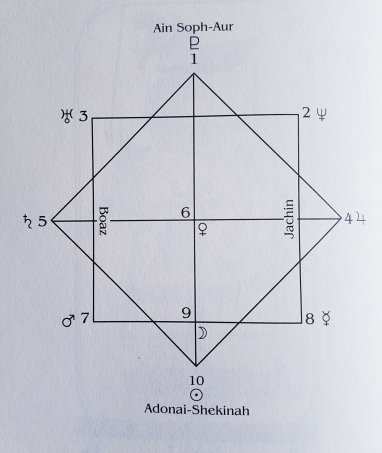
    The Spread of the Kabala, The Sacred Tarot CC Zain
    The Kabala Spread, The Sacred Tarot: The Art of Card Reading and The Underlying Spiritual Science, C.C. Zain, Church of Light Press, 2005.

    Jumping into the minor suits, I find the same quandary of correspondences unfold. The general consensus is to go with elementary associations: wands=fire, cups=water, swords=air, coins=earth. Again, I perceive this is due in part to the particular astrological foundation within the framework of the tarot pack. The minors each have decan attributions, which themselves, due to the sign within which the decan resides, have an elemental and seasonal component. Moreover there is also the inclusion of numerology, as each of the minors correspond to a numbered sphere in the Kircher tree. Variations occur, naturally, as each Tarot pack under the wing of esotericism calls on a specific school of thought•, which vary from place to place. See the Gran Tarot Esoterico or the Crystal Tarot by Elisabetta Trevisan for a divergent take on the minor and major astrological and elemental associations.

    Truth be told, this search I began led to much more than I had originally bargained for, yet it also affirmed for me what I knew in passing only. There are no concrete UNIVERSAL TRUTHS within the Tarot. I sought a tarot deck I could use to understand astrology and the way the planets and signs and even houses interacted. How to verbalize these interactions and see them in images. What I discovered for myself is that if I want a deck that speaks fluidly astrologically, I have to come at it from that angle first, instead of the tarot angle. In other words, I have to learn for myself how the planets and signs and their houses interact and speak, before I land upon a deck that coheres my understanding of these concepts. It is a matter of learning the language of astrology then weaving the language with the tarot.

    Despite my meandering wanderings in this labyrinth of significations, I did come upon very interesting tarot decks. The Gill Tarot came to my attention by chance, through the Reader’s Studio (I was watching recaps). It is a deck with a solid basis on the Kircher Tree, leaning toward the Thoth in the minors. Despite my general lack of interest in the Kabbalah, especially with regards to tarot, this particular deck has an unpretentious air that endeared me, tugging at the sensorial parts of me. The colors pop and move, while the aesthetic is sweet without being silly.

    In my search for different astrological correspondences within tarot decks that resonated with me, I was looking for comparisons and options, my interest in Tarot of the Holy Light was reignited as well. I remember years ago when this deck first came out amidst a flurry of fans. At the time I was curious, but found the deck completely out of my depth, as in, it was more complex than I was willing to dive into at that moment. As the deck resurfaced within my attention, I decided to seize the chance and grabbed a copy (actually two, the black and white and the deluxe color version).

    Additionally, I did a bit of house clean-up. As I pondered on my small deck collection I realized that there is a particular coherence I prefer in my decks, an internal reflexive mirroring, one that is somewhat aligned to the general gist of the esoteric packs, specifically with decks not related to the Tarot de Marseille school. If a deck has an esoteric framework, namely astrological, I prefer it to be solid and overt, functioning as a nexus around which all other factors, such as the art, circumambulate. This creates an overt mirrored narrative within the deck which I like.† This revelation led to a rearrangement within my collection, and I traded a couple decks in favor of others. Another gem uncovered in my search is that I really do love, dearly, Pamela Coleman Smith’s & Waite’s creation, the classic Rider Waite Smith tarot pack. I discovered I loved it more than it’s derivatives, which is somewhat of a surprise for me. I love Pixie’s art, it has a softness and a subtlety akin to the sentiment in the Gill Tarot, which really tugs at my emotional strings. So now, aside from the Centennial Smith Waite tarot pack, I also have The Albano Waite pack in my collection. I’m hoping to add a vintage University Books Rider Waite Smith deck to my collection someday.

    I conclude all this with the assertion that one’s journey of learning with the tarot is never over, there is always more to learn, more to apprehend and understand. Moreover, in the midst of one’s journey there is a point wherein one comes to the conclusion that there is a (minor t) truth one will prefer over others. One which resonates with one’s approach to divining, to reading the cards, and to understanding the images. Curiously enough, as part of Runesoup’s member community, the new upcoming course was just recently decided (through a member voting process), and guess what topic won out? Tarot. Perhaps, my summer exploration was a lead up to this?

    ~~~

    • The Sacred Tarot: The Art of Card Reading and The Underlying Spiritual Science, C.C. Zain, The Church of Light Press, Los Angeles, 2005.
    • Tarot of the Holy Light: A continental Esoteric Tarot Vol. 1, Christine Payne-Towler, illustrated by Michael Dowers, Noreah/Brownfield Press, 2015. Kindle.
    • Brotherhood of Light Egyptian Tarot, designed by Vicki Brewer, created by The Church of Light, US Games Systems, 2009.

    • Lodge within the western magical tradition.

    † For an example of this, see M.M. Meleen’s Tabula Mundi tarot.


    Mist and Ether Natalia Lee Forty Tarot Divinatrix

  • A retreat within

    by

    I wanted to wait until the first week of July passed before posting this month’s augury. I felt there was just too much in the air, the atmosphere was electric, at least over here on my end. Therefore, just as the week is ending I’m here with a quick look at July slinging the fiery Tarot del Fuego.

    Again with the shuffling, I promise I shuffled long and well.

    What does July look like, and what should we pay attention to as the month advances?

    Tarot del Fuego Fournier Tarot decks
    Tarot del Fuego by Ricardo Cavolo published by Naipes Heraclio Fournier, Spain, 2014.

    Let’s look at the first two cards, the ones drawn. Here there is a kindling of an internal fire that harbors us from the lightning descending from above. These four sticks kindling the fire spark life and growth as flowers and leafy greenery blooms upward. While a crowned squirrel lies hidden and protected by four sticks and one straight above. Inside this refuge, flowers bloom in the ground as well. Clearly, this is not about igniting a fire that is spread, sharing our ideas, our spark, our passions freely, noncommittally. This is a retention of our fires, keeping our stimulus in a protected nexus. The emphasis of July will be on this detail, how well can we retain our stimulus against outside influences? How well can we protect and guard our selves and our fire from outside intrusion that seeks to disperse and disorient our focus?

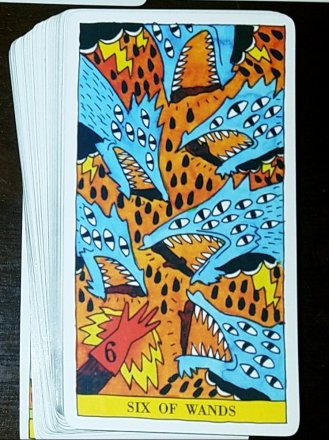
    Tarot del Fuego Fournier tarot deck
    Tarot del Fuego by Ricardo Cavolo published by Naipes Heraclio Fournier, Spain, 2014.

    When I turn over the pack to look at the last card I see that it further reinforces the push to keep contained. Here a fiery hand stands in a maze of many-eyed and sharp-toothed beasts with sticks in their mouths. Is the hand trying to retrieve the sticks? There is a note of chaos as the beasts surround the fiery hand. A sense of hesitation before plunging into the fray. The advice, keep your hand tucked in, keep your focus, keep your center, and most importantly fan the flame within. Don’t spread the flame, don’t overexert yourself. Overexertion will lead to loss of priorities. July is not a month for expansiveness, it is a month for holding in, the deep intake of breathe before August appears.

    Lastly, let’s answer the question of what to pay attention to for July. Pay attention to outside influences that interrupt you and how you are choosing to protect your self this overly frantic month. Moreover, keep a close watch over the retention of clear focus.

    Hope the message, although brief, serves as inspiration for walking through July.

    ~~~

    Mist and Ether Natalia Lee Forty Tarot Divinatrix

  • Encountering the Suits: Heart of Life

    Lectio Divina is a medieval monastic practice embodied as an engaged reading of the Word. It is not analytical, and it does not employ the mind in discourse under prescribed limits, inquiries, and notions. It is an engagement with the word through contemplation, experience, sensation and meditation.

    Lectio Divina is a feasting on the Word. First, the taking of a bite (read); then chewing on it (meditate); savoring its essence (pray) and, finally, “digesting” it and making it a part of the body (contemplate). -Gervase Holdaway, The Oblate Life

    Image from Pixabay.

    Cups are a suit of engaging the non-discursive. It is one of feeling, of moving with currents other than the analytical, other than with the head.

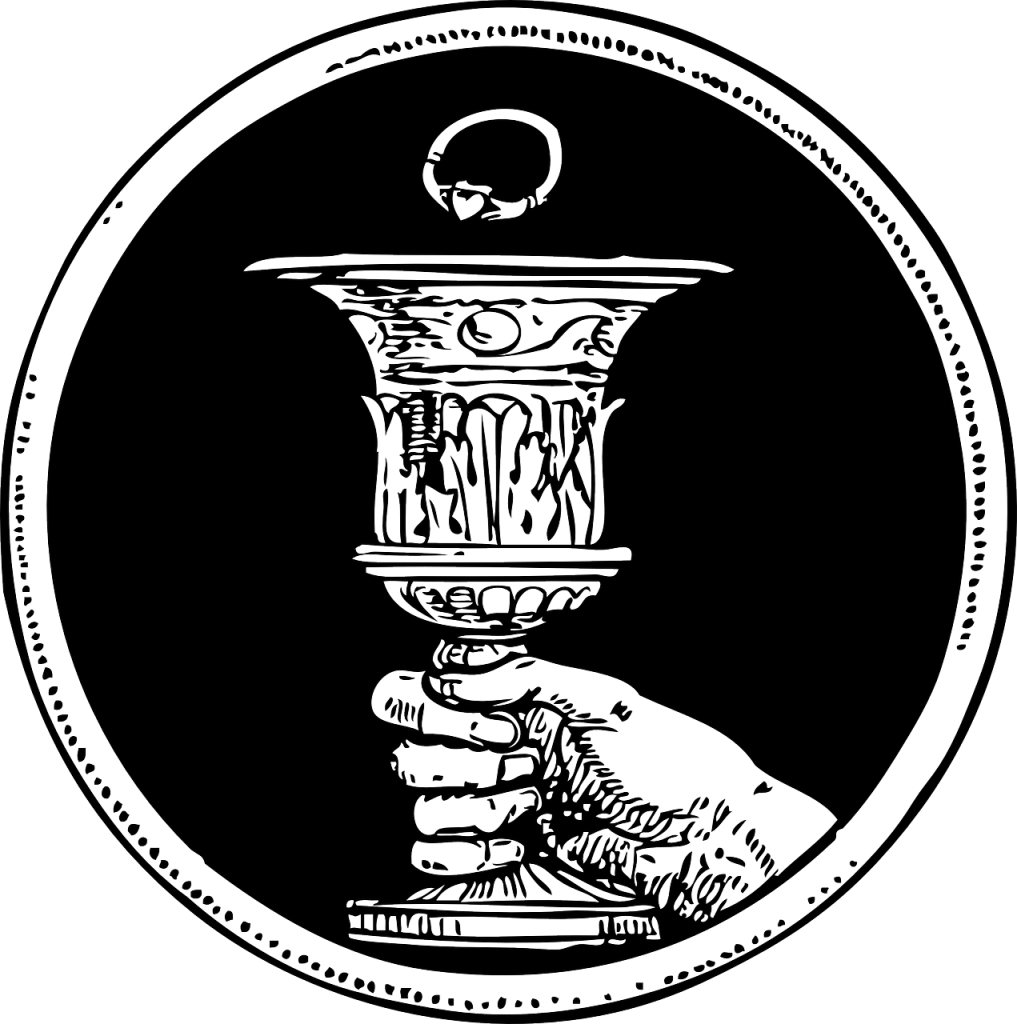
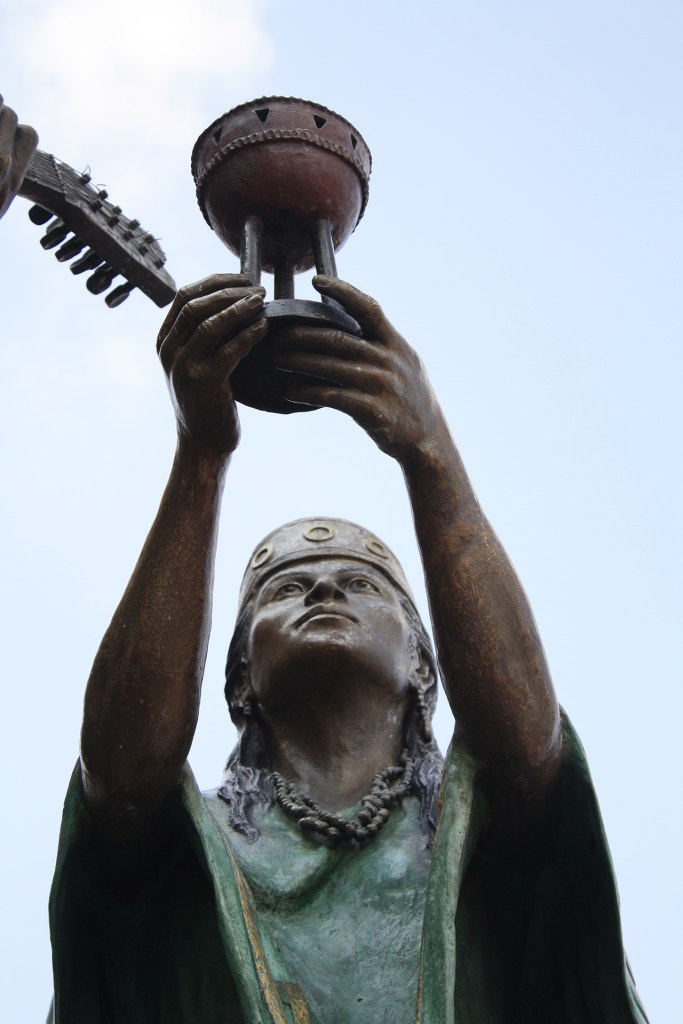
    With cups we drink, we share, we satiate, on occasions in excess. They also come in all shapes and sizes, from tumblers, long and pillar shaped, to coffee cups with a handle. There are also glasses for different liquors. The cup concerned with here is more of a chalice. Maybe even a sacred cup, considering how ornate and stately it stands upon an elaborate base and body, while the top features turrets reminiscent of a cathedral. The communion chalice perhaps?

    mexico Queretaro offering cup
    Image by Senlay from Pixabay

    In this cup is invested our desires, hopes, and feelings, like tendrils weaving together, proliferating from one cup to the next, and in doing so entwining our hearts and emotions. A cup is a cup, but it is also how we feel about things, how we experience with our heart and our body, our skin. It is about the sensory experience. Feeling here is nuanced, emphasizing that which moves our heart and our body. Cups hold liquid we ingest in, or pour out. Cups are also shared, or indulged in solitary. Like the interweaving vines moving through each of the cards in this suit, cups weave our lives and hearts together, sometimes in excess stimulating the growth of poison. More often slowly, with the rhythm of water, taking its time with steady consistency nurturing our homes, symbolic, corporeal, and spiritual.

    From the beginning, one is the blessing, and the home. Two is the communion and the coming together in like heart. With three and four there is the birth of life that establishes the foundation. Five is the heart, the center of pleasure and sensuality. Attending to the center and what presides over the moment. Six is the flowing river, onward we go toward new paths ahead. Seven is the unexpected, secrets bubbling from the depths that confront our movement forward. Eight is the gossip, the chatter, words in excess that proliferate and colonize our feelings and our engagement with others. Nine is the key that unlocks what is sought, the loosening of what was tightly bound, the opening. Nines are a threshold we cross. Tens are the end and beginning in one. The spilled cup that can hold no more, over-satiation, drunkenness, excess.

    The suit of cups Marseille Tarot the pips minors
    The Spanish Tarot published by Heraclio Fournier, Spain.

    This suit contextualizes our heart’s and body’s engagement vis à vis the other. It is close to our body just as we hold a cup close to our self, a mark of proximity. Since cups are also shared, and offered, they suggest relational aspects. How we relate to others, and how our bodies relate and feel about others?

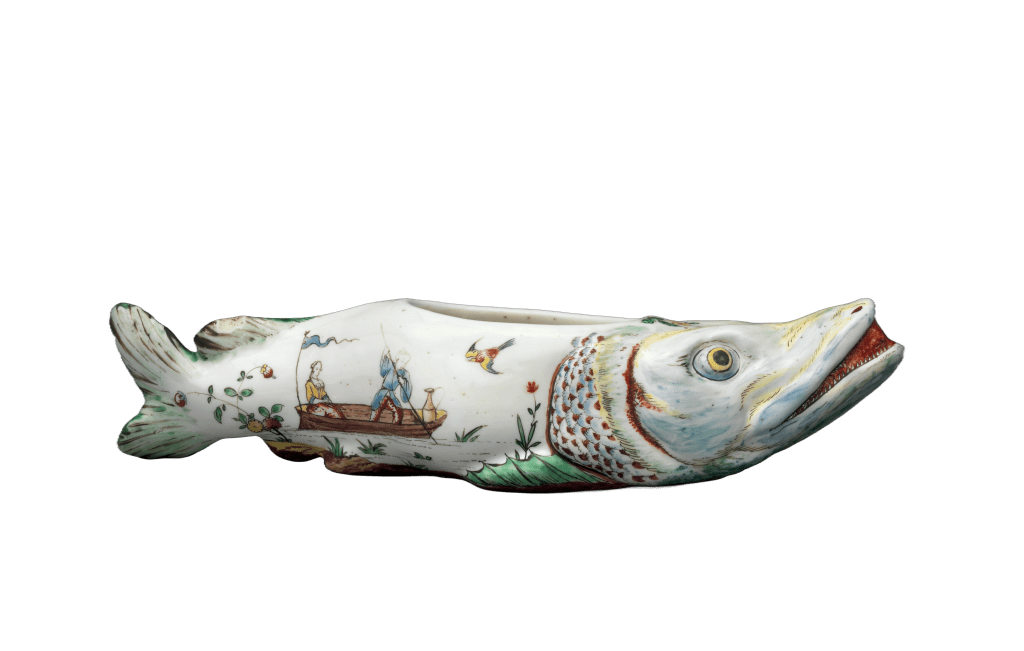
    Re-taking the aspect of liquid, one can extend this to be subsumed in Water, along with all the connotations ascribed to Water/water. Water as the river of life, as the blood that courses through our veins, lubricating, and water as that which nourishes and cleanses. Just like water, flowing onward on the path, traversing rocks, boulders, fallen trees and the numerous obstacles in its way, continual movement. This suit moves in like form through openings, consistent even if slow at times. The focus here is on what the cup holds and how that element moves in the world, water.*

    river flow water body of water current
    Image by JosepMonter from Pixabay.

    When thinking of the object that holds the water, the cup, one enters the territory of receptivity, because the shape of the cup receives what is put into it. It is concave, hollow, holding what is put inside. Herein secrets lie, the dark, and the hidden connoting the occulted. This receptivity has its limits, until it is spread throughout other cups, creating a dynamic narrative of inward and outward movement.

    Clearly, to give this suit the sacred definition of the grail is an easy jump to make. This suit is both profane and sacred, close to the body and pleasure, while also rising beyond the everyday into the divine. It can hold both the liquid of communion with spirit, just as it can also carry muddy profane water, impenetrable, murky, and dubious. It is open and willing, just as much as it occults within its depths. On a more mundane note, this suit also indicates family, familial bonds and dynamics. Perhaps because of the allusion to blood with the communion cup.

    To mirror one of the 21 Trumps…

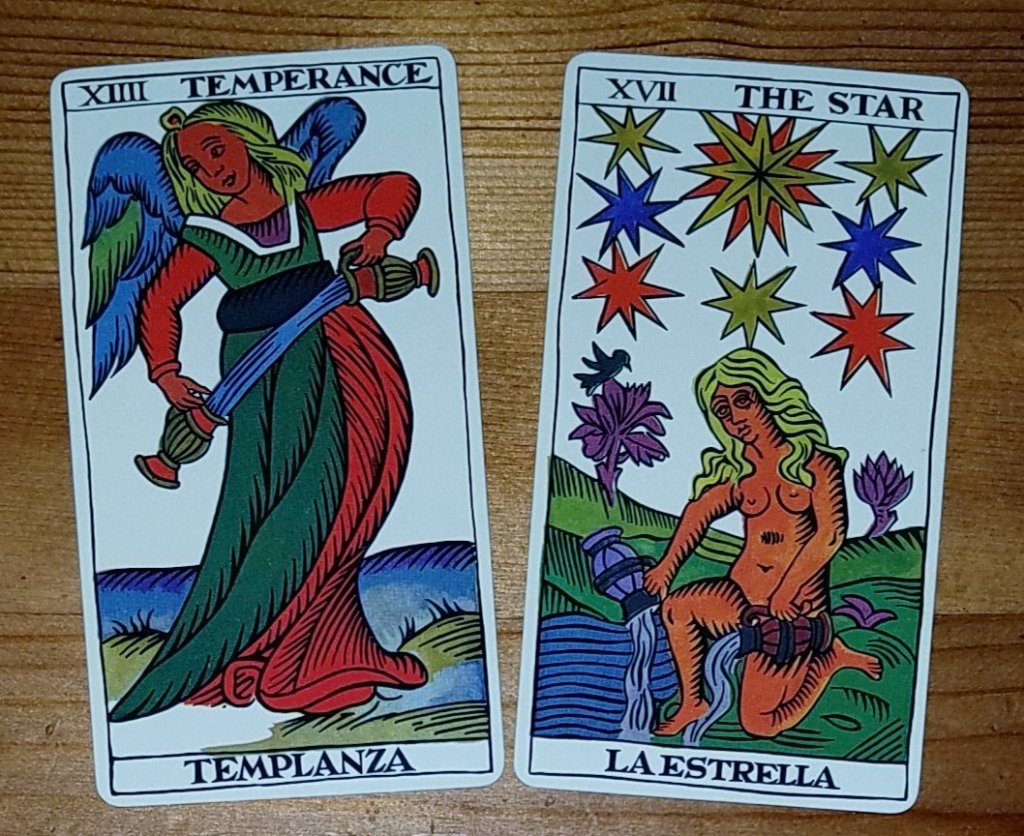
    Temperance The Star Major Arcana Tarot
    The Spanish Tarot published by Heraclio Fournier, Spain.

    How to condense such a subtle suit to one trump? Containing both the sacred and the profane, that which is beyond and that which is close. Different modalities of being and experiencing require differing approaches. From one spectrum, Temperance rises with her two pails, pouring and mixing, getting the recipe right. Moving, displacing, refining the flavor, and balancing.Temperance moderates the right mixture of experience from her high vantage point.

    Conversely, The Star with her two pails spills out its contents, letting the water intermix with the moving river and the verdant soil. Close to the ground, bare, she furthers what Temperance began. The journey of experience here is one of refinement with the body engaging in the process. This is the alchemy of the body and the heart in conversation.

    Like The Star, the suit of cups is distinguished by vulnerability and sensibility. As is often mentioned, the Ace of Cups is the Holy Grail, that which is sought with vigor and zeal. It is this same Holy Grail that contextualizes our desires, and our wants. Demanding we ask ourselves, how far will we go for that which we desire? Yet Temperance and the Star together reveal that this is no blinding drive, on the contrary, there is tempering in the experience, for she is naked, bare, yet wants for nothing, instead pouring out. Just so, this suit plays an alchemical game between desire and non-desire. Mixing one with the other, seeking the perfection of both in the admixture.

    Whether one cup or too many, this suit will always challenge us in a game of love and desire.

    Bringing all this full circle, I want to refer back to the monastic art of Lectio Divina, the embodied experience of the Word. It is a hearing of the divine that is felt with the body, and with the heart. Wherein meaning is a continual enunciation that reverberates from within and without, spinning a tapestry of boundless color. This is the singular quality of the suit of cups.

    ~~~

    ∆ If you’re catching this post/series midway, Animating the Tarot Pips, the introduction along with a master list (with links) of the installments can be found here.

    Lectio Divina: Divine Reading, The Online Guide to St. Benedict, http://www.e-benedictine.com/lectio-divina/. 1994-2016.

    * Water subsuming all liquids ingested and not ingested, sea water, river water, well water, wine and diverse liquors, coffee, etc.

    Mist and Aether La Maga Etsy mist and ether
    Creative Commons License


    Animating The Tarot Pips by Natalia L Forty is licensed under a Creative Commons Attribution-NonCommercial-NoDerivatives 4.0 International License.
    Based on a work at mistandether.wordpress.com.