“Cartomancy, or the divination through playing cards, is more modern, for cards were only invented after Charles V. This branch of the conjectural sciences, still today practiced by many people, and sincerely accredited by many more, is the great resource of lovesick girls, using it out of jealousy, suspicion and longing for the object of their affections. Cartomancy is practiced with thirty-two cards, or with a deck of seventy-eight. Today, among us, the forty card deck will be used, with each card meaning one of the things we will thus expose.”
Crossed Cartomancy, alternately Cyprianic Cartomancy, is fortunetelling with playing cards but with a specific number of cards and approach. I have created this overview of the art blending the cartomancy sections found in the inimitable tome, The Book of St. Cyprian: The Sorcerer’s Treasure translated and with commentary by José Leitão, published by Hadean Press. While also taking into account Jake Stratton-Kent’s contribution, “‘Seven Years The Sea Thou Roamed‘: Cyprianic Ritual and Divination.” Let’s jump right in…
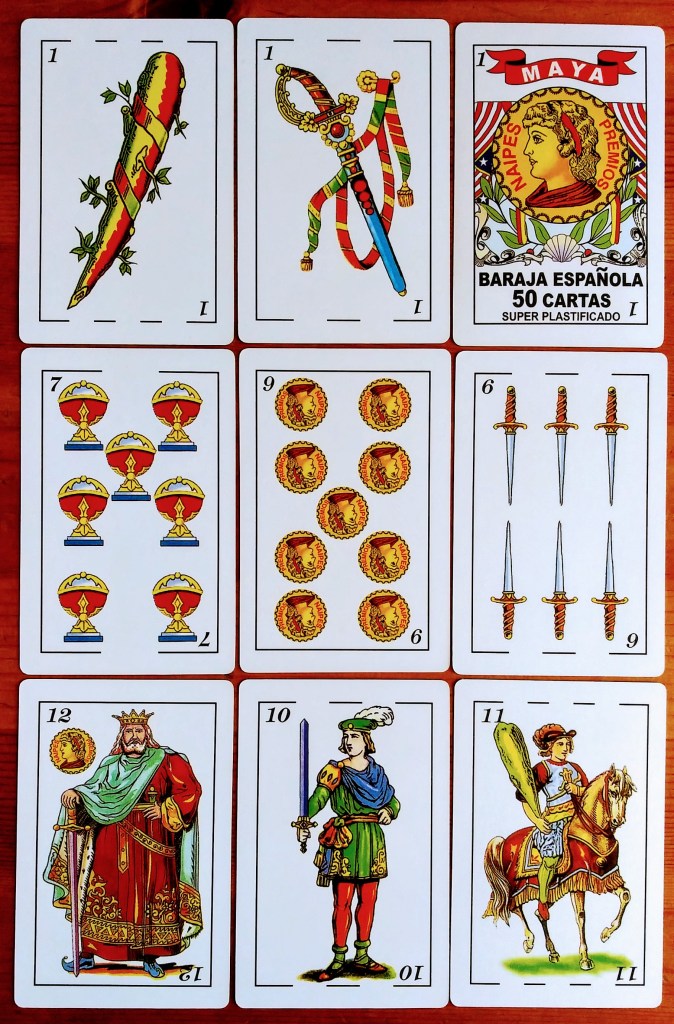
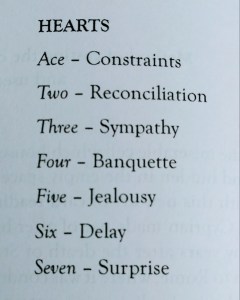
There are four cartomancy sections in The Book•, with the first having a marked voice, derisive yet playful. It has a brief introduction on divination as the millennial science, of the ages. Then a list of the signification of each of the cards is given. This section cohesively mirrors the last cartomancy section in the book, titled Crossed Cartomancy, which is the most comprehensive overview of the technique. The other two sections in between are brief and generally cohesive with the whole technique. Divination with playing cards as experienced in The Book, has a distinct framework. First, each card has a specific meaning. Examples: Ace of Diamonds is a gift, Two of Diamonds is soon, Three of Diamonds, with joy. From another angle, Ace of Clubs is by night, the Two of Clubs, through long paths, Three of Clubs, through fast paths. Another take is, Ace of Diamonds is a promise, Two, marriage, Three, cuddles of love; Ace of Clubs, vice, Two, treason, Three, disorder. This isn’t exactly unique, but when the system is taken into account as a whole, it feels so. Second, the pips used within the 40 card structure follow the Spanish decks, Ace-7 then the Knave, Knight, and King, with the exception that the deck used has the French suits, which substitutes the Knight for the Queen. I found this curious, as The Book is Iberian, yet the cards used in the cartomancy sections are the ones with the French suits. I would have thought la baraja Española, the Iberian line of playing cards, would be front and center.
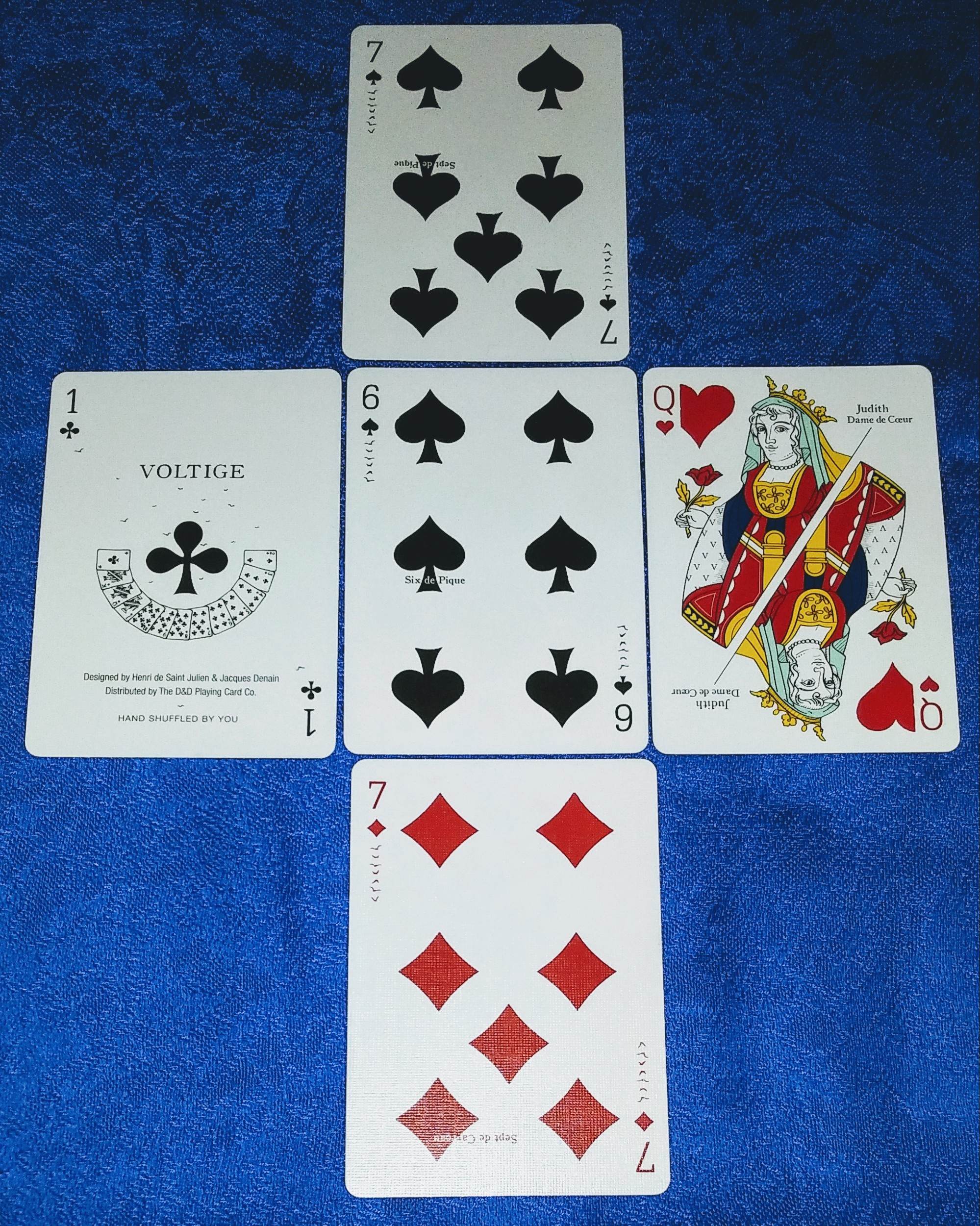
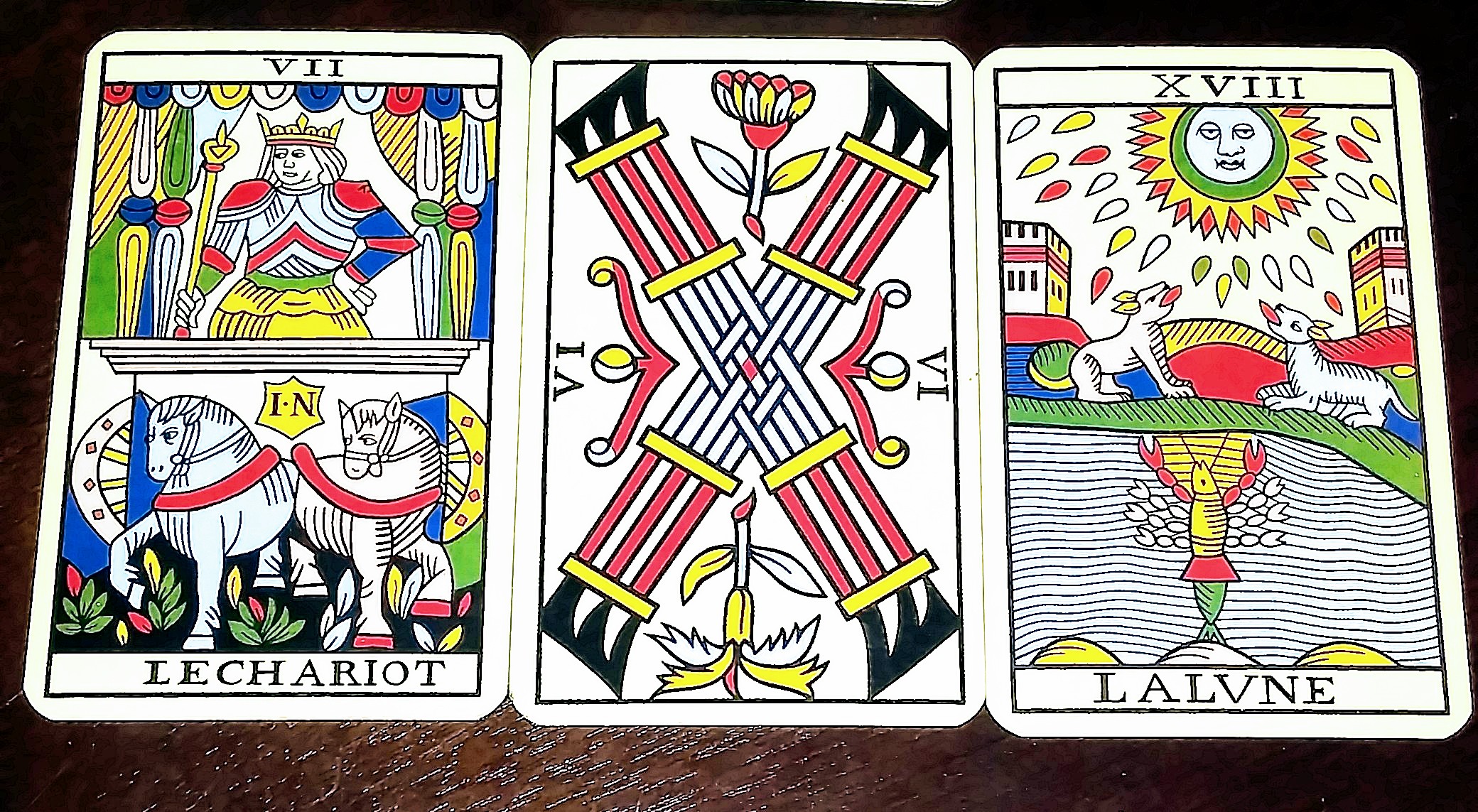
With the ending card in each suit being the seven, the progression is clearly shortened. Giving the last card, the seven, a quality of closure, or endings. But this isn’t too far a stretch as it can be easily worked with. Moreover the 7s and the Aces have the special quality of being considered Temptations, and these are held separate from the rest of the cards when shuffled and laid out on the table. As mentioned, each pip card has a precise signification, which as Jake Stratton-Kent states in his essay, “Closely resembles ‘text generation’; in a similar manner to cut-ups and other such devices. […] The form it takes here bears all the signs of practical use one associates with folk-level Cyprianic works” (166, Cypriana). As each card has a specific word or action attached to it, in reading them together one forms sentences. This creates a system aptly suited for answers that respond to specific questions, and also, one that is unique for prediction. An example:
Now let’s explore how the Saint came upon these methods, the consecration of the deck, and the historiola or orison to be said while divining.
Let’s begin with a story.†
Saint Cyprian, having come into the grace and power of Christ, finds himself far from loved ones, in the middle of the sea in exile. A lonely man, longing for news of home. He soon realizes, and laments, that he doesn’t have a way of knowing about the state of his loved ones, of disclosing how they are, especially now that he has put aside the cunnings of Lucifer. After much pondering and meditation on the matter, night arrives, and the Good Saint falls asleep. Then, an Angel of the Lord appears to him as in a dream, questioning his faith in doubting the power of God as “illuminator”, ruler of all, and knower of all. When he awakes, pleased and reassured with the encounter, a sudden insight dawns on him. Instead of divining under the auspices of Lucifer, he will divine under the auspices of Jesus. He then, “Endowed the cards with great virtues, so as they could divine all that he desired” (63, The Book of Saint Cyprian). The years passed, as did the Saint’s martyrdom, and in a cold little cell, his last residence in life, was discovered a manuscript which held all the secrets to divining with the cards, holding the title of Crossed Cartomancy. Who discovered this black tome is not known, but what is known is that it was taken to Rome, where it was hidden until, with the passing of years, the manuscript resurfaced. This time under a cloud of fear, as its effectiveness was discovered to be astounding. It was condemned to be burned, and would have suffered such foul fate had it not been for the hand of the Saint, now beyond death, intervening in the matter. With holy and Cyprianic Inspiration, the one in charge of destroying the tome replaced it for another, which he threw into the fire instead before all to witness. In this way, the manuscript moved, hidden, from hand to hand, landing in the library of Rome. One day, a man from the Iberian peninsula visited the Holy City and was allowed access to the library. There, he came upon the manuscript, and again, in Holy Inspiration, copied its contents. This fellow took what he copied with him, outside of Rome, outside of Italy, and from there the black tome passed many hands and many eyes, hidden yet seen.
Consecration. The recurring pattern in all the sections is that the cards are to be consecrated by sea. One states: “The deck should have been passed by the waves of the sea, at midday on a Friday, while uttering at that time the following words: ‘May the celestial spirits give thee the virtue’” (135). Another part illustrates how the Saint himself, “took the deck of cards and passed them one by one, in seven basins of holy water, each one from its own church. Next he passed them through the waves of the sea, wrapped seven times so as not to get them wet” (63, emphasis mine). Consecration by waters is the key here, as holy water and the sea mediates and cleanses the cards, and I would add even endows the cards with deeper virtues. The cards are woven with these waters, blessed by the waters, both the Holy and the all (the expanse, the Great Mother†) that is the Sea. In this way the cards enter into harmony with these points of power.
Words. The historiola, and the orisons given in each of the sections vary. The uniting thread is that each states the power and virtues of St. Cyprian, just as he himself is the first to devise this method of cartomancy, so we take up his mantle and continue his tradition and way of reading the cards. The diviner, in the act of divining, is a continuation of St. Cyprian’s work, as the cards are blessed and the prayers breathed into life, spoken. Here is an orison, “May these cards, by the power of St. Cyprian, now a saint and previously a sorcerer, tell me the truth, for the glory of this same saint and the satisfaction of my soul” (138). Others recall St. Cyprian as the wanderer in the sea, far from home, searching for truth and finding it in the cards. What Jake Stratton-Kent says on this is pertinent, “With this mythic precedent the historiola implies that the truth the diviner seeks will be found; indeed a historiola is a form of magical leverage, assuring results” (166, Cypriana). I would add that the prayers and stories are a way for the diviner to enter into the narrative with the Saint, to partake of the Saint’s virtues, and of his art in divining with the cards. Moreover, the praxis underscoring Crossed Cartomancy or Cyprianic Cartomancy is a way of weaving one’s self into the story with the Saint, of enfolding oneself in the landscape with the cards, under the Saint’s auspices. In this way, the cards will speak truth, just as they did for the Saint.
Another indispensable act is crossing the cards and oneself while saying the orison, and when cutting the deck. This will come into play more fully as the cards are cut and spread in the same cross pattern.
Reading the cards. The pack of 40 cards is divided between the temptations (which I mentioned are the 7s and the Aces), and the rest of the deck, the 2s-6s along with the courts. There is a specific manner of approaching the courts, which relies on the question. The Queen and King of Diamonds, the querent and the object of their affection or lover, the Jack of Hearts and the Jack of Spades are kept. One jack represents an intermediary and the other is a rival, respectively. The rest of the courts are removed from the deck. This is another curious detail, as the example spread given in The Book itself includes a King of Clubs. Which directly contradicts the rule of keeping only those 4 courts. I find removing most of the courts reductive and limiting in scope. For me, I remove this rule and keep all the courts in the pack.
The temptations are shuffled and placed in the center, all eight cards, face down. The rest of the pack is shuffled and cut, saying an opening orison:
“May these cards, by the power of St. Cyprian, now a saint and previously a sorcerer, tell me the truth, for the glory of this same saint and the satisfaction of my soul.”
The cards are then laid in a cross pattern. At the same time, the reader crosses him or her self and the cards as well, with the words “St. Cyprian with me.” Each word corresponding with a direction when crossing one self and the cards. St. corresponds with the top or the head, Cyprian with the center of the chest, with with the left side, me with the right side.
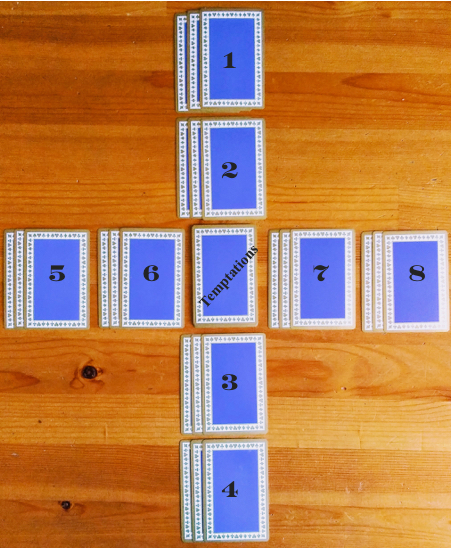
If the book is followed, there will be three cards in each position, with the 8 temptations in the center. When the first question is asked only the top card in each pile is turned over, along with one temptation. A follow up question would require turning over the following card in each pile. The last card turned will always be the temptation. After being laid out in like manner, with the orisons and the hand gestures, the cards are turned over in the following order:

At this point it gets a little unclear in all the sections. There are no specifics as to how the cards are to be read, if in line or not. As this is Crossed Cartomancy, my approach is in reading the cards exactly how they’re turned over, the cards that mirror each other are read in tandem. In other words, 1+2, 3+4, 5+6, etc., moving inward in the same order. In this way, the crossed emphasis is not only on the layout but also in the manner the cards are read. The temptations are the last cards to be read, and again, it is unclear as to their nature, the cards do have given values or significations, but what makes them a temptation is unclear. As they are in the center and will either be an Ace or a 7, I see these cards as being the closing word, or the final outcome, of the entire reading. Temptations can also be considered the heart of the matter.
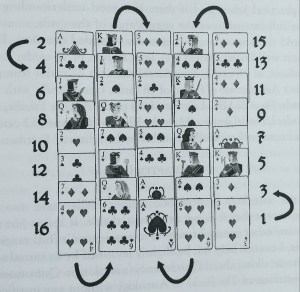
Difference. In another section of the book, the cards are laid out in the same way but instead of there being eight piles, two in each of the four directions, there are four, one pile in each direction. The center remains as the temptation. There is also a reference to a full 40 card tableau. The whole pack is laid out here in five columns, with eight rows. The central pillar or column is sometimes called a novelty. This happens when there are no courts in this column. When a novelty occurs, the querent gets to ask an additional related question. Here it gets tricky as the rest of the cards are then picked up and reshuffled, saying the orisons, 21 are placed directly on top of the pillar, which remains unmoved, and then the remaining eight cards are spread in a cross, each hand having two cards. You will be left with three cards in your hands, these three will answer the additional question. There is no explanation as to why the elaborate process, but I think it has to do with the numbers. Rather, the meaning of the numbers in relation to the shape that is being used in the spread. The tableau is also read in the same mirroring way, as pictured in José Leitão’s commentary.
There are good bones here that can be played with if the method and approach is followed.
- Purchase or find a playing card deck.
- remove all the 8s-10s.
- Consecrate with orisons and by taking the cards to the sea. The Book mentions that St. Cyprian wrapped the deck 7 times so as not to get them wet, so you could get creative as to how and with what you can wrap the pack 7 times to avoid getting them wet. The importance lies in that the cards meet the sea. And don’t forget the Holy Water.
- Separate the Aces and the 7s from the rest of the pack. Shuffle, and place in the center.
- Shuffle the rest of the cards, intoning the St. Cyprian orison.
- Spread the cards in a cross pattern, cross your self and the cards.
- Turn the cards over and read them in mirrored pairs, the same way you crossed the spread and your self. The last card read being the center, or the temptation.
As this has turned out to be much longer than I anticipated, I will give example Crossed Cartomancy readings in a follow up post, along with ending commentaries on the whole.
~~~
• Whenever The Book of St. Cyprian: The Sorcerer’s Treasure is referred, the text will read as follows: The Book.
† This story on St. Cyprian is a mélange or a co-mingling of the different stories given in the cartomancy sections of the book, along with my own bits added in.
† The Sea as the Great Mother, from whence all life arises. The cauldron of life.
~ The Book of St. Cyprian: The Sorcerer’s Treasure, translated and with commentaries by José Leitão, Hadean Press, 2014.
~ Jake Stratton-Kent, “‘Seven Years The Sea Thou Roamed‘: Cyprianic Ritual and Divination,” Cypriana Old World, edited by Alexander Cummins, Jesse Hathaway, and Jennifer Zahrt, Rubedo Press, 2016.








 Natalia Lee