A little while back, I was asked a question regarding reading the cards, why I read and what I’m doing as I read. This is something I don’t give much thought to when I pick up the cards, but it was interesting to have to put into words where my perspective sits with these questions. My response I find is closely tied to my whole view of life, of living and being and moving in the world. Closely tied to what began some years ago as the blog was still in its nascent stage, and it is my approach to living in the moment, in the present, in awareness. It began as a learning, an adjustment, to slip into the moment, to keep myself present, not extending my thoughts and whatever emotions born out of them beyond my present. Now as some years have passed this is still my engagement with being and living. Embodying my self within the land, within the landscape my body inhabits, and keeping my focus and attention in place, and aware.
When I read the cards, I read them with all this bundled in the reading. I or the querent has a question, I shuffle the cards, cut, lay a handful on the table, and put into words what I see with my eyes the cards are articulating about the question. The question itself is a thing of the moment, containing the context of place and time. Hence it is a matter of slipping within and amidst a particular landscape. The cards disclose relations, the flux and flow of connections, and tensions. This is the foundation of my approach, and why a question is vital. A question establishes the place, the tone, the context. Secondly, I choose to shed idealizations of symbolic, subjective conjectures around semiotics. Simply put, I look and speak, weaving together where the dynamics of the laid out cards and the question meet, in answer.
Reading the cards, or divining, is for me a way of clarifying the lay of the land. Elucidating the often veiled landscape where the question (and by extension, not necessarily always covered in a reading, the querent) is situated, hence trapping the answer.
When I began writing my auguries a couple years back, there were several motives in play. I wanted a space for exploring the decks I own consistently, getting to know the language of each, while also playing with words, sight, and the cards themselves, stitching all these together to form omens. My auguries might bend toward the lyrical because my inclination is for poetry.
If you’ve stopped by here before or do so once in a while, and liked what my monthly auguries bring to the table, I’m indulging in this bit of conversation for you, wanting to share what I do with the cards and why. There are extensions or rather more involved dynamics that come into play during a reading one on one with a querent. These dynamics complex-ify what begins with a slipping into the lay of the land, covering more terrain as the conversation develops with the cards and the questions (often preoccupations) the querent brings to me as the reader.
What I do with my auguries is a slight slippage within the lay of the land, peeking into whatever changes loom ahead. It is not meant to be precise, it is meant to set a tone to the month ahead, a tone that the reader then harmonizes with other subjective tones in their own lives.
This month there was no augury, as I found myself still adjusting after my time traveling and away from home. And now I’m gearing to move, which is daunting as it will be during the holiday season. Despite feeling all manner of fluctuations at the moment, with changes afoot and preparations underway, I foresee getting back to monthly auguries for December to usher in the new year. Before I close, I’d like to share an exciting project taking shape.
The Cult of Tarot Form is running a collaborative tarot project, a tarot deck created by different members of the community. It is currently midway in its kickstarter campaign, and as a contributor to the deck and member of the forum myself (my cards for the deck are The Star and The Hermit), I would like to share the project here: Button Soup Tarot.
This month’s augury is coming into play a bit later than expected, as I’ve found myself with lots on my plate. So here, 11 days into October, is the omen.
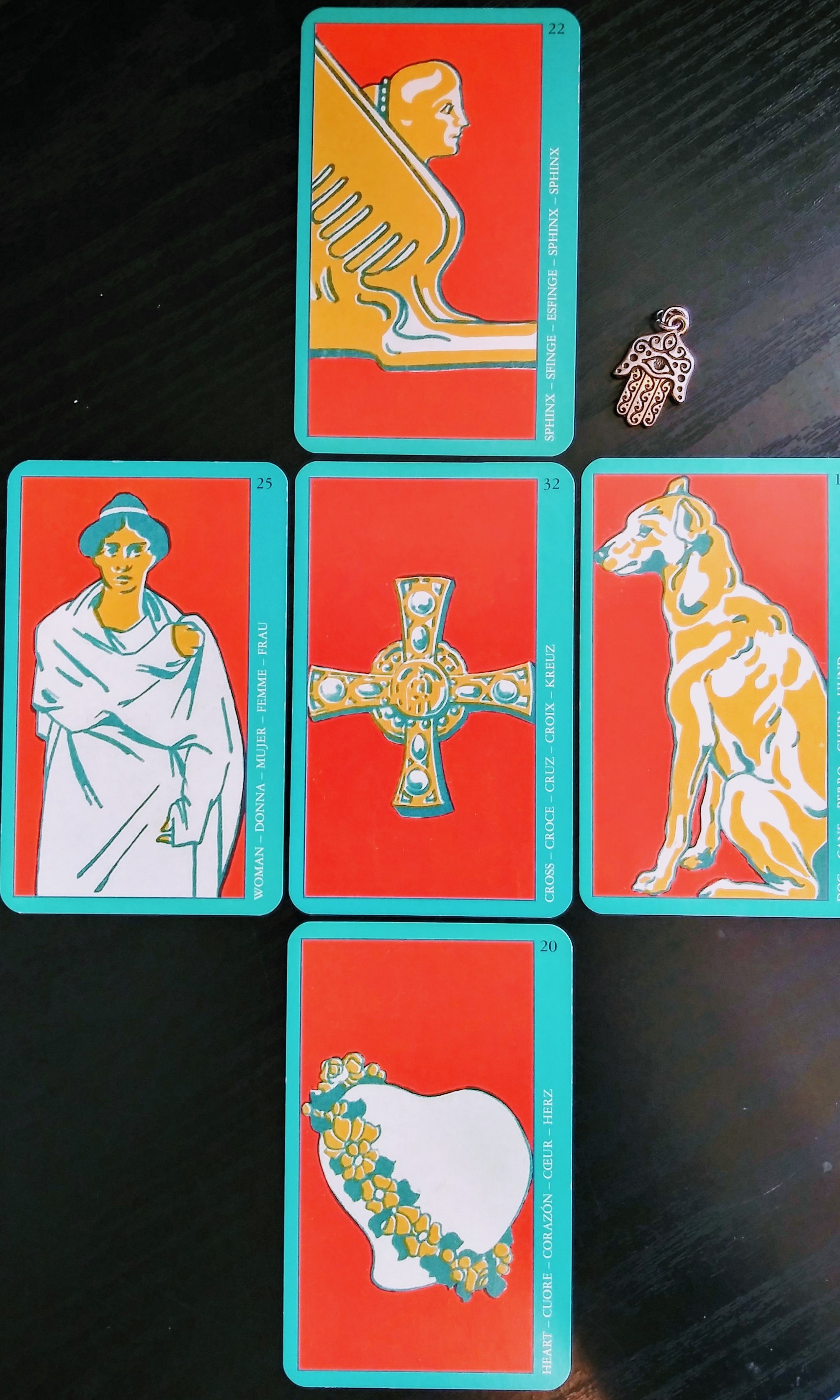
Oracle de Fatima, published by Lo Scarabeo, Torino, Italy. 2004.
Tangled hearts in riddled messages of crossed desires stay the course. October is an interesting month for matters near and dear. We find ourselves still persisting in untangling the depths of what we want, and where we want to apply our selves. (Isn’t this always the case?). This insistent doggedness in our attempts might prove quite the cross to bear, as some enigmas and depths are better left to their rhythms. In time perhaps what was undisclosed will be revealed. On the other hand, some aspects of these deep dives might prove fortuitous as we persist in our delving. The key here is to discern how to apply our efforts, to what degree and strength, and for how long, lest we get lost along the way bearing a heavier cross than intended. This month is shaping out to be one for orientating the self in relation to exertion and flow. What we need to let rest and what we need to inquire further into, this is especially the case with matters close to us, of the home and of the heart. Moreover, it is not just about letting rest or exerting over certain areas in our lives, but about situating ourselves vis à vis what we want to attend to, re-orienting our focus as well.
~
I would like to add that I have an unexpected trip coming up which will keep me away from home and busier than anticipated. Because of this, October might be quiet around here. I am moving the next installment of my Animating the Tarot Pips series for November. I also have a couple reviews in the works which will hopefully be shared toward the end of October beginning November. Lastly, I realize I’ve been doing my auguries for some time now, and for those of you that follow them, or those that are new in following, you might be wondering what I mean with them and who my intended audience is (the querent, in others words), perhaps even what are the dynamics in play when I’m slinging the cards for these auguries. As this is a question that was recently posed to me, I want to share my thoughts around this, and by extension divination. Why I do what I do, and where I’m coming from. This will be the topic of my next post.
A couple weeks back I was interviewed by the Greg Carlwood of The Higherside Chats. This has been an enlightening and freeing experience for me as I had never been interviewed before. We chatted about spiritism, Puerto Rico, and a little about the cards. If you’ve ever wondered what kind of magical doings I get up to, especially here in Puerto Rico, and also about me and where I come from, give the interview a listen. Greg is an excellent host. Click on the image below to go directly to the site and listen.
An additional note: Greg mentioned videos from someone that I had recommended he watch for context, it is the youtube video channel of Sancista Brujo Luis. He is an excellent resource on all things Folk Caribbean Spiritism. I highly recommend his channel, which can be found here.
Also, if you prefer the youtube version of the podcast, here is the link: THC.
Jumping back into the fray of Cyprianic cartomancy, I’m now going to survey several approaches to the method.
The main, or recurring, spread used in The Book is the cross pattern, as illustrated in the first part, which can be read here. It is with this one that I will stay. Moreover, for three examples I will keep the temptations within the pack, shuffling them along with the other cards, and the last one will be a reading with the temptations kept separate.
Let us pretend Brenda has walked into the cartomantic parlor, and sits before the fortuneteller in a bewildered state of anxiety, immediately launching into her conundrum. “I’m having problems in my relationship, my my husband of 12 years doesn’t want to open up to me any more and keeps pushing me out. What’s going on?” The fortuneteller begins shuffling the cards calling on St. Cyprian as she crosses herself and the cards. Then cutting the deck, she proceeds to lay the cards out.
Vintage Tiffany & Co. blue and red Playing Cards, New York.
The response: “What is keeping your lover tied to you is a bed contract, as in the compromise the relationship holds over him. He looks with longing at improving his fortune, despite the stakes this might impinge on your bond. Two disparate focuses are playing out here, and because of this division your relationship is sick, not doing well. You want love from a man, and in a relationship that is no longer giving love, while your partner seeks only his fortune and career advancement. What this dynamic causes is delays in understanding and in companionship.”
The keywords in this reading are strung together and woven to form the answer to Brenda’s question. Now let’s see what it looks like to read the cards without the keywords.
Mark walks into the parlor, and in a calm air sits before the fortuneteller. He asks, “I’ve been getting to know this person for some weeks now, is this person the one?”
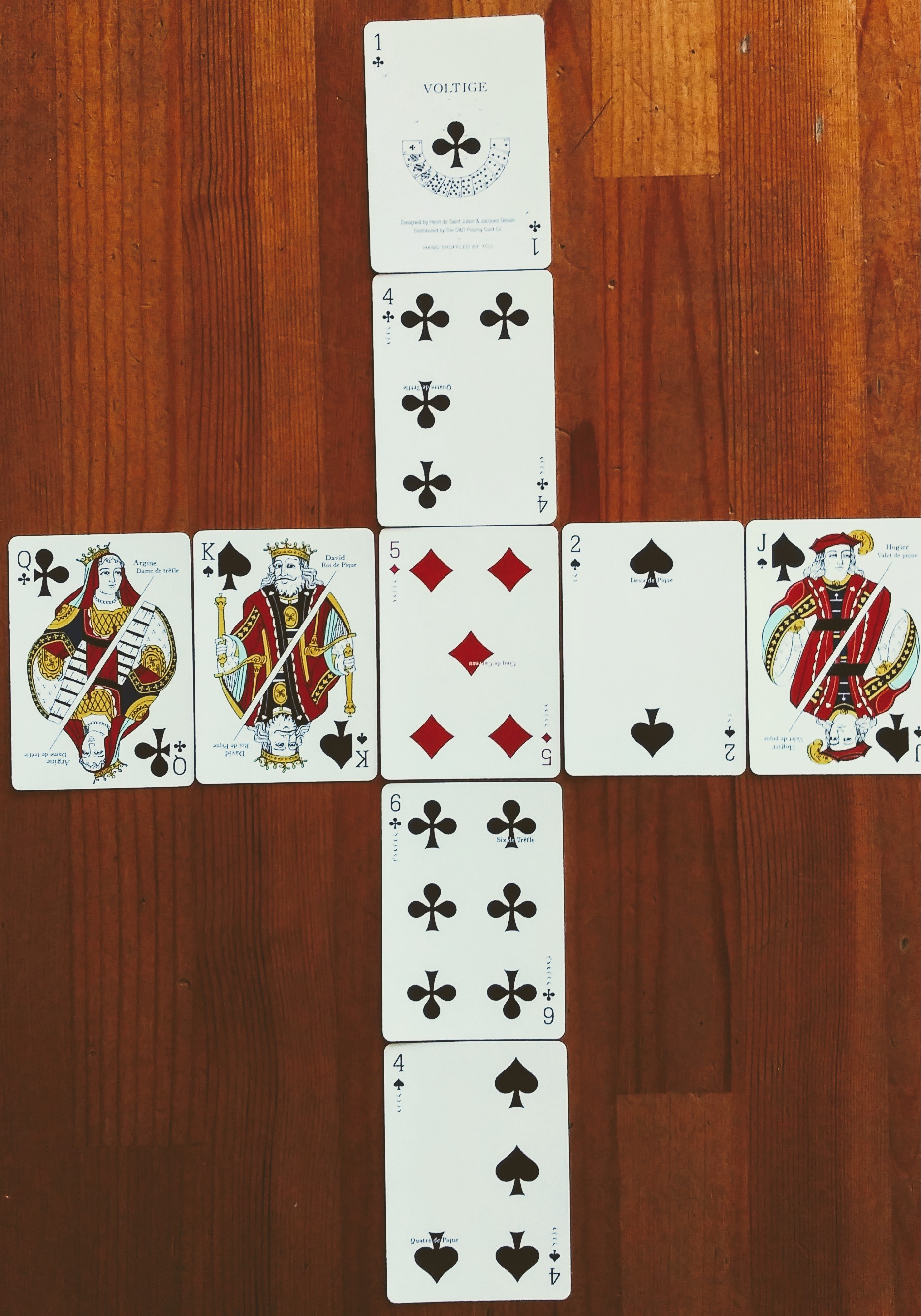
Voltige Playing Cards designed by Henri deSaint Julien & Jacques Denain, published by D&D Playing Card Company.
The response: “This is a new beginning marked with hidden agendas. You met this person through a co-worker, and so far it has gone smooth enough as your interactions have been superficial. Someone opposes this budding relationship, and it is the person you least expect. Nonetheless, this budding romance is but a momentary indulgence of mutual pleasure from both sides. In other words, no, this person is not the one, moreover be watchful of the traps other’s might be sowing around this romance aimed to take you down.”
As you can see, both approaches are viable, both with and without keywords. My judgement on keywords is that they are a matter of personal preference. If you don’t have the book, you can come up with your own keywords based on how you read pips. For example, Jake Stratton-Kent clearly states in his survey of this cartomancy that he “burrowed from Papus in systematizing pip card meanings.” (169) The important aspect with keywords is keeping it concise, at maximum two words. You can apply reversed meanings as well. As I’ve mentioned, what holds significance with the method overall is the framework within which the divination is approached. Aligning yourself with the Cyprianic current through the prayers, keeping to the 40 cards, with the pips being 1-7, and reading in a crossed pattern. Another option for the spread is to reduce the size of the cross, with one card in each direction and the central temptation. This depends on how much information you are seeking to disclose.
Here is another example with the shortened spread, and using the Spanish baraja. Let’s return to Brenda, this time smug and cheerful. She asks the fortuneteller, “I want to find love, a love that stays. What can I do to improve my chances and make this desire happen?”
Ruedo Baraja Española, naipe opaco marfil, published by Heraclio Fournier, Vitoria, España, 1972.
The response: “Be available, dare to say yes to unexpected offers, especially those relating to career. Interacting with others in the work environment will lead to potential love prospects. It looks like a work companion either is a potential love prospect, or will be the one to introduce you to the staying love you seek. Dare to say yes to new projects, and new adventures, step out of your home, and outside of your comfort zone. And on a practical note, order your house and your finances. Attending to whatever is in flux will foster stability in your home which will enhance your readiness to welcome a new staying lover.”
As mentioned, the cards are read in a crossed pattern: 1+2, 3+4, ending with the central card, the closing statement, the final judgement. The temptation can be seen strictly as the word itself is defined, “A thing or course of action that attracts or tempts someone.”† In other words, as this card closes the reading, it has the final say, a disclosure of hidden desire in relation to the question and the answer received. But temptation can also move beyond that and be thought of in terms of its related latin counterpart, tempto, encapsulating, “Bribery, testing, trying, urging.”† There is a sense of a persuasion attempted in someone’s or something’s favor. In this case, the card presents itself as the tempter, the one doing the tempting, so it is an urging to move in a certain direction in relation to the reading. In turn, Jake Stratton-Kent speaks of these 8 cards as representative of “the nature of the story generated by the crossed reading of paired cards.” (171) That is to say, the temptations denote the underlying current of the overall reading.
Retaking the pack and beginning anew with the shuffle, but this time removing the temptations, the Aces and the 7s. These will be shuffled separately, and will carry the weight of temptation, and the significations encapsulated with the word. While the rest of the 32 cards will remain together and shuffled so.
A tense Karin enters the parlor and says to the fortuneteller, “I’m getting married next week and I’m feeling very nervous. Should I follow through with the wedding? Are my nerves indicative of something negative? Is this person the right one?” The fortuneteller chuckles here and responds with a crisp, “Let’s start with one question, and see how we disentangle the others.”
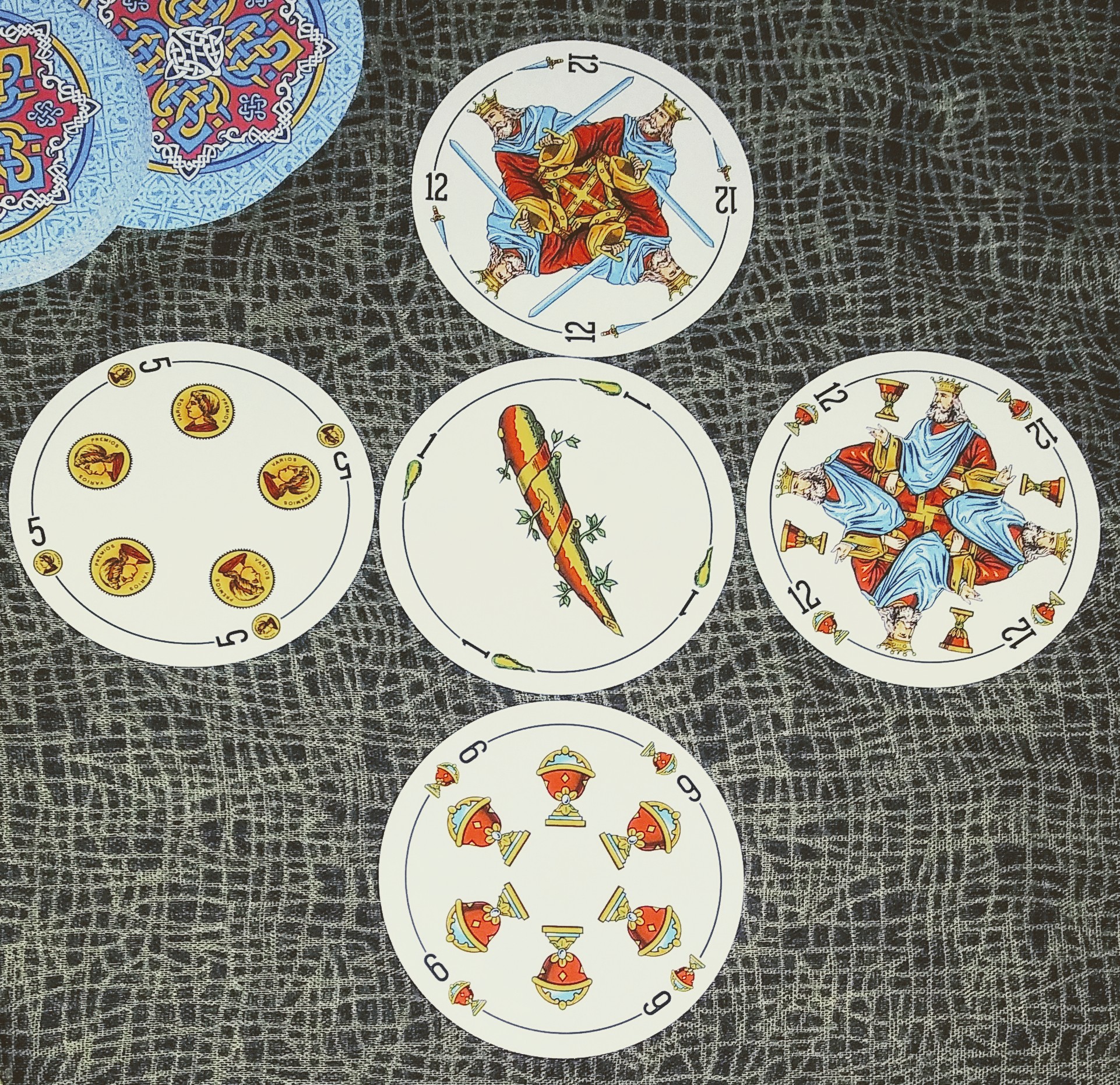
Ruedo Baraja Española, naipe opaco marfil, published by Heraclio Fournier, Vitoria, España, 1972.
The response: “You are embarking on a new and exciting path that holds both promise and difficulties in equal measure. You have both emotional and financial security with this person that fortifies the relationship. I see also love and passion. The ending card says yes. Take this step, get married. The nerves are merely a sign of the changes looming ahead but your relationship is ready to face them.”
Here, the temptation sealed the deal with a strong answer. My suggestion is to try it both ways, as in keeping them separate, and also with the rest of the pack when doing a reading. You have to find for yourself how the reading flows and your preference. This is also a matter of either making the center itself the temptation or of assigning this word to the Aces and 7s alone. I typically interchange between keeping the temptations separate or not. What is a must for me is reading that middle card last. There is also the option of using the entire 40 cards, but this is a spread I haven’t tested out myself as I find the cross perfect and succinct in answering my questions. You should also discern for yourself whether you prefer the baraja Española, or playing cards with the french suits.
Conclusion. Crossed Cartomancy is a rich method that has the virtue of aligning you in favor with the Good Saint. While also being a great way of establishing and growing a relationship with him. It is worthy to note that I am in accord with Jake Stratton-Kent’s observation that the King of Diamonds or Coins is the card best keyed to Saint Cyprian. Above all things, it is important that the diviner develops their own approach and converse with the Saint, and as always relationships take time and effort. Lastly, I know I used examples solely involving love matters, I was playing around with the introduction that states that this art “is the great resource of lovesick girls, using it out of jealousy, suspicion and longing for the object of their affections.” Despite my tongue in cheek approach, I can assert that this art is valuable both within and beyond the bounds of lovesick girls. As The Book rightly states, “Crossed Cartomancy may be applied for the uncovering of any mystery.”
If you haven’t already done so, you can read the first part to Crossed Cartomancy here.
Merry and Potent Feast of Saint Cyprian and Saint Justina of Antioch. Holy Martyrs both.
~~~
† Temptation from The New Oxford American Dictionary, online.
~ The Book of St. Cyprian: The Sorcerer’s Treasure, translated and with commentaries by José Leitão, Hadean Press, 2014.
~ Jake Stratton-Kent, “‘Seven Years The Sea Thou Roamed‘: Cyprianic Ritual and Divination,” Cypriana Old World, edited by Alexander Cummins, Jesse Hathaway, and Jennifer Zahrt, Rubedo Press, 2016.




 Natalia Lee