• From the devil to the star

    I’ve been sick for most of the month of February, putting things into perspective for me. With being sick and reluctant to do many things as I’m pulled down by what my body is combating, I’ve kept coming back to a trio of cards that have been on my mind for months. The Devil, The Tower, and The Star. With this trio comes to my mind the act of re-enchanting our lives, of thriving and resilience. Weaving songs of hope along the way. The way from the devil to the star is the song for these times.
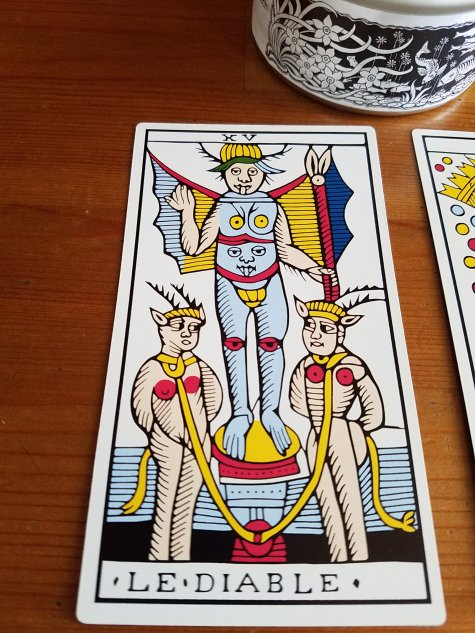
    Jean Dodal Marseille Tarot Flornoy
    Jean Dodal Tarot de Marseille reproduced by Jean-Claude Flornoy,editions le-tarot.com, 2009.

    The devil binds, ties, and obstructs. This half man, half beast figure stands upon a pedestal holding a wand, a scepter of authority as below the humans turned imps, enslaved with hands and necks tied, look on with sadness. Or is it contempt? In binding, the devil hinders the way forward as he stands formidable and seemingly indomitable, larger and more imposing than those beneath him.
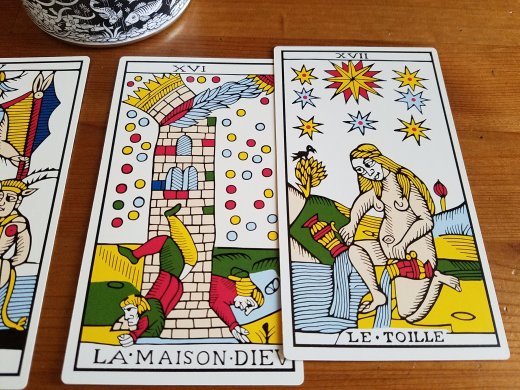
    Jean Dodal Marseille Tarot Flornoy
    Jean Dodal Tarot de Marseille reproduced by Jean-Claude Flornoy,editions le-tarot.com, 2009.

    Catastrophe strikes, a sudden flash and the crown is toppled. What was once lofty has been torn asunder. Out of the binds we are thrust, it is sudden. This is the revealing moment, the apocalypse. The veils are torn and perspectives are reversed. Falling, falling, falling while the electrified sky intensifies the nightmare. Foundations are broken, what was solid crumbles. This image highlights vulnerability, our collective vulnerability as humans. Vulnerability because what we know, what we hold as foundation today, can change unexpectedly. Nothing is certain except change, except mutability. This is the moment when, just as those thrust out of the toppling tower illustrate, we move “outside.” It is an expulsion from constructs that forces our position to drastically change.
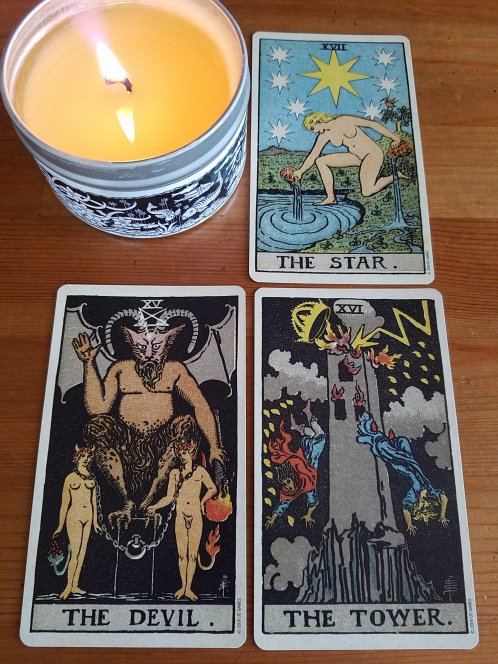
    Centennial Waite Smith Tarot Rider Waite Smith
    The Centennial Waite-Smith Tarot, US Games, 2009.

    Sans strictures and fortifications that keep us shackled, we are outside, vulnerable and naked, clearing the air to create for ourselves a life that is boundless and full of possibilities under the light of the stars. To a gentle stream we take our battered selves, there kneeling on the edge of a flowing river, with face turned towards the past in remembrance of the apocalyptic moment, we pour out from our vessels, we pour out our waters, and let them mix with the river. Emptying the anguish and agitations. The dark night has passed and transformed into a sky full of stars, and song, and birds. Then relief seizes us.

    The star is the initiator of a life outside the chains of the devil, a hand made life. A life that begins from what is boundless, rolling hills, the expanse of the sky, the distance of the stars, the song of birds, and flowing waters. Moreover, from the devil to the star is the road to resilience, and re-enchantment. Breaking bonds and surviving the terror of the apocalyptic moment. It is a story of strength, and a song of rejuvenation.

    I sat with these thoughts for most of the month, dwelling on what it means to be resilient. Taking a cue from the cards, resilience is about seeing possibilities within and without, boundless possibilities unchained from systems of belief and of perspectives. The lesson is in following the rhyme from the devil to the tower, ending with the star. This is how we re-enchant our lives, placing our sight and our selves in the midst of what is immeasurable as opposed to what confines. It is interesting to note that in the traditional Rider Waite Smith deck the background of both the devil and the tower is black, limiting the sight, not allowing our vision to pierce beyond. While the star is embraced by the blue sky and the green folds of the earth. In other words, what binds, does so until we step outside of that frame.
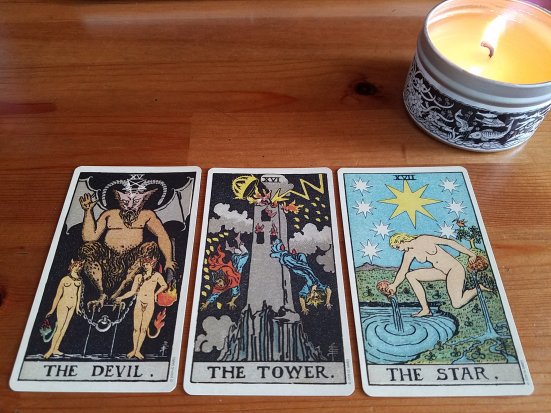
    The Centennial Waite-Smith Tarot Rider Waite Smith
    The Centennial Waite-Smith Tarot, US Games, 2009.

    ~~~

    Mist and Aether La Maga Etsy mist and ether

  • The Dreamkeepers Tarot

    Mid-2018 I was pining after Baba Studio’s Victorian Romantic Tarot, roaming through several tarot trade groups desperately seeking the first or second edition. In one of these groups, someone posted a link to a kickstarter campaign. I clicked on the link and found that the campaign was for a beautiful tarot deck by artist and photographer Liz Huston, The Dreamkeepers Tarot. The art for the deck is photo-montage combining, acrylics, oils, and watercolors. I don’t have experience with photo-montage tarot decks, but this one was something else. The colors and shadows had a dreamy and ethereal quality that I was instantly drawn to. After glimpsing this deck and deliberating the matter in my head for about a day, I opted to forgo searching for the Victorian Romantic and joined the campaign to get the deck published. Towards the end of November, after a successful campaign, the deck arrived in my hands.

    The details:

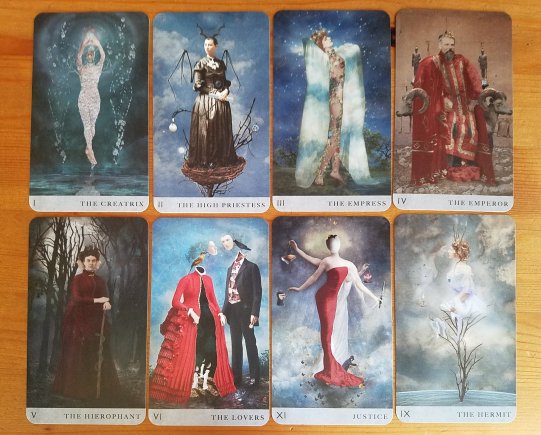
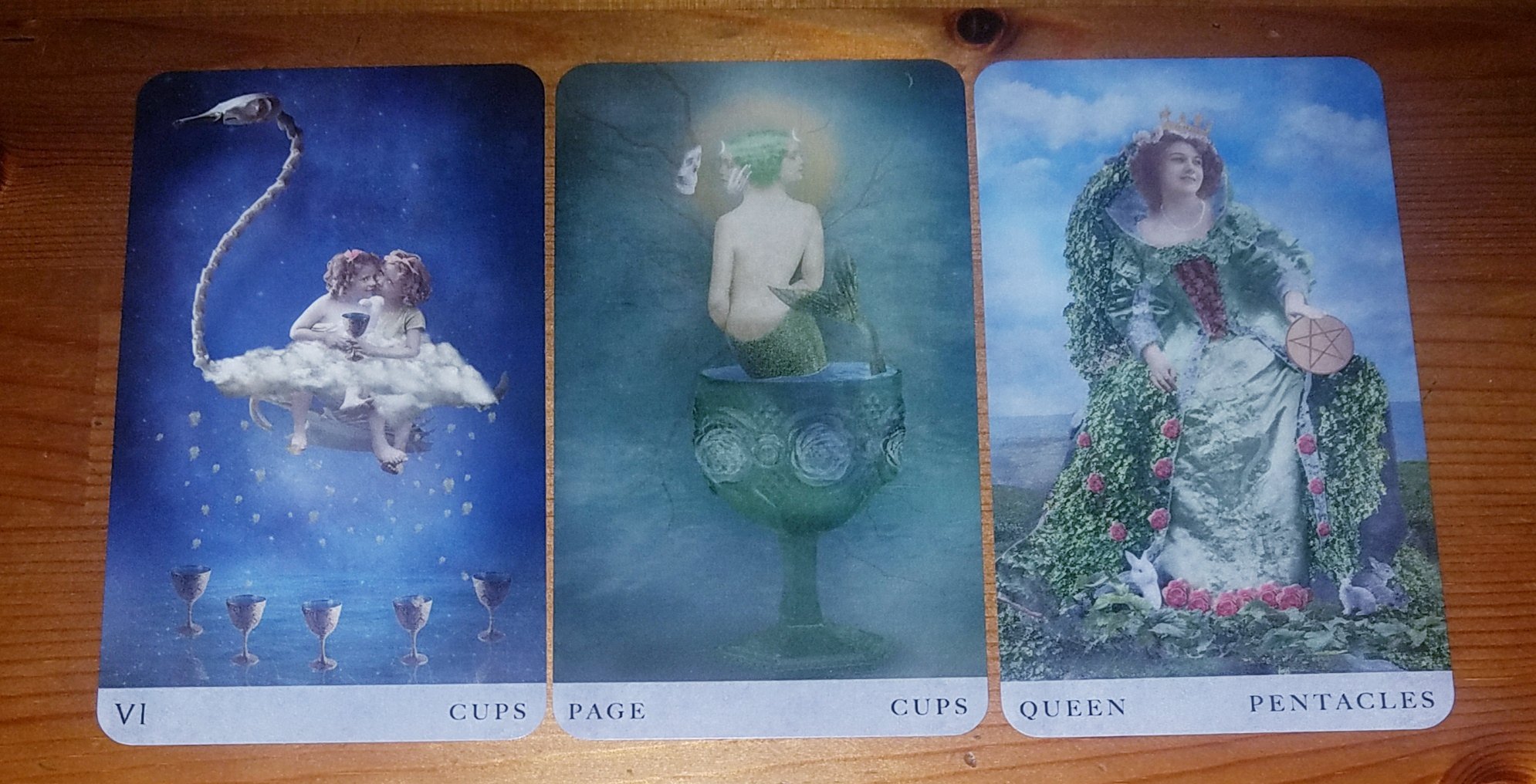
    It is a fully illustrated tarot deck, inspired by the Rider Waite-Smith system, with interesting and slightly different illustrations of the traditional cards. As I mentioned, the deck itself is a mixture of photo-montage and mixed media, see this mini video for a glimpse of the process. The technique for creating the deck allowed for a distinct nostalgic and affecting quality. The tone overall is muted, soft, with an emphasis on shadows. Also, the images within the images gives a depth to the illustrations that is stunning, allowing for a contemplative mode when reading the cards. The entire deck, 78 cards, took about ten years to create, which I feel is evinced in the thoughtful explorations played out in Huston’s interpretation of the classic Pamela Colman Smith art.

    The Dreamkeepers Tarot Liz Huston borderless
    The Dreamkeepers Tarot, borderless edition, Liz Huston, 2018.

    This slideshow requires JavaScript.

    In the slideshow you will find some of my favorites cards, although truthfully I find the whole deck beautiful. Some of the standouts for me are the Queen of Wands, The Empress, The Hierophant, the three celestial cards The Star, The Moon, and The Sun. Also, the Page of Coins, the Knight of Coins, and the Four of Swords. I only have the borderless version of the deck, and I really appreciate the art having no borders. When reading the cards it is almost as if the images bleed into one another.

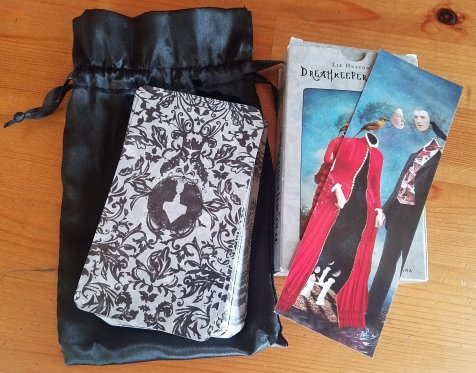
    The card stock is supple, buttery, and more on the thin side, and it has a soft linen finish. It shuffles smooth. The linen finish reminds me of Uusi Design Studio decks. The backs feature an ornate black Victorian aesthetic design on a grey-ish background, it is also non-reversible. It came in a standard tuck box, with a small little white book that only has keywords for each of the cards, and a silk black tarot size bag with drawstrings.

    The Dreamkeepers Tarot borderless Liz Huston
    The Dreamkeepers Tarot, borderless edition, Liz Huston, 2018.
    20190208_0955044168055100562914814.jpg
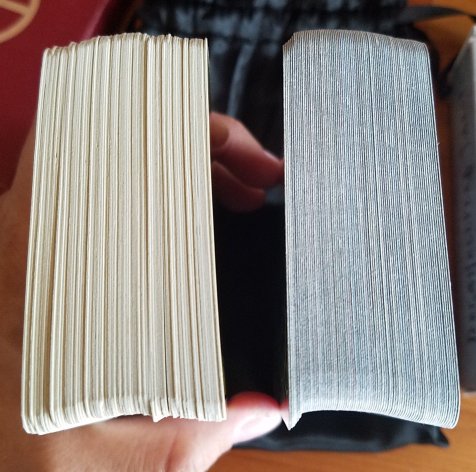
    Thickness comparison of the Centennial Smith Waite Tarot by US Games Systems(left) & The Dreamkeepers Tarot by Liz Huston (right).

    Sampling a reading:

    Who are you?

    The Dreamkeepers Tarot, borderless edition, Liz Huston, 2018.
    The Dreamkeepers Tarot, borderless edition, Liz Huston, 2018.

    I am she that looks ahead and to the past, a message that spans generations, a connection that enriches life. I bestow gifts and reveal secrets. I open your heart while engaging your intellect. Come to me amenable to hear my voice.”

    All in all, The Dreamkeepers Tarot is an art deck with a delicate touch of romanticism that makes using the deck a real treat. It is has the quality of transporting the reader into another realm of half-light, dreams, and the past. Making it the perfect companion for exploring dreamscapes, and for contemplation.

    ~~~

    • To order the deck, visit Liz Huston’s website.
    • Please excuse the quality of the images, my hand was shaking more than usual as I took the pictures. The images belie the real beauty of the cards.


    Mist and Aether La Maga Etsy mist and ether

  • Aiming for the heart

    by

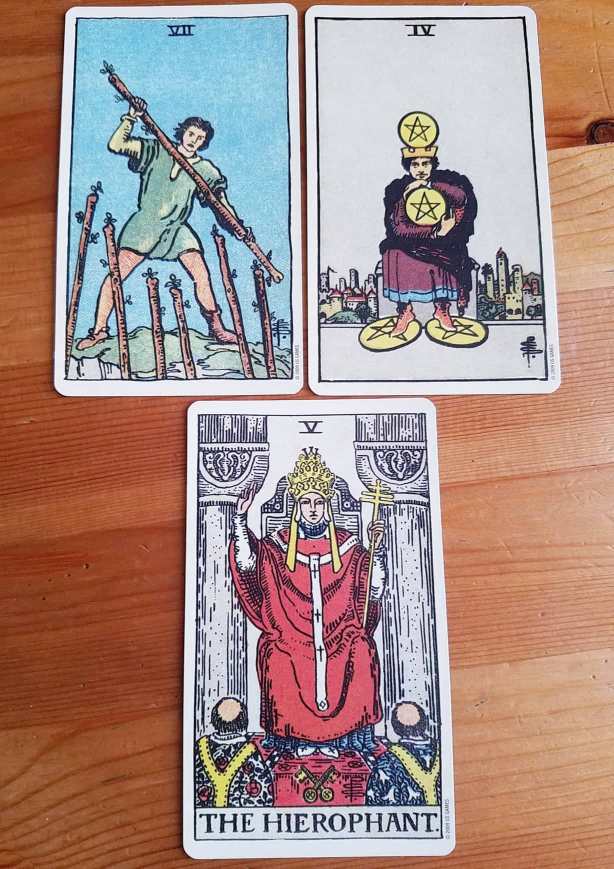
    I’ve been using the Centennial Smith-Waite Tarot of late, keeping it next to me on my night table and going deeper in my connection with the deck. Thus I will be using the deck for this month’s augury.

    Centennial Smith Wait Tarot Rider Waite Smith Tarot US GAMES
    Centennial Smith-Waite Tarot, published by US Games Systems, 2009.

    This month simmers with questions of authority and power. Swinging spears and coming up against what remains still is the general theme for February. Issues of dominance and order force us to confront unpleasant aspects of our psyche and also our surroundings. It is good to sit with these tensions and interrogate our intentions and drives. It is also good to sit with what stands for the structures around us and our lives. We might be surprised to find the roots have an appearance heretofore unrecognized and not wholly welcome. Because of the arising tensions we will find our boundaries challenged.

    • How taut are your foundations?
    • How orthodox is the ground you stand upon?
    • How much room for dynamic shifts is available for your ideas, for your work, and for the towers you are constructing?

    As your boundaries are challenged, find the space that allows for protection. Guard your borders even as you keep them malleable. This month is a lesson in remaining steadfast yet daring, protecting what you value even as you provoke and interrogate that which you protect.

    Antonio Da Trento Woodcut Sibyl

    ~~~

    Mist and Aether La Maga Etsy mist and ether

  • Continuing lines and pythian gifts

    Motivated weeks ago by Camelia Elias I had the idea to create a spread inspired by my contribution to 21+1 The Fortuneteller’s Rules. By weeks ago I mean back in December. During most of December I was in a distinct Sibylline mood, thinking on the annunciation of the divine light and the doom of the apocalypse entwined with these revelations.

    For context see these following links:

    I was also reading Danny Nemu’s excellent book, Neuro-Apocalypse, so you can understand somewhat what was playing around in my mind. In essence, an apocalypse is a veil shattering revelation that uncovers what is hidden. “ORIGIN Old English, via Old French and ecclesiastical Latin from Greek apokalupsis, from apokaluptein ‘uncover, reveal,’ from apo- ‘un-’ + kaluptein ‘to cover.’” How else to encounter the divine light but through the apocalypse? For me, divination is a tool that facilitates apocalypses, instances of revelation. With all this in mind and considering my 21+1 contribution, I birthed this spread.

    In true Sibylline mode I have titled the spread, The Vision of the Oracle.

    Pythian Delphic Oracle Sibyl Greece Oracle of Delphi
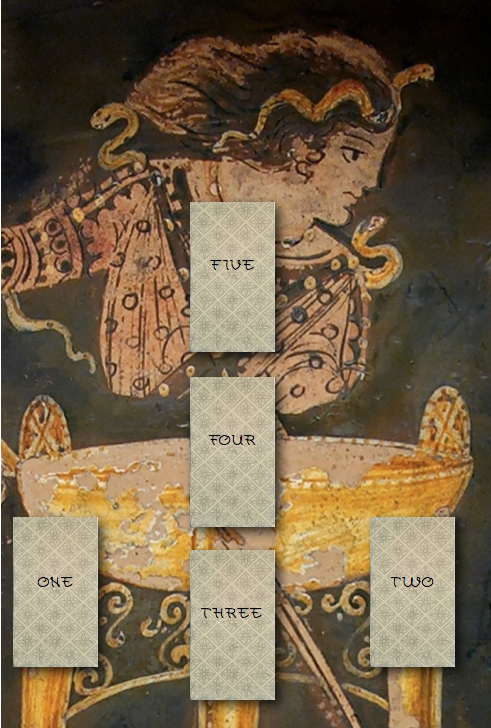
    Paestan red-figure bell-krater depicting the Delphic oracle sitting atop her tripod, circa 330 BC. With my superimposed tarot card images.
    Priestess of Delphi Pythian Oracle Sibyl Delphic Orace
    Priestess of Delphi (1891) by John Collier, showing the Pythia sitting on a tripod with vapor rising from a crack in the earth beneath her.

    I envisioned the shape of this spread following the shape of the Pythian tripod, “The Pythia would chew laurel leaves and bay leaves, drink from the sacred spring and wear a crown of laurel while sitting on a tripod adorned with laurel over a fissure in the cellar of the temple (Sourvinou-Inwood, 233).” “The Oracle then descended into the adyton (Greek for “inaccessible”) and mounted her tripod seat, holding laurel leaves and a dish of Kassotis spring water into which she gazed.”

    The image of the tripod and a vessel or curved dish merged in my mind’s eye, I began to see both the Pythia on the tripod and the vessel with water mirroring the other. Meaning that, just as the oracle sits on the tripod and divines, so the vessel used encapsulates the same meaning. From within the vessel, the waters, and from without, the vapors mix to rise and play with the visions of the diviner. In like manner the diviner sits on the tripod and she is the water that experiences the oracle as her body and sight entwine with the vapors around her. Then she speaks and the utterance pronounces the oracle.

    Speaking specifically of the spread, it functions both as the oracle’s tripod and the vessel. There are three cards at the bottom in the shape of a basin (at least that is my intention for the spread) and two cards moving upward that mirror the vapors  of revelation. The two flanking cards are the initial instigators that mirror each other, the center pillar three cards are the revelation and the answer. This is a spread for feeling your way through to the answer, letting your eyes and mind move with the rhythm of the forms sans restraint. It focuses on apocalypses, on sharp revelations. There are no defined questions for each position. The shape of the spread defines the intention. The spread’s clear aim is to sharpen the vision, to sharpen the words, to sharpen your inner trust, and especially to sharpen truths.

    Delphic Oracle Pythia Pythian oracle Delphi
    The Delphic Oracle. Kylix by the Kodros painter, c. 440-430 BCE. From the Collection of Joan Cadden.

    Now I will take the spread for a spin. Context: I am currently pining after an obscure Italian deck by artist Franco Anichini, a deck created to raise funds for the Sacred Heart Institute, Fantarocco (Images can be viewed by following the link). The deck would would be purchased from Italy and I would have to pay the price of the deck, which is not modest, plus the shipping. Now my birthday is coming up soon, and despite going through certain financial restrictions at the moment, I really want to add this deck to my small collection of Marseille type decks. I asked the cards about this situation, framing it from the angle of revelations.

    Question: What is the truth behind my desire to purchase the Fantarocco deck?

    The spanish tarot fournier tarot decks spain
    The Spanish Tarot, published by Heraclio Fournier, Vitoria, Spain.

    The two mirroring cards demonstrate the obvious, I want to seize the opportunity to indulge in spending for myself. The revealing column illustrates that the truth behind my extravagant spending desires is that I feel at odds with myself, frustrated at what is not moving and unsatisfied. Displacing my desire for change upon the purchase of an obscure tarot deck fulfills a fleeting desire instead of the real desire. In other words, my deck lust is all about displaced desire.

    There you go, reading the cards for apocalypses.

    Freely play with the spread at your leisure and may it serve as a drop or a ripple in the well of your craft, and may it facilitate revelations.

    ~~~

    Sources:

    • Apocalypse definition from the New Oxford American Dictionary.
    • Both “Paestan red-figure bell-krater depicting the Delphic oracle sitting atop her tripod, circa 330 BC” & “Priestess of Delphi (1891) by John Collier, showing the Pythia sitting on a tripod with vapor rising from a crack in the earth beneath her” taken from wikipedia: Pythia
    • “The Delphic Orcle. Kylix by the Kodros painter, c. 440-430 BCE.”
      From the Collection of Joan Cadden from www.coastal.edu.
    • The featured image is from Pixabay and is a Temple in Delphi, Greece. Walkerssk.
    • Read Camelia Elias’s spread.


    Mist and Aether La Maga Etsy mist and ether