• An Ukiyo-e Lenormand: A review

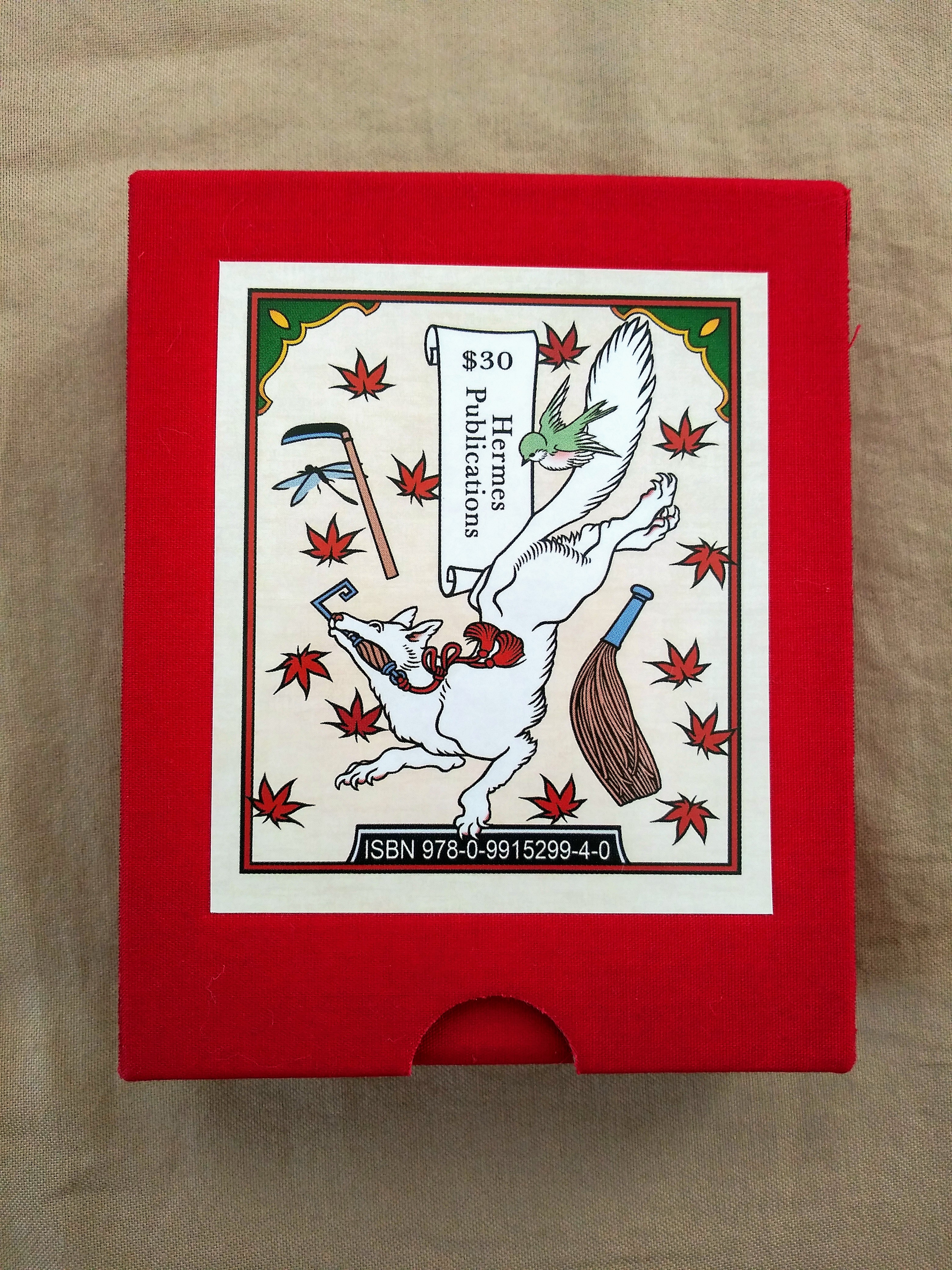
    An Ukiyo-e Lenormand by Robert M. Place is beautiful. It comes in a red cloth two part box that slides out, with arched grooves on both of the boxes for easy access. This is the packaging that Robert Place looks to be implementing in all his new decks and I love it. As per Place himself: “The box is based on an antique deck in my collection. It is a design that I have not seen being used for 100 years.” It keeps the deck neatly in place, provides a sturdy home for storing the deck, and also for carrying it around in a bag. The top box has two labels, one on each side.
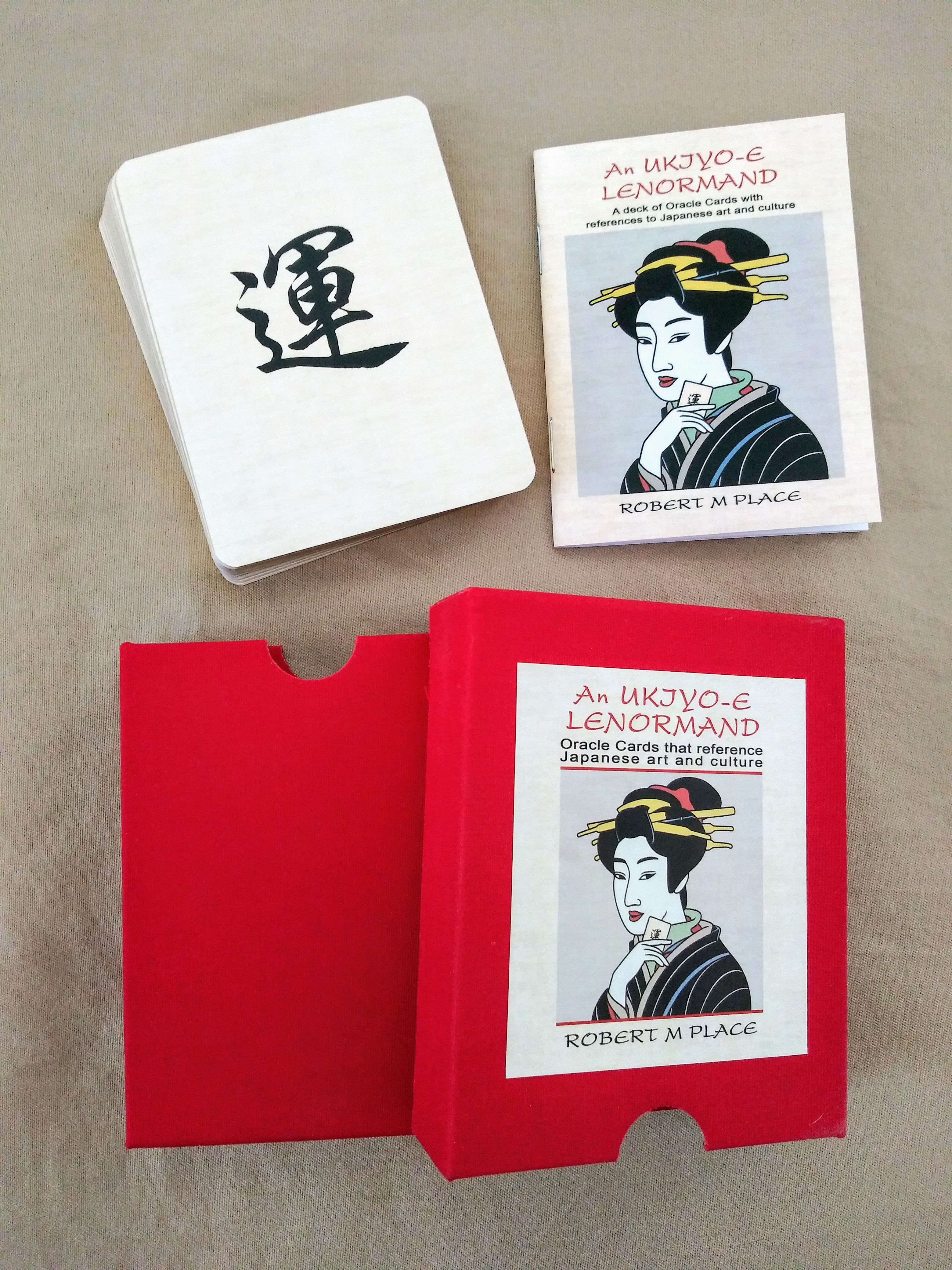
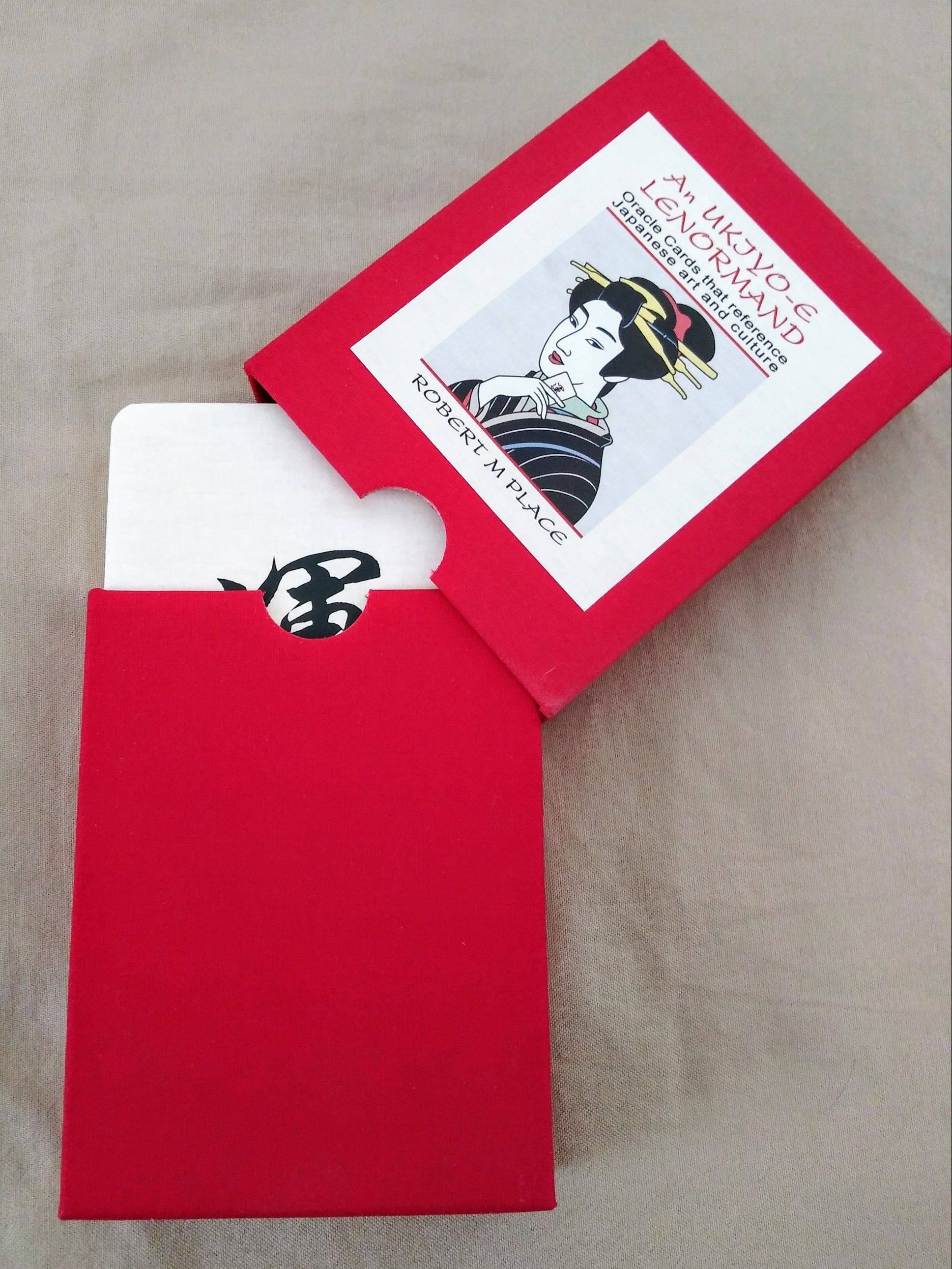
    The deck comes inside the inner box wrapped in a thin layer of plastic along with the small guidebook. The cards themselves are edged in gold, and their size is more square than rectangular, slightly larger than a regularly sized bridge or poker deck. Four by three inches to be exact. The cardstock is a silky smooth matte, and easy to shuffle. I should add that I’ve owned previous Robert Place decks in the past and in comparison, the cardstsock quality on this one is much improved.

    The guidebook is small and brief, mostly including the same information already available on the cards themselves from Robert Place’s website, linked below. There are one or two paragraphs on the Lenormand in general, and a couple more on how to read the cards towards the end. What I liked about the guidebook, which can also found on the website, are the description of the cards. Although each is short in length, it addresses how he linked the traditional cards within Japanese culture, mythos, and the ukiyo-e aesthetic. There are tidbits from history and Japanese culture that I enjoyed as well.

    “The name Ukiyo-e, meaning “floating world,” refers to the style of Japanese woodcuts and paintings made famous in the 19thcentury. The deck references Japanese art and culture, including Shinto deities (called kami), Buddhist bodhisattvas, and other mythic figures. At times, these references may modify the meaning of the card.”

    Some of the traditional cards have been re-positioned through a Japanese cultural lens. These cards add a rich texture of Japanese mythos. They are re-interpretations that offer different perspectives on the traditional card meanings. It should be noted as well, that some of the cards are reworkings of Ukiyo-e prints from Place’s own collection.

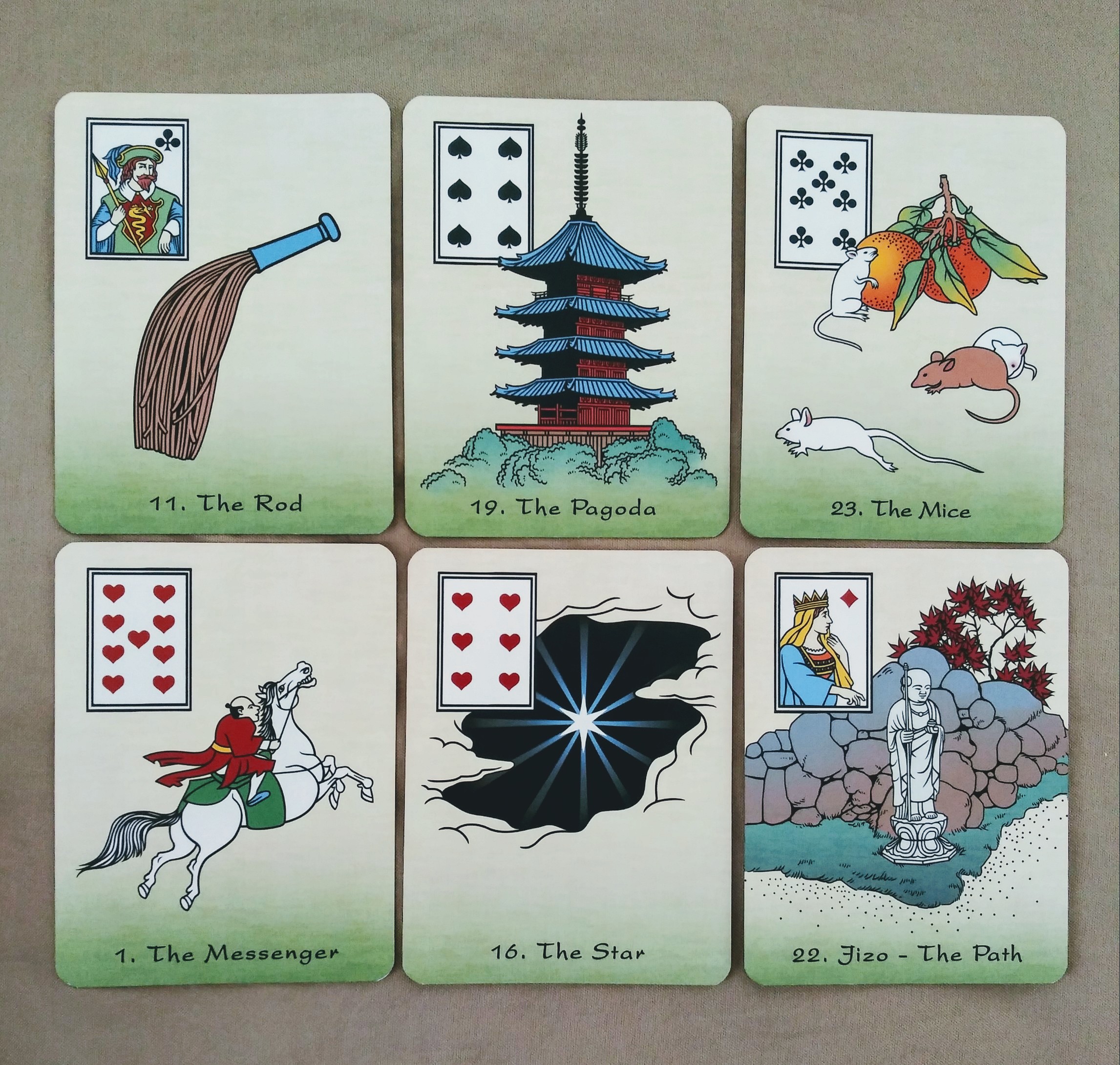
    Qualities of the cards include strong lines, a rich color palette, borderless cards, with a background the color of rice paper. The inserts are large and clear, and I find the courts to be surprisingly animated.
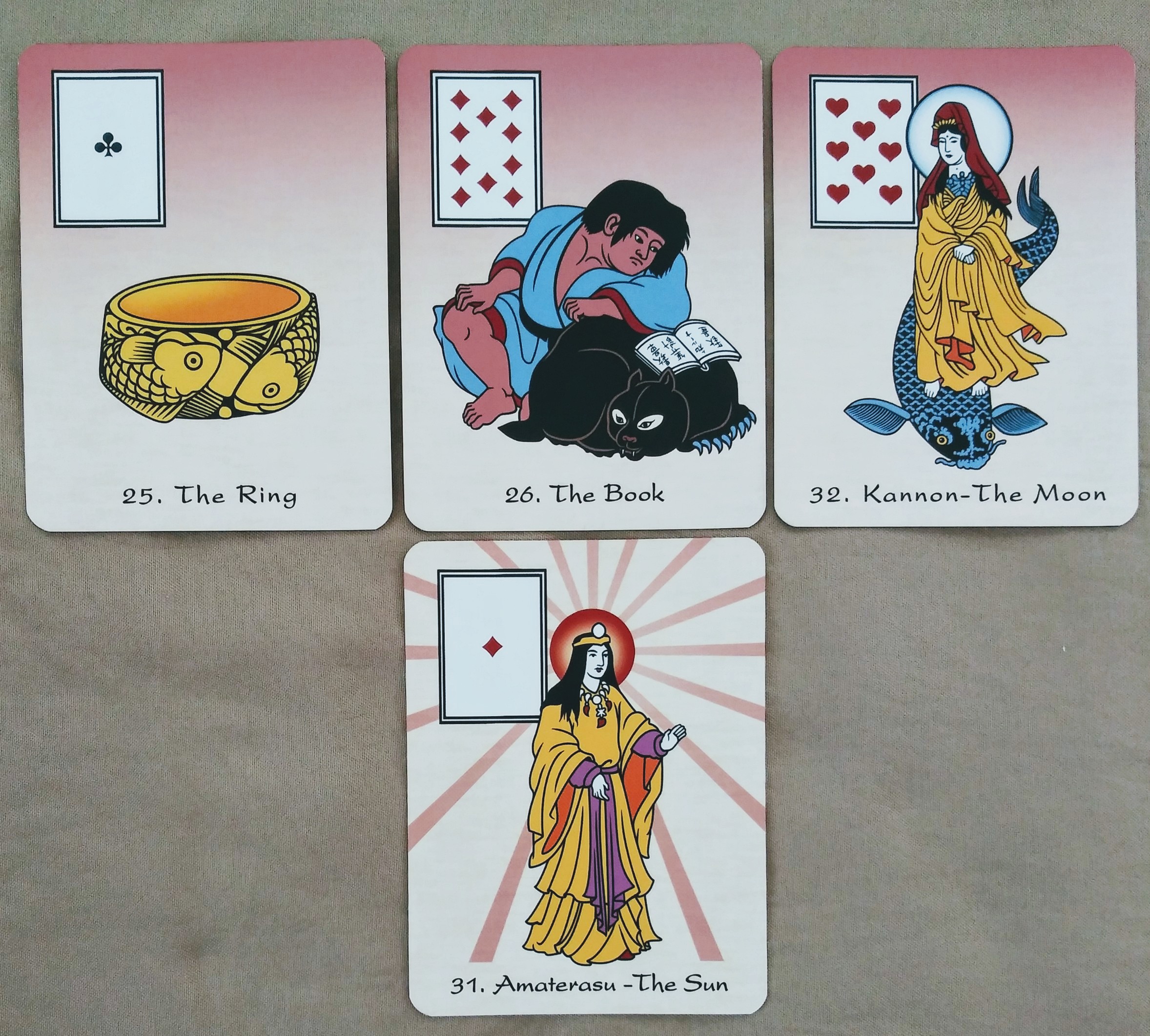
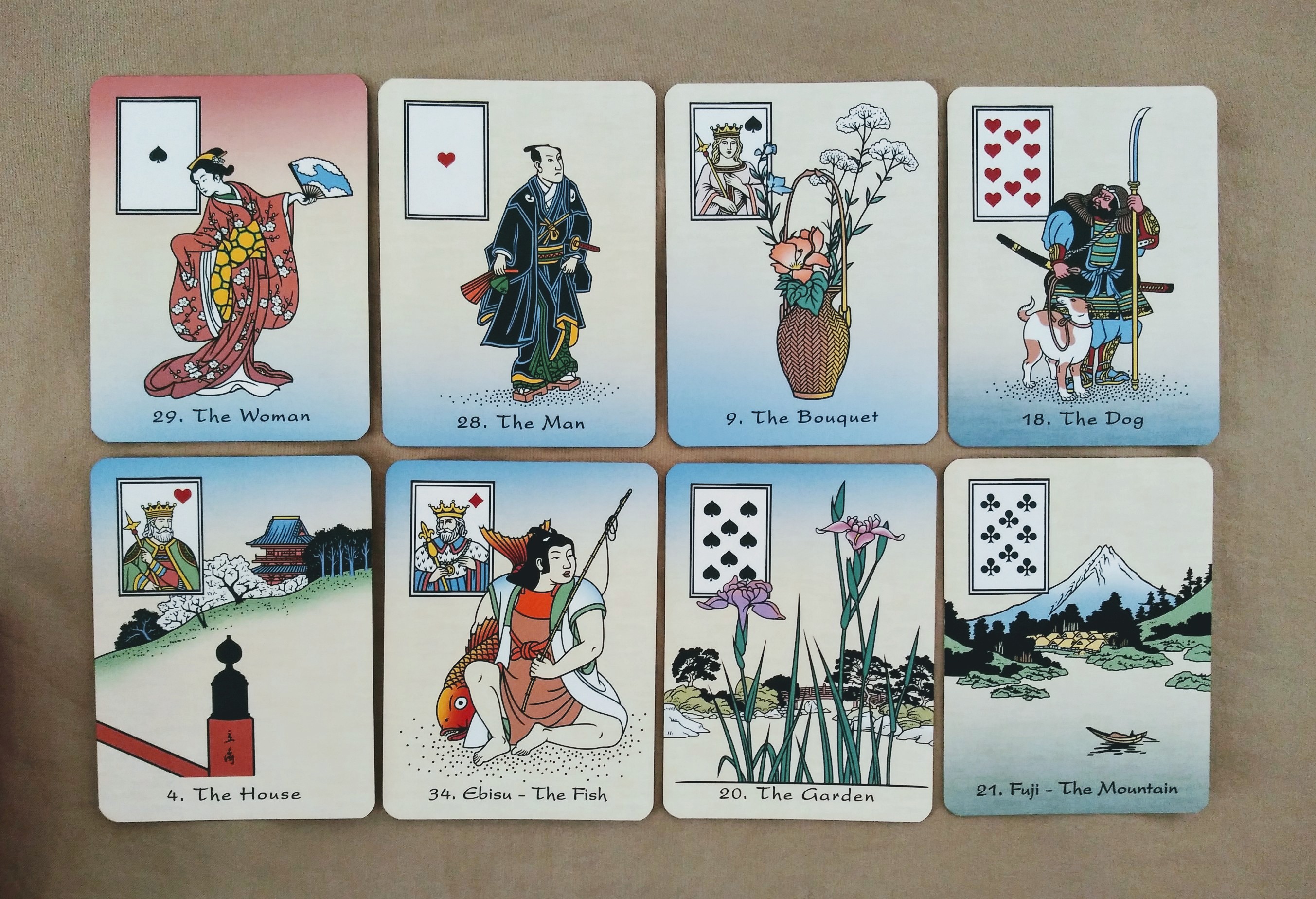
    There are also sets of cards in no particular order, or grouping, from what I can see, which I find interesting because the coloration above or below lend themselves to an added subtlety of tone within a reading when looking at a tableau. Especially considering the interplay of color significations and their associated meanings. For example, and these are brief:

    Bad words and malicious gossip eat away at the fecundity on offer throwing a cold pall over the gathering/party. (The green in the mice card that turns into the blue in the garden card, from fecund to stagnant.)
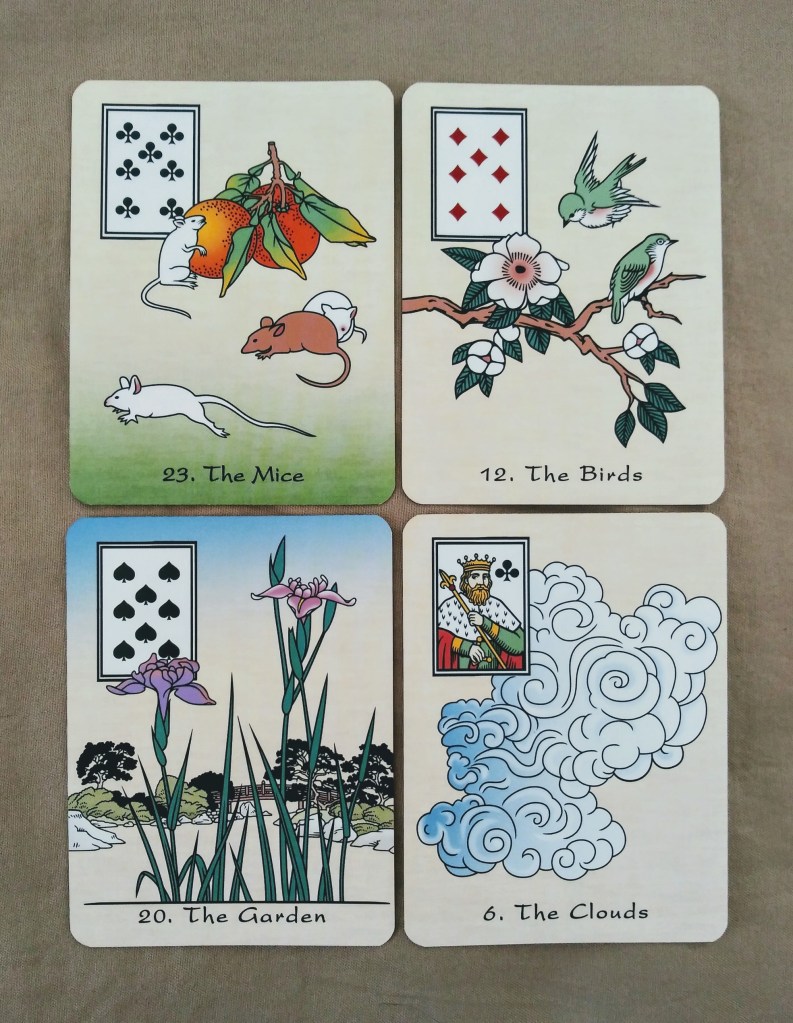
    An Ukiyo-e Lenormand: A deck of Oracle Cards with references to Japanese art and culture, by Robert M Place, Hermes Publications, 2019.

    Or, looming difficulties cloud loyalty, dampening commitments. (Looking specifically at the grayish bottom of the mountain card and the bottom blue of the dog card.)
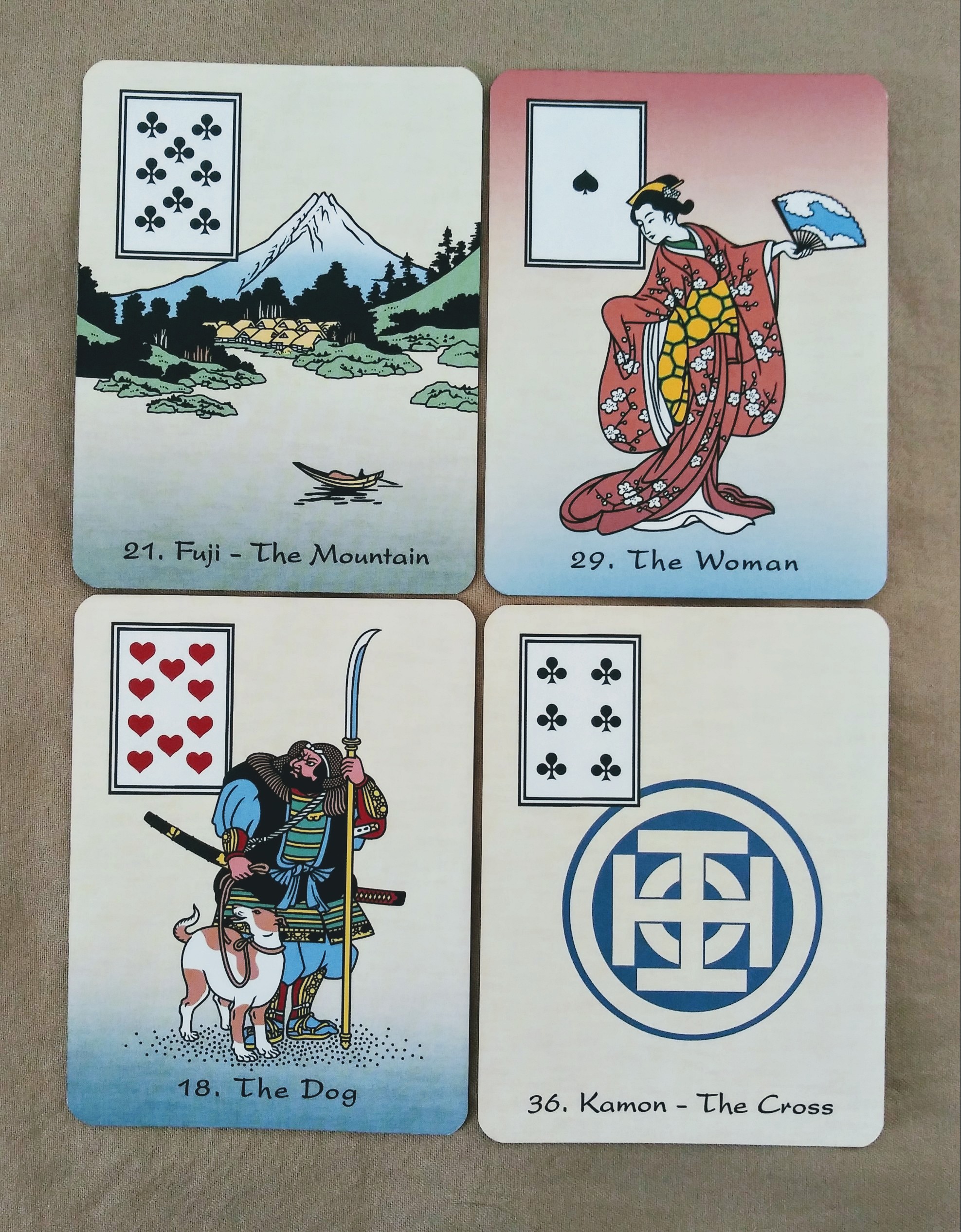
    An Ukiyo-e Lenormand: A deck of Oracle Cards with references to Japanese art and culture, by Robert M Place, Hermes Publications, 2019.

    Overall, this deck is cohesive in presenting the art and culture it aims to explore through the creator’s eyes, while somewhat in keeping with the Lenormand frame. Robert M. Place has created a deck imbued with a deep appreciation and respect for Ukiyo-e art and the culture within which it arose. It is harmonious and elegant. A divinatory reading with the deck is clear and dynamic. To be frank, there is nothing I do not like about the deck, I bought it because of its beauty, and find myself reaching for it often because the readings are eloquent.* Needless to say, I highly recommend this deck for cartomancy lovers, especially those that appreciate a differently structured voice from the traditional Lenormand world.

    • To order the deck and see all the cards: An Ukioy-e Lenormand.
    • To read more on how the creation of the deck arose: here.
    • Caveat: I’m not fully versed in lenormand reading and admit that this deck would read more as an oracle than as a straight traditional lenormand deck.
  • Monthly endnotes: June 2020

    This closing month has felt like an overwhelming roller coaster, both in wider culture/society and within my small circle. I continue learning, despite bumps along the way, how to find joy in the little things, reading a good piece or writing, listening to music with a glass of spiced rum, dancing in my living room, shared laughs with my son, taking morning dips in the beach when I’m able.

    Social media has been the expected mine field, and I had to conscientiously tell myself to cool it with frequently opening my social media apps. There have nonetheless been good conversations shared here and there.

    True to the feel of the month, my reading book-log has been all over the place, I have more unfinished books by my bedside table than I’d care to admit. Between books for personal study and books I’m enjoying I can’t tell what’s what anymore.

    ~~~

    My reading shop has picked up as well, and I’ve been navigating judicious time management strategies, and what each option I come up with looks like in action. When I first re-opened my virtual shop about 4 months ago I did it with the full intention of being available, especially financially accessible, during the lockdown period of those spring months. Now that things have shifted and accommodated, I am adjusting my prices to reflect my standard rate.

    Speaking of spreads and reading offerings, I’ve been playing with the full 12-card astrological spread with view of making it available as an option in my shop. I’ve been reading the spread focusing on the houses that highlight the specific question asked, and then I look at how these areas interact, through angles, with the rest of the cards. I find this approach organic and fitting, although it’s still in testing mode so I might change some aspects of my approach. I’ve also been using different decks and find that a solid esoteric deck works real well here. Hence, I’ve mostly been using Tarot of The Holy Light.

    Moving on to decks, after waiting three years, some of you might remember this post: Tarot decks under my radar, well I finally got my hands on Ryan Edwards’s Playing Marseille. Just published by US Games in May. It is gorgeous, I love that the tones for the people in the deck are darker and varied, the line work is exquisite, and the size is perfect (around poker deck size) for big spreads. While on the same topic, I also have a couple Lenormand reviews coming up. I’ve really found my taste for them. Years ago, I played with the Blue Owl Lenormand, but it never clicked so I gave it away. It seems I just needed to wait and spend more time with tarot and other things before diving back into the “Lennie” world.

    I’ve been working on the next piece for my Animating the Tarot Pips series. Truthfully, the progress these past couple weeks has been stop and go more than anything else. Fluctuating between inspiration and “the funk.” The “funk” here meaning a sort of lethargic blues where the muse is nowhere to be found when I call for her. I feel I just needed to relax. I imagine this feeling will cease or ease and I will find the muse exactly where she always is, waiting for me. So, working on that next piece, which is frankly the most experimental, if I can use that term, of the series. A poetical incantation of the pips.

    In the meantime, my last post on the eve of St. John The Baptist was on tarot dreams and I’ve received really good feedback on it, if you would like to try the tarot for dreaming, here is what I wrote on it: Tarot dreams, or dreaming with tarot.

    Watching: Listening: Reading

    I’ve been thoroughly enjoy the podcast/interview series My Magical Thing With… of the Deep Magic youtube channel run by Julian Vayne and Nikki Wyrd from The Blog of Baphomet. It’s a brief interview series about 5-10 minutes each with guests from different magical/academic/artistic living experiences. Each interview features a guest with their one special magical thing. Watching this series has been a source of joy and inspiration for me, listening to the stories around each person’s magical thing puts me in mind of how our lives are deeply intertwined with the physical world, the things we use and care for. And the objects are varied and rich with history, both of the object itself and what each individual develops with the object. I’ve seen all the interviews so far, but here are a couple to motivate you to check it out.

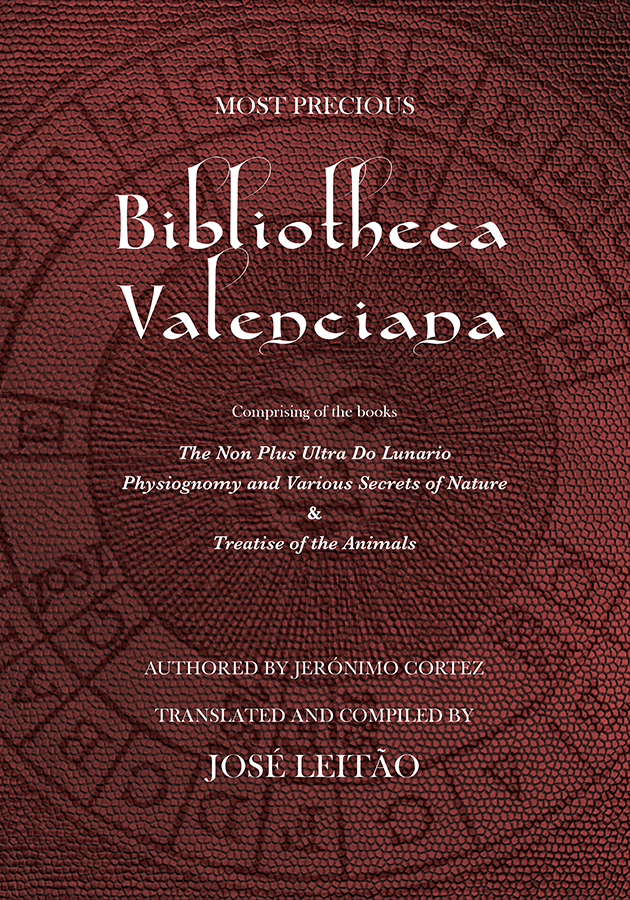
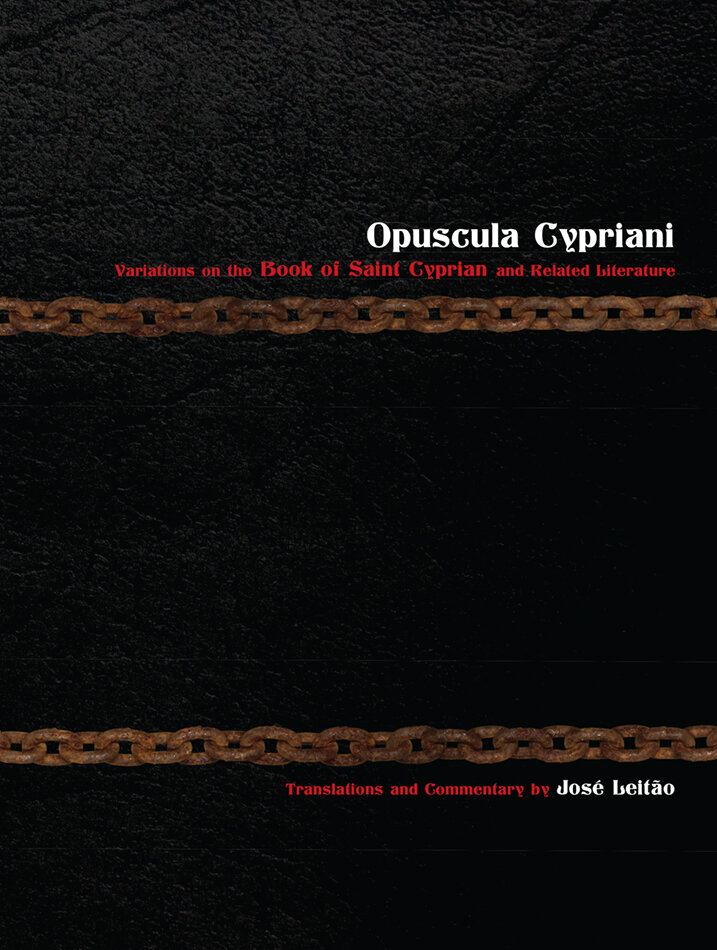
    As I mentioned above, my reading pile is quite high, but there are a couple books I’ve been reading since before the lockdown which have been steadfast companions during the frenzy of June, Bibliotheca Valenciana and Opuscula Cypriani. Loosely put, both are translated compilations, edited, and with extensive commentary by José Leitão. Both are excellent. Bibliotheca Valencia has this endearing flavor that I find very soothing, especially for reading at night. It’s hard to explain, but it feels like I’m curling up in bed with a dear friend that will tell me all sorts of magico-religious stories about creation, the world, the elements, the planets, while also showcasing the diverse fauna of creation. It also has remedies. I love the book, and confess that when I feel anxious before bed, I will read an entry on one of the animals in the bestiary part. Never fails to soothe.

    Bibliotheca valenciana José Leitão Hadean PressOpuscula Cypriani José Leitão Hadean Press


    This about covers the full month, I hope you find yourself safe, well, loved, and blessed. Keep going.

    ~~~

    Mist and Ether Natalia Lee Forty Tarot Divinatrix

  • Tarot dreams, or dreaming with tarot

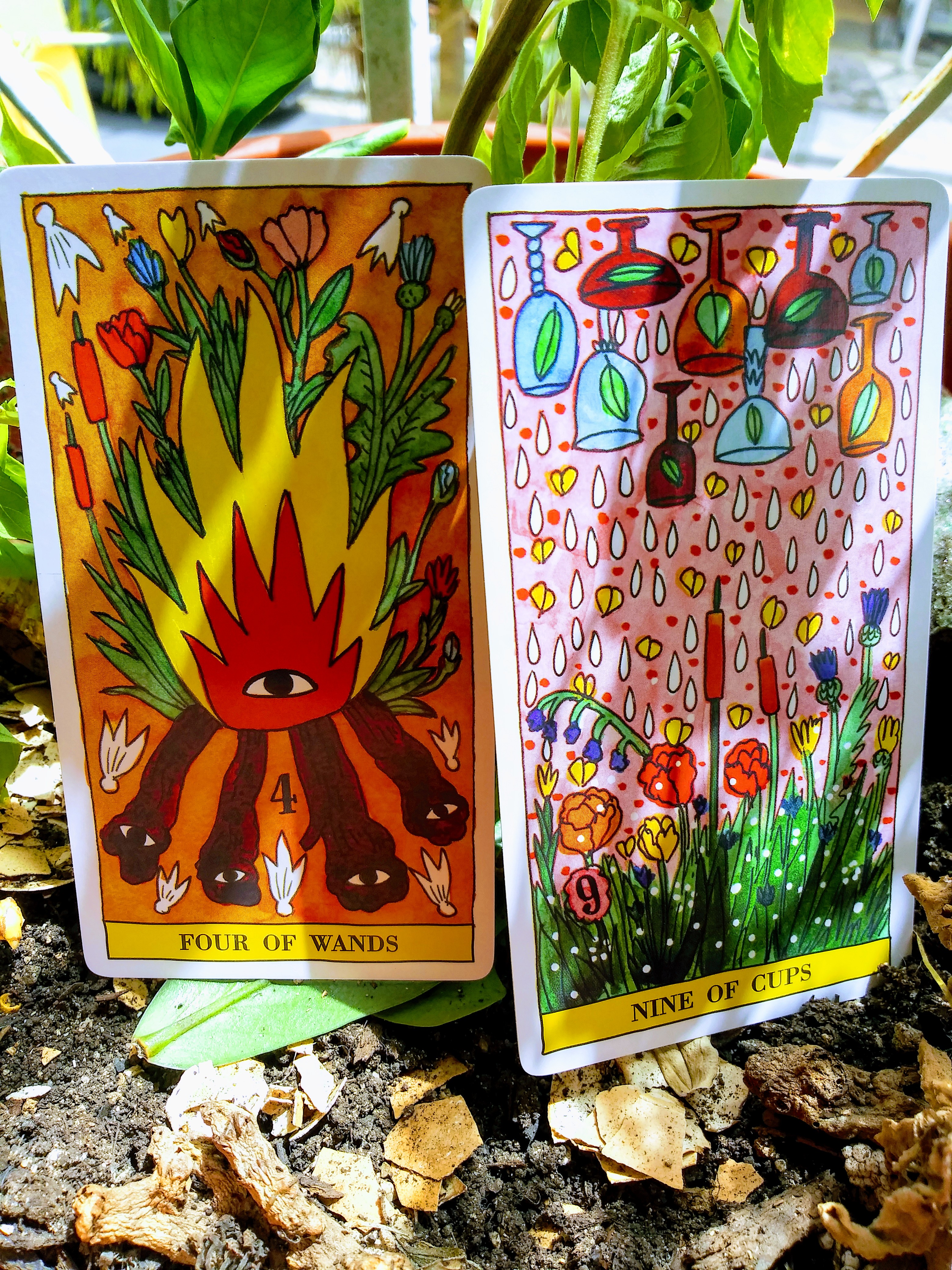
    Tarot del Fuego Fournier tarot deck
    Tarot del Fuego by Ricardo Cavolo published by Naipes Heraclio Fournier, Spain, 2014.

    The eve of St. John the Baptist is here and for me the actual eve, the night, of this day is about imaginal, and not so imaginal, escapades. Wild nights under the starts, ecstatic dancing, and a communion between the living and the spirits (including the dead). Since this is about entering into more fluid territory, I want to talk a little about tarot and dreaming, or dreaming tarot.

    Through my play with the cards I’ve found that dreaming with tarot is an excellent way of loosening the boundaries around the tarot and the signification of the cards. I mean here both using tarot cards to describe (de-code) dreams as well as using the cards for dreaming. What I’ve found through doing this is that the card image bends to dream logic. For example, coins can become mirrors, portals, heads, seeds, fruits, or even summoning circles. What is coin breaks down and morphs into varied shapes and things encountered in dream. The same goes for swords, batons, and cups. What is sword blurs beyond recognition so that I as the reader seeing the cards and having experienced the dream recognize the multi-valent capabilities of the thing portrayed on the card (s), the image. Meanings loose their solid state, warping into imaginal dimensions, coaxed into a realm outside objective frameworks.

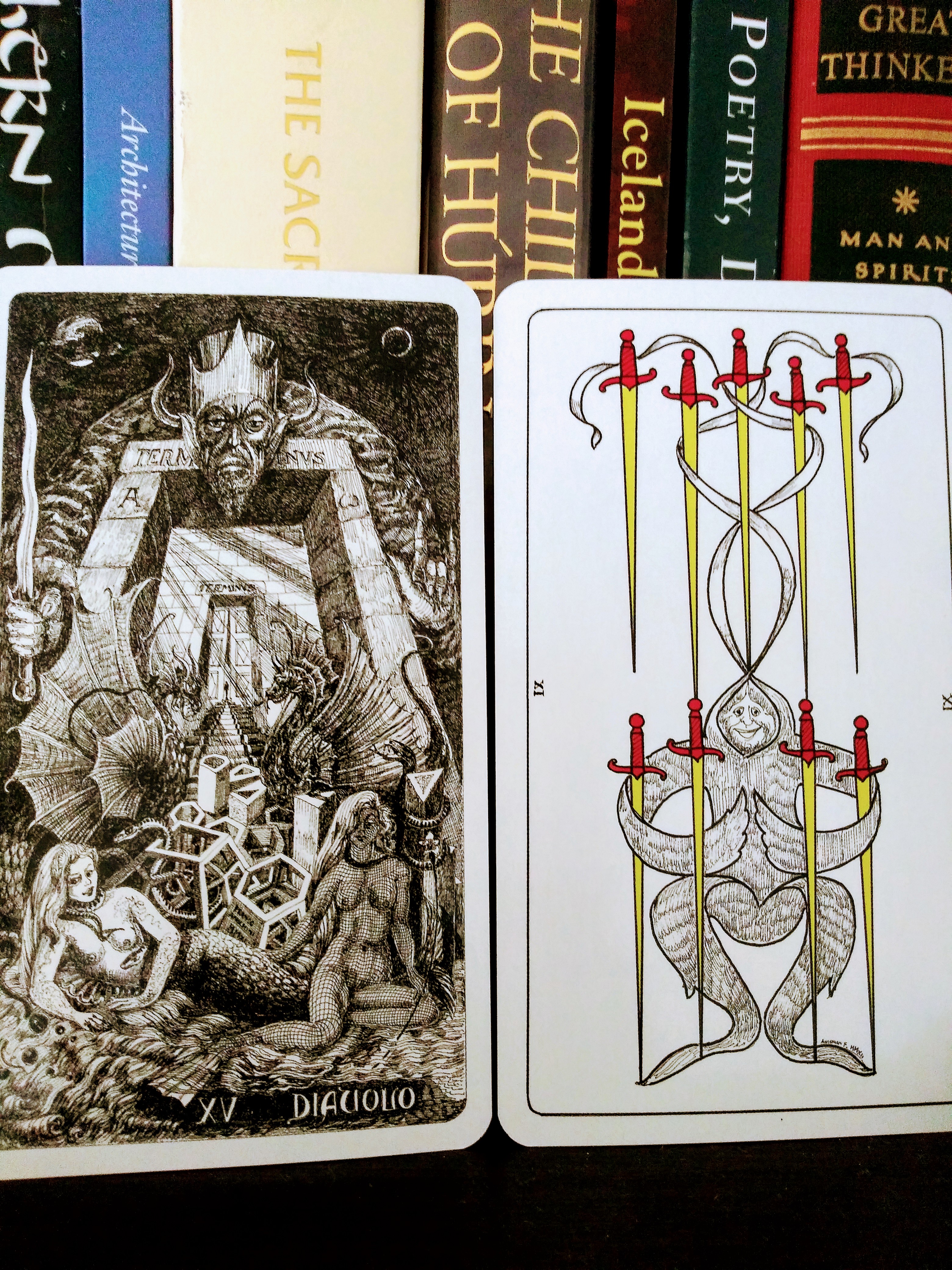
    Fantarocco di Franco Anichini, published by Modiano, Italy.
    Fantarocco di Franco Anichini, published by Modiano, Italy.

    To describe dreams with the tarot:

    • Immediately as you wake up before speaking, shuffle the deck and lay out cards, a handful at most.
    • While you’re shuffling and laying out the cards, ask about your dream, ask the cards to describe it or show you your dream.
    • You want to start small and build up, as if you were having a conversation with the cards. By small I mean lay out a handful of cards first and build up from there.
    • Also, it is best to keep the deck next to you while you sleep, on the night table or the floor.
    • Review your dream as you read the cards.
    • Think about the ways in which the cards on the table/bed describe your dream and what it says about it.

    On the other hand, using the cards to dream, while still allowing for the same malleability of significations and experiences, can also open up interesting and often profound avenues of exploration.

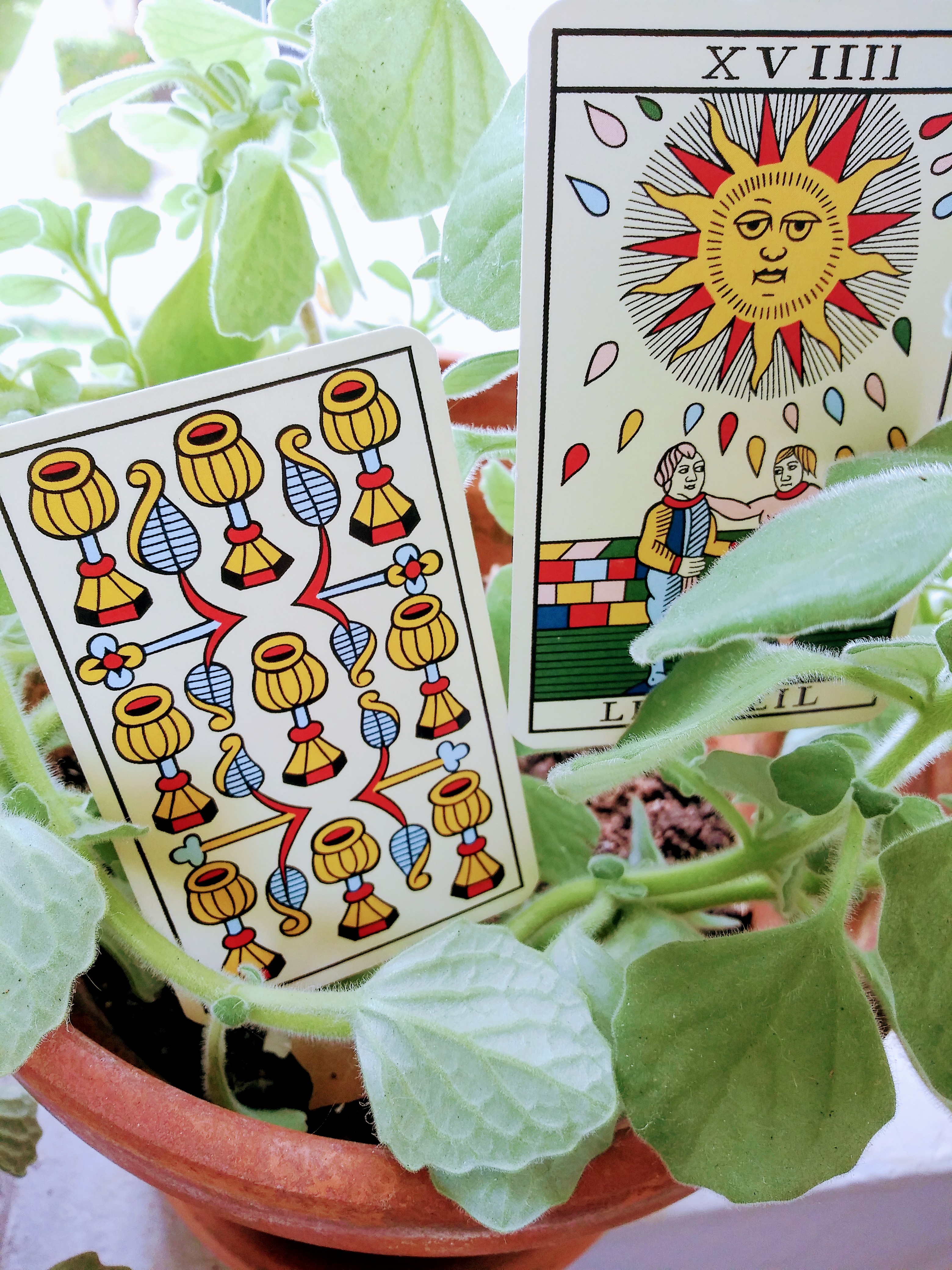
    Jean Noblet Tarot de Marseille, reproduced by Jean-Claude Flornoy, editions le-tarot.com, France, 2014.
    Jean Noblet Tarot de Marseille, reproduced by Jean-Claude Flornoy, editions le-tarot.com, France, 2014.

    To dream with the tarot:

    • Choose a deck, preferably a deck you keep hot, that you use often.
    • Have a question or purpose/focus in mind. (What do you want to find/encounter/discover in the dream? What you want answered through the dream?).
    • Before sleep play with the deck, and look at the images.
    • Take your time doing so, along the lines of meditative contemplation of the cards in the deck.
    • While thinking on your question and/or focus, choose no more than two cards (three or more cards gives muddled dreams), that you feel are descriptive to your goal/question.
    • Look at these cards just before sleep and lay them next to your head before laying down, you can also put them under your pillow if you prefer.
    • Sleep.

    When you awake, recall your dream and look at the cards again, thinking on how they addressed what you wanted to uncover, and also review what you actually uncovered. I’ve found that this method needs to be done often so as to really pinpoint a couple things. One is finding the right hot deck that is conducive for your dreams, to how you dream and your dream landscape, not all decks are the same. I’ve found that the best decks for me are less than a handful from my collection. Second, it is learning the language of the cards within imaginal territory. It takes time to bend toward different ways of seeing and reading the image (s). Third and tied with the second, it takes practice to learn to find what cards best describe what you seek in dreams. This is one of the reasons that it is best to keep the card count for this approach at no more than two.

    Now that I’ve shared a little about what I like to do with the cards besides reading for  querents and for myself, I want to close with a small prayer to St. John the Baptist:

    Sacred precursor of Christ; Sanctified in the womb; Admiration of all in the exercise of the virtues and privileges with which the creator enriched you. Angelic in chastity; Blessed apostle. Martyr, in the constancy with which in your rebuke of Herod you offered your head to the knife. Luminous prophet, of whom Christ himself declared: “Of those born of women non greater than John the Baptist.” Glorious Saint grant unto us the grace of spiritual joy, today and always. Amen.  

    On this St. John’s eve, seize the opportunity to glimpse beyond, divine, dream with the cards, and experience what unfolds for you.

    ~~~

    † I specify tarot in this post but you can replace tarot with an oracle or playing card deck. What is important is that it is a deck you use frequently.

    Natalia Lee
  • Telling Fortunes in Times of…

    In an interview with Sam Block from The Digital Ambler in the Glitch Bottle podcast, he said something about divination that has stayed with me for some time, and it is that divination is for seeing the bumps, or obstacles, ahead as we navigate down the river of life. This has been rephrased in my words as I don’t recall the exact wording of his statement but the sense is there. We ride down this River with a changing the topography and divination helps us see into what possible obstacles loom ahead. I find his assertion to be true. To divine is to peek through the patterns being woven around us, both by ourselves and others. It is to open a thin connecting line between diviner and the divine, so as to see more than. More than our daily sight-lines, more than our quotidian habits, our comings and goings.

    When I look at it from the angle of fortune, as in telling fortunes, I see how each of us carries our fortune, that which is possible, whether through choice or circumstance. What is plausible within what is possible. Therefore to tell fortunes is to glean the probable but not yet formed. It is to gain sight so as to draw details of the terrain ahead in our map. In times of trouble and turmoil telling fortunes, divining, reading the cards, provides “space” for strategiz-ing around agency, creation,and imagination. If we can see facets of the terrain ahead, we can imagine and create ways around or through to move forward.

    Omen logic, or the logic of omens, and reading the cards from this position while also within the context of navigating the River, points toward learning how to see and read the meanings of the unfolding terrain. It is a surfacing of a language that is in direct converse with the landscape (terrain) interconnected with our moving, experiencing, sensing, bodies rowing along the River. It is a surfacing from the world of spirit, which you can also name imaginal. This surfacing can be read as an omen that we interact with and ascribe meaning to in relation with the ways in which our current place reveals what lies ahead down the River.

    I should probably define, from my perspective, River. By river I mean life, living, the things we need to do, want to do, our accomplishments, responsibilities, and relationships. All facets of living are subsumed in the River. We are the ones rowing down this river, encountering boulders, waterfalls, setbacks, curves, diverting tributaries, etc.

    When traveling along this River, omen logic can be seen as the universe noticing us noticing the universe noticing us. I say this and am reminded of Derrida’s signifier. Always pointing toward the signified but never managing to penetrate the boundaries. In a way it is a tension of unmet desires. Reaching yet never grasping. This tension also fits in this rhizom-atic omen logic. Sitting with both premises, there is no inherent meaning in whatever revelations divination affords since we all formulate it with words that are equally incapable of grasping what is signified, and also we are all inundated in a landscape of meanings within a web of connections and interconnections, that is the River, the rowing along, the water below, the edges around the water, the trees, the boulders, waterfalls, tributaries, and curves. We move onward and describe through our own experience of doing and seeing. And so we come back to reading the cards in times of… trouble , turmoil, upheaval, pain, suffering, unrest, pain, loss. In all our living, telling fortunes is useful because it opens up ways of seeing, ways of moving, possibilities for revealing angles/corners around looming obstacles/difficulties ahead, while also allowing us to create new routes.

    With all this said, I do hope you are keeping safe, fighting the good fight. For me to say Black Lives Matter is an understatement, as a person of color from the Caribbean, I know Black Lives Matter. As a way of contributing, from afar, to the flourishing of local communities within this upheaval, I’ve offered readings for donations for the next week or so. No money passes through me, just donate $9 minimum to a local organization. send me a snapshot of the donation with a question to my email mistandaether(at)gmail(dot)com and I will respond with the reading. With this offer on the table, I’m going to go ahead and share a frequently updated document that has links to incredible organizations that are working to be present and provide aid at the local level within affected communities: Reclaim the Block.

    In other updates, I’m currently refining the website as well as my content. I’ve decided to move my auguries unto social media, IG and twitter to be exact, and post them weekly, looking at the week ahead. My website will continue to offer the same content, occasional deck reviews, talking tarot, books, with the addition to more Saints, while also opening up a bit more about what I do and what I think around these topics of what I do, the witch, the spiritism, the animism as an embodied web of interconnected living/being, and everything else in between. I hope you continue to read and enjoy what I write, also sharing your thoughts and ideas, whether on here through comments or by sending me an email. I’m also available for a diversity of readings through my consultation page. Keep going.

    ~~~

    Mist and Ether Natalia Lee Forty Tarot Divinatrix