• Expanding on crossed cartomancy

    It is that time of the year again, September, the month I like to focus on St. Cyprian and St. Justina, as their feast day is in this month. Today as a matter of fact. Seizing this opportunity I’d like to expand a little on crossed cartomancy or what can alternately be termed Cyprianic cartomancy. (For an introduction please go here). I’m going to start with words from Jose Leitao, in an introduction to one of the pamphlets found in Opuscula Cypriani.

    Cyprian-derived systems of divination or cartomancy are complex, variable and fluid systems which, through subsequent publications and rearrangements, find new forms, significances and meanings. This instance should not be considered an inferior pastiche, but actually how Cyprian literature and divination systems function and are generated at each new interaction.

    From a practitioner’s perspective, such an instance underlines how, with each new step in the march of this material throughout history, new systems are meant to be born and synthesized. One does not need to really concern oneself with keeping the purity of the system, because, if the analysis of this pamphlet and all the others present in this book tells us anything, it is that this material is not pure to begin with.

    Toward the end of my first survey of Crossed Cartomancy I briefly spoke about an alternative spread, the tableau, this is the spread I now want to explore.

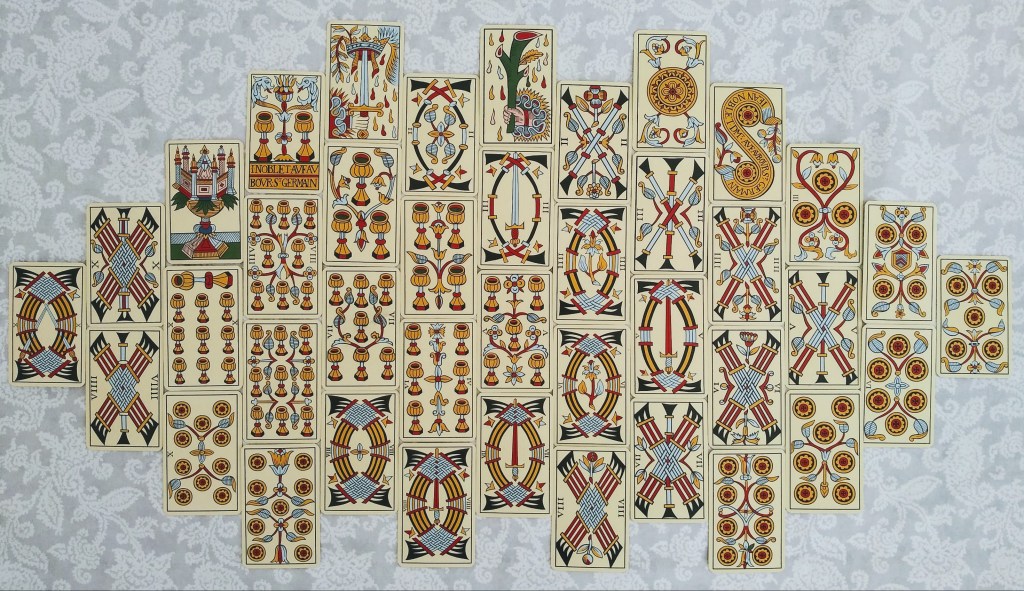
    In the 40 card tableau, the whole pack is laid out in five columns, with eight rows. The central pillar or column is sometimes called a novelty. This happens when there are no courts in this column. When a novelty occurs, the querent gets to ask an additional related question. Here it gets tricky as the rest of the cards are then picked up and reshuffled, saying the orisons, 21 are placed directly on top of the pillar, which remains unmoved, and then the remaining eight cards are spread in a cross, each hand having two cards. You will be left with three cards in your hands, these three will answer the additional question. There is no explanation as to why the elaborate process, but I think it has to do with the numbers. Rather, the meaning of the numbers in relation to the shape that is being used in the spread. The tableau is also read in the same mirroring way.

    Here are a couple images from the book illustrating the method of reading the tableau.

    One can see here that two possible ways of reading by mirroring is offered, one is starting from the two outer columns, the top card with bottom card (Ace of spades with 4 of clover), the other is mirroring columns side by side as in the second picture. To be honest, from the several examples given in the book, most are clunky at fully explaining how to read the tableau well. Moreover, what I’m interested in here is seeing what I can coherently form out of what is given in the book. Therefore we have here the 40 card deck, Ace-7 in the suits, with all the court cards.

    Naipes españoles, la baraja española.

    So we can start from the farthest two columns, reading the cards that mirror each other at an angle, whether from top-bottom or bottom-top. As an example, I will use a set of significations from Opuscula Cypriani, and I will not pose a question to the cards just read them and create a story.

    • a lover’s letter 11 of cups+2 of cups
    • sent by courier, through paths 11 of coins+6 of cups
    • is received with joy at the banquet/dinner 7 of cups+3 of coins
    • sharing good words of recuperation from an illness 3 of cups+5 of swords
    • The father, opposed to the love affair, intervenes 11 of batons+12 of swords
    • creating strife in the house 4 of batons+11 of swords
    • with the five senses (in full awareness) 5 of batons+2 of coins
    • the lady quickly determines to change plans 6 of swords+10 of swords
    • not thinking twice about severing ties 2 of swords+3 of batons
    • she determines to follow her passion 7 of swords+10 of batons
    • and with the help of a friend escapes to a church 4 of coins+12 of batons
    • affirming that bad words sour relations ace of sword+3 of sword
    • this is an opportunity to take courage 10 of cups+ace of coin
    • a novelty that allows her escape 5 of coins+4 of cups
    • She sends a courier through slow paths 10 of coins+2 of batons
    • hidden by the night with the message of promised pleasures to her lover if he meets her in the church 7 of batons+ace of baton

    I embellished a bit and quite a scandal of a story arose from the spread, I’m also not finished as I left the middle column alone, since, as per the book, this is where one judges whether the column is a novelty or not based on there being court cards. In this case, there are court cards, deeming the column a novelty.

    Novelty is not clearly defined in the cartomancy sections of the book. There is only the mention of an additional step should there be one. As mentioned above, one leave the cards (in the column) on the table yet removes all the other surrounding cards; shuffling them and laying them back down in a cross above the cards already on the table. Given that my aim here is to read the entire tableau in one go using crossed techniques, how to keep the novelty, and yet not have to do the part of removing the other cards? A novelty as per Merriam-Webster dictionary is defined as “something new or unusual.” Perhaps, if there is a novelty one could allow the querent/sitter to ask a new question, based on the reading of the other cards so far, and the answer would lie in reading this column alone. This would create a sort of closing judgement on the reading overall, a closing statement. If there is no novelty then one reads the entire tableau in one go, no new questions added. As there is a novelty here, let’s say the lady asks the cards if the lover will respond to her couriered letter with arriving at the church to sweep her off her feet.

    • indulging in luxuries, the lover 12 of cups+12 of coins
    • will receive the lady’s message, in bed with another, at a party ace of cup+4 of swords
    • only tears and heartache would the lover bring, for they are impoverished 5 of cups+6 of coins
    • being a zealous gambler and swindler 7 of coins+6 of batons

    In the end, the lover will not arrive to rescue the lady, and she will have left her home for no good reason. Since this is a straight vertical line of cards, the crossed reading would be done by reading the cards that mirror each other, starting from top+bottom and working inward.

    As this is a very straightforward approach to a crossed tableau, one can actually play with other types of decks, such as the Lenormand which has playing card inserts.

    Maybe Lenormand by Ryan Edward published by US Games, 2016.

    The key to following this method is in laying the tableau so as to have an odd number of columns, nine for lenormand, and five for a 40-card deck. This would allow for there to be a column that stands alone after pairing the others in reading them.
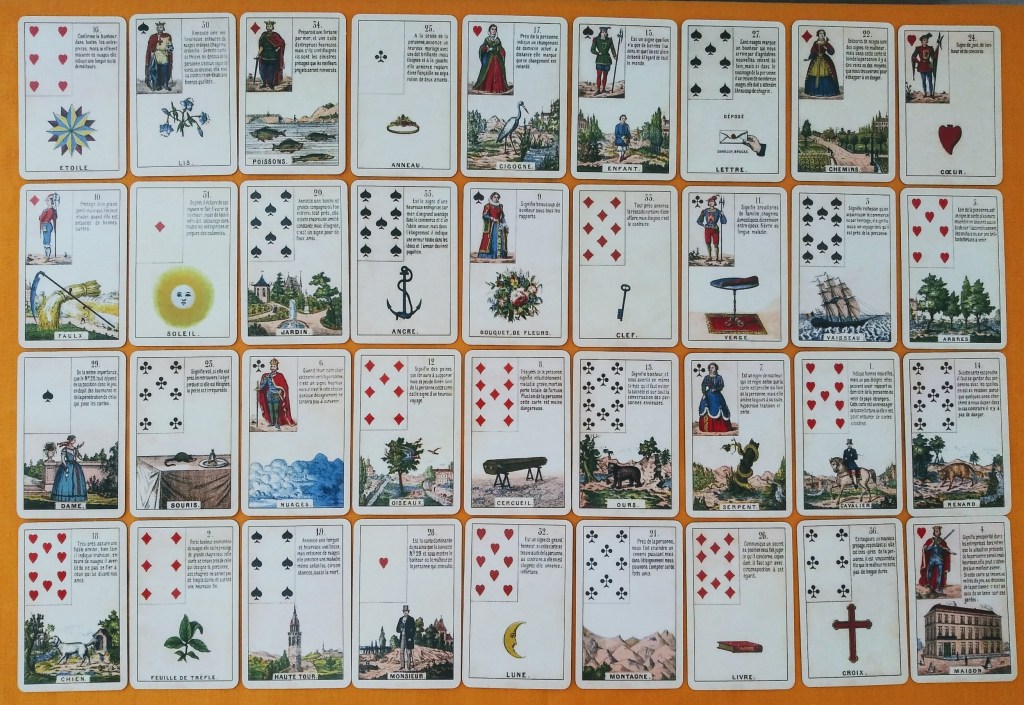
    Caitlín Matthews’ Daveluy Lenormand Deck c.1860, reproduced by thecartomancer.bigcartel.com, 2020.

    The way I see it, Cyprianic cartomancy or crossed cartomancy is about seeing across things, for looking at the corners that frame and reading from there toward the crux. From the edges you put together arbitrarily distant points, making your way to the center, the heart of the matter.

    There are other considerations I’m thinking about in relation to playing with this tableau and keeping to a cross reading. In the end, it is about finding the threads that you can work with. In the example I gave above I used the significations from the book, but you can use your own significations, what matters is arriving at the heart with the answer. I will add if you are in the market for a book on reading playing cards, a very good one I recommend, with an excellent survey of playing significations, and ways to use playing cards for divination and magic is Professor Charles Porterfield’s A Deck of Spells: Hoodoo Playing Card Magic in Rootwork and Conjure.

    May all your divinations alight on the heart of the matter at hand.

    Icon by Biso, Saints Cyprian and Justina. Icon a gift to the church St. Kiril and Metodi, Slivnitsa. From Wikipedia, 26 September 2020.
    • Jose Leitao, “Opuscula Cypriani.” Published by Hadean Press, 2019.

    ~~~

  • “Sorcerous Poetics”

    I originally began writing this as an exploration of historiolae and their narratives within a Cyprianic context. To be sure, historiola as a thing is the basis for this piece, but my focus has changed. I want to zoom in on “Saint Cyprian as a Healer and Further Considerations on Sorcerous Poetics” from Jose Leitao’s Opuscula Cypriani, specifically on that last part, sorcerous poetics, elaborating on ideas around my personal perspective; how I see incantations, the lyricism of the charm or historiola, and what it portends to utter these lyrical narratives. My exploration will be via a collage of sources from several books and places, with my thoughts interspersed in between, as inspiration has led me.

    In crude terms the historiola is a narrative (often rhyming) one voices in order to achieve X desire. The charmer (or insert whichever title preferable that points to the one who voices the narrative), as an individual within a community and immersed in a landscape, is a person embedded in a living terrain of interactions. This terrain is like a breathing web of continuously moving connections. Immersed within this web, the historiola can be seen as a thing that erupts like an out-breath through the voice, a self in response to the terrain and to desire. From Henni Ilomaki’s The Self of a Charm, “Charms can be seen as an act of communication, in which it is assumed that the singer’s message has a (supranormal) recipient. A charm can thus be seen as speech (parole) containing a given message. Formally speaking a charm is a monologue uttered against another’s force” (53). They are “texts for specific rites, for which the reciter must be entirely committed; a vehicle for momentary yet intense influence, which draws each charm-reciter into that influential power” (55). The historiola as a charm enfolded with a specific desire, arises out of a milieu like an out-breath, and it is inextricably in-relation with the (a) terrain, the body, the voice, the charmer, all within a web of reciprocal interactions.

    In David Abram’s The Spell of the Sensuous he illustrates how we, people, live in a an embedded perceptual field of meanings in an animate flesh-world of relationships, not just human to human, but human and the landscape, the topography, the flora, the fauna, etc. His “field of meanings” is what arises out of this sensuous relationship between the human and more than human embedded in this landscape. It is a web of interlaced threads, the human perceptual experience in place, the more than human, and the terrain within a temporal influx and efflux.

    We are all participants in this field of meanings, within a conversant constantly interacting landscape. From here Abrams proposes arises language. Language arises out of this interconnected perceptual experience of place. The voice and the breathe give a form to experience, yet semantic-ally condensed. “The sensing body is not a programmed machine but an active and open form, continually improvising its relation to things and to the world” (49). All are in continuous sense-uous involvement and by “affirming the animated-ness of perceived things do we allow our words to emerge directly from the depths of our ongoing reciprocity with the world” (56). Hence, as our bodies are enmeshed in this breathing web, and if language is met in the body, through the body, as in the body as a place of encounter, then voice is another expression of the body in relation to the living terrain of forms and beings. Moreover, when what is voiced mirrors this lyrical involvement of form and movement, then potentially one enters into a field of creation through influence.

    Now I want to slide into Sorcerous Poetics.

    In the typical realms of Cyprian magic, the incantations used most frequently take the form of historiolae, stories, be them canonical or not, through which a certain power, entity or aspect of that power or entity is called forth for a particular action to be named and discussed in the remaining incantation. [Involving] linguistic artifices that produce a sought-after sound in order to make up what might be perceived as a powerful utterance.

    The presence of such linguistic and poetic tricks brings us to the idea that there is no monolithic source of power when dealing with verbal folk magic. One may call upon a Saint or spirit through a predetermined incantation specific for that effect, but one can also apparently call on a certain ‘faceless’ power by the skilled use of voice and sound. Such an example can be seen in incantations which, while not calling on any power whatsoever, are used to gain power over a disease or evil by describing it in appropriate poetic verbal terms.

    Therefore, when an individual within a community in-cants particular verses, themselves arising within a particular milieu, expressing a desire through voice, said individual enacts its participation in the multifaceted field of forms and relations, of sensuous involvement, and through this enters into a field of creation where reordering through the voice (what is spoken) is possible, as, “In the Beginning God said… and in the Beginning was the Word.” The keys here are enunciating the “appropriate poetic verbal terms,” cohering the rhyme and the flow. Hence, the key is unlocking the rhyme that mirrors the temporally emplaced interactions in the field of meaning, translating desire (what is desired) through this web to allow for influence/change. One can see it as a spontaneous dance between desire and the breathing web, where the poetic voice is the vehicle that influences.

    In his commentary, Jose Leitao is focusing specifically on folk magic within a Cyprianic context. Yet I find that one can dive into this and need not conscript it to folk magic, and extract it as such exclusively. One can instead perceive the jewels and gems that form historiolae, and from there explore ones own participation within ones own animate landscape. Voicing for oneself a lyrical involvement, in-line with a Cyprianic context yet embedded in one’s own terrain.

    To condense what I aim to express, if language arises in relation, and lyrical language holds the key to express this reciprocal web while also allowing for desire to be a channel for creation, then taking a cue from Jose Leitao, we can begin to weave “our” own historiolae fed by the same Cyprianic stream.

    My aim here was to cohere a thought by various ways, a thought that arose out of, and inspired by, this section of Opuscula Cypriani written by Jose Leitao. True to form, towards the end of this section he adds his own lyrical creations given as examples, cementing the idea that Cyprianic charms or historiolae can and should be contemporaneously explored.

    • David Abrams (1996). The Spell of the Sensuous.
    • Henni Ilomaki (2004). “The Self of a Charm.” In Charms And Charming In Europe, ed. by Jonathan Roper (pp. 47-57).
    • Jose Leitao (2019). “Saint Cyprian as a Healer and Further Considerations on Sorcerous Poetics.” Opuscula Cypriani (pp.103-11).

    ~~~

  • The Oracular Incantation

    We begin in a hall like a cathedral full of echoes, enclosed by high stone walls. There is a cup, a breath disturbs the waters of this upraised cup, prayers are intoned. Within all is holy. Beyond, a sword stabs the earth, sinking deep and disturbing the soil, echoing the words, “the earth gives and the earth takes away.”

    Next, the breathe speaks with utterances of love and desire, and a tipped cup spills into another, coaxing a third to birth. While the hand that gripped the handle pulls the sunken sword, standing in a clearing with a sigh of relief as the frenzied moment passes. “Now let’s make our way through this forest.”

    Seeing eye to eye is a matter of negotiation, discerning through exchange, a temporal dance. A construction, a reconstruction, a formulation and an articulation of definitions and significations. A play of words and body, re-created and re-arranged. The art of form expressing itself through temporal movement entwined with the voice. Walls and fortifications built around need and mediation, the tension.

    Suddenly a hush descends, the silence of recognition for the word symmetrically expressed. The word and the image dance. The sound of equilibrium. The flesh moves within this frame, inhales, exhales.

    Then the great doors groan open, outward flows the nave, an axis mundi in motion. With this opened course, the heart and the body moves, the mind following. Where places unknown, a labyrinth yet to be voiced, lie unseen.

    Diamonds, cups, grail, scepters, swords, sticks, coins, daggers, branches, leaves and hearts. Things, all things we use, tools for the hand and the flesh to encounter. Except the heart, the heart which we always carry inside, yet on occasions, we find it spilling outward in bursts or trickles. When the axis mundi tilts, these Things slip from our fingers to fall in a clatter at the threshold, a cacophonous array at our feet, complex-ifying the exit, entangling the flow. With this a brigade of thoughts invade the mind, what to take and what to leave behind. Locating desire the fulcrum of the quest. Enough!

    The stairs appear, that were always there, winding endlessly up and down, down and up, above, below. Ways, roads, paths and courses, winding outward beyond the reach of our sight.

    Between the tower and the star, the fool stumbles onward, a pack full of fallen tools gathered along the way, resting on his shoulders. From a little to a lot, and often gathering in between stops, the inhale and the exhale continues. From one, the many stumbles out in brazen nakedness, a coagulating web of movements, forms, and omens. Signs of things that are, are not, will be, or evanesce into the mass of all else. The expressive self, emplaced, mirrors the sign, mirrors the body, mirrors the sign, in circles we go. To end and begin anew. The snake swallows its tail.

    Jean Noblet Tarot de Marseille, reproduced by Jean-Claude Flornoy, editions letarot.com, 2014.

    ~~~

    -For the beginning, go here: Animating the Tarot Pips.

    Animating The Tarot Pips by Natalia L Forty is licensed under a Creative Commons Attribution-NonCommercial-NoDerivatives 4.0 International License.
    Based on a work at mistandether.wordpress.com

  • “When outside forces impose”

    I’m quoting myself in the title, it’s from my lyrical exploration of the tarot trumps, or majors. June and July have flown by, maybe it’s more like a rumble, they’ve rumbled by. Now we’re in August and I’m thinking about the world, the card in the tarot pack The World or Lemonde as it’s called in some older packs.

    The Spanish Tarot published by Heraclio Fournier, Spain; Tarot de Marseille Jean Dodal reproduced by Jean-Claude Flornoy, France 2009.

    In a wreath like a cocoon, holding a wooden stick, looking back and appraising what’s been left behind, if you take the left as being in the past, or she could just be trying to look behind her. The naked self in confined contemplation, thinking back on what has passed while keeping to the present. We’ve all been in this contemplation of place, our movements restricted, feeling the vulnerability of isolation from what was, within this new unfolding world. We’ve all been placed in a position of evaluating where we stand.

    While I could say that this person, the one in the card that ends the trumps series in the tarot pack, rises above the crowd crowned by all the four corners, robed and scepter bearing, they are also in a place of alienation, of being separate from. Depending on how I look at it, I’m either in the crowd of onlookers or the person in the center, apart. This is a good card to take forward as the second half of the year continues rumbling onward. It gives me the vigor to bring forward.

    Let’s consider this, how are your fours corners? What is the condition of each? Solid, wobbly, vulnerable? Did you find and don your cape? Yes, cape. What you will carry with you to whatever comes next, when the cocoon opens and the seed sprouts. This cape will be a protection, a security, a covering, and also the cloth that connects you to the air, the rain, the earth, as it and the elements encounter each other it becomes a thing of relation, of connection. How are you shoring up your self when outside forces impose? How are you putting the stick that is a wand to use? Are you directing the way forward for you and your home in flow with the movement of your cape?

    One day the germinating seed will spring up out of the cocoon and the road will open in different directions, as it always does, and we should be constant in our readiness to expand and keep walking.

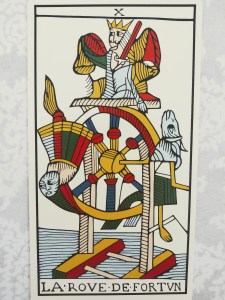
    Lemonde closes the tarot trump journey, if you see the cycle as a thing that is linear, but the journey is a web of directions and temporal overlaps. Time is a breathing rhizome. Lemonde knows this secret, and shows us how they are both within and without, above and below, enclosed and open. Lemonde is the seed that opens like a plate in the ace of coins. Perhaps going even sharper, Lemonde is the rider on the wheel of Fortuna.

    Tarot de Marseille Jean Dodal reproduced by Jean-Claude Flornoy, France 2009.

    With this I open the month of August, contemplating The World card. I’m also going to mention that I have a newsletter, it’s in its nascent stages but I have a lot of dreams to grow it into something beautiful, like a crimson hibiscus. In the newsletter you can find oracular omens, stories from and maybe about me, updates, and things that are wafting through my mind. You can click on the link above, or on the image below to hop onboard and stay in the loop.

    I have a couple reviews for this month, one of them being on the recent book I devoured, The Way of the Rose: The Radical Path of the Divine Feminine Hidden in the Rosary by Clark Strand and Perdita Finn. And you will also be seeing my oracular incantation on Animating the Tarot Pips.

    ~~~