• Fortune’s Fools Lenormand

    Things have been quiet around here as I’ve been focusing on my newsletter and building closer contact with readers. But as things are always in a constant flow of change I now desire to open the doors to more frequent writing on here again. So I creak open the door with a deck review.

    For the past couple years I have not been participating in the acquisition of new tarot decks as I feel I have a good and decent collection, I am satisfied. What I have been doing, on and off, is keeping an eye out for playing card reproductions that catch my eye. Well, this year a deck was published that I have been following for a while. It is a Lenormand deck, a strikingly iconic Lenormand deck. Iconic in an emblematic sense, and this is the deck I want to talk about now.

    The Fortune’s Fools deck is a creation from and with the times, to be precise and per the guidebook it “is a two-year collaboration between Gordon White and Scottish illustrator, Colin Alexander.” What is really, I have to say, cool, about the deck is that it is truly a communal and collaborative creation, since it was created through youtube lives, with active participants in the conversation of each of the cards. “The finished product (the deck) is as good as it is thanks to the generous collective insight of the RuneSoup community.” So besides being a collaborative creation, it is also, given the medium through which it arose, an international creation, with voices from diverse parts. For all these reasons, before diving into the aesthetics, it is a unique fortunetelling deck with it’s own particularly strong voice.

    “We have also sought to make the deck more of a global, polyvalent affair, rather than cleaving too close to Lenormand’s European pastoral tableau. And so the whole thing is a love letter to rich, adventurous engagement with a vibrant, living cosmos.”

    I’m going to swerve into the aesthetics. The technical points are, it is printed on a premium matte black cardstock, with high intensity color images, from my perspective high intensity as the colors really do pop out against the matte black background. The playing card insets are included in the cards, which is always a plus in my book. I don’t believe it was specified in the guidebook but the deck is poker size, allowing it to be manageable for big spreads. The card edges are black, and it comes with a 161-page book on fortunetelling. The book is divided into two parts, the first part is on how to step into becoming a better fortuneteller with any deck. The second part is a overview of each of the cards in the deck. Admittedly, I purchased the whole package, partly from wanting the deck but also because I really wanted the book as well.

    I have read a good amount of Lenormand books, and mostly all of Camelia Elias’ writings on Lenormand card reading. My favorite book being Lenormand Thirty Six Cards: An Introduction to the Petit Lenormand by Andy Boroveshengra. But I wanted to read Gordon White on fortunetelling, as he has mentioned previously that this is his fortunetelling book.

    It does not disappoint, re-enlivening the landscape of telling fortunes, weaving in the whole animate cosmos in light of what it means to tell fortunes, reading signs, and symbols. There’s a brief history of Madame Le Normand, of cartomancy in general as well as tarot, and then it dives right into the metaphysics of play and omen logic. No corner is left untouched in the fortunetelling section, it is succinct, to the point, yet eloquent, as it guides the reader around the world of telling fortunes.

    In the second part of the guidebook, each of the cards get roughly 2 pages of descriptive information along with reading examples, keywords, and even songs to think with that go with the card. Which is a fun rabbit hole to jump into, listening to the songs for each of the cards. All in all the guidebook is excellent, and serves as an excellent companion to the deck.

    What else can I say about the deck other than it is saucy, talkative, colorful, and easy to use. The images are well defined and easy to read. I will add as a caveat, as someone who uses glasses, that all except 2 of the cards were easy to recognize. The two exceptions for me were the house and the mice card. Now that I know them I don’t get confused, but initially I did need to turn up the room light to see them better on the spread.

    Speaking of lighting, the cards are well suited to moody, atmospheric, candlelit readings. It is very apropos to the feel of the deck. Actually, I will add that the deck is also very well suited as a trusty traveling companion, for unexpected encounters, engaging in new landscapes, and exploring different places. It is adventurous.

    On shuffling, they shuffle wonderfully smooth. Flexible cardstock. For overhand shuffling, the cards do tend to stick together initially but ease into it with use.

    Here are images of a grand tableau, in thinking with Gordon’s words on this spread:

    The grand tableau is the most animist of layouts. Along with the more than human, quotidian motifs of the Lenormand oracle, it offers up to the skilled fortuneteller a web of complex relationalities and a process-oriented way of seeing we have almost lost. It is quite literally a jungle (White, pg. 80).
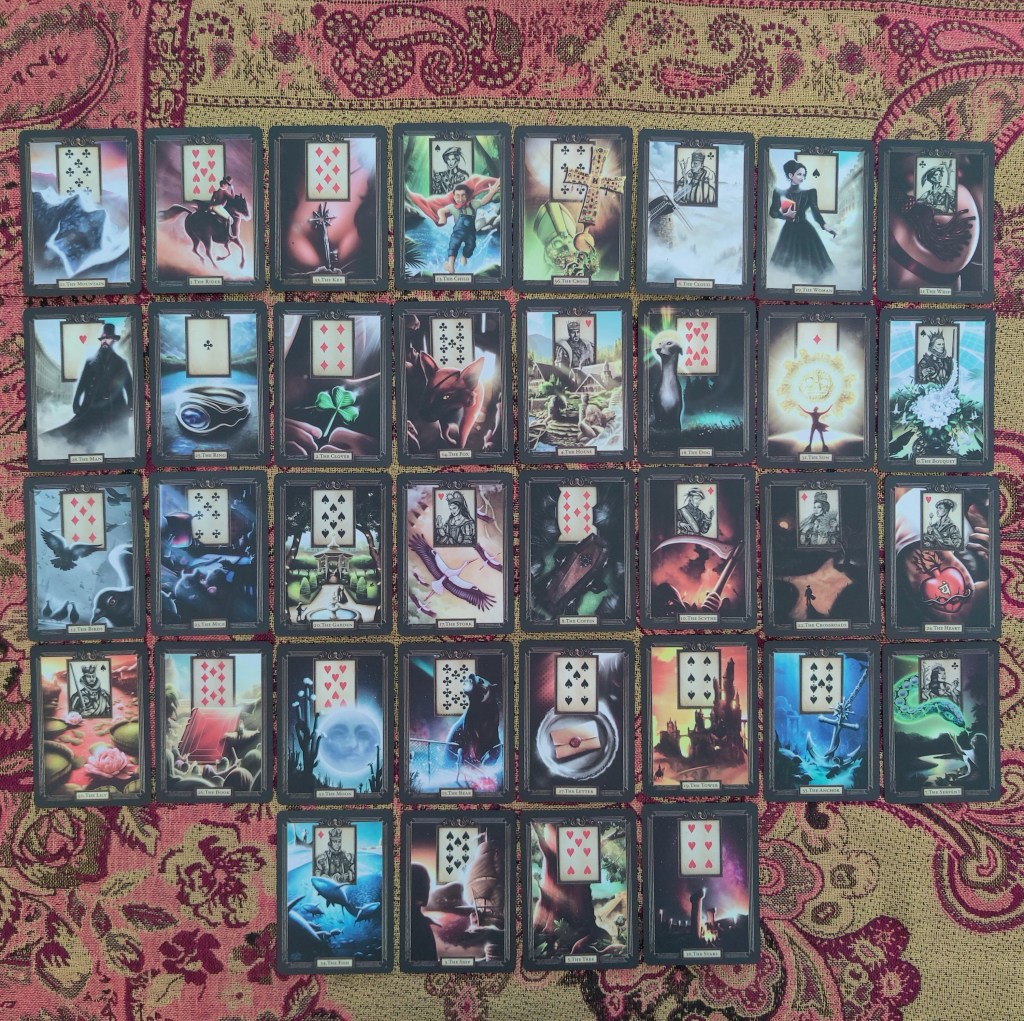
    All in all I heartily recommend this deck for fortunetellers, cartomancers, and diviners. It is a deck that walks both with tradition, while also surmounting boundaries, it is daring and fresh.

    • To watch all the cards as they are born, see this youtube playlist: here.
    • To purchase the deck: Fortune’s Fools.
  • Clearing the waters: Cyprian and the seafarers

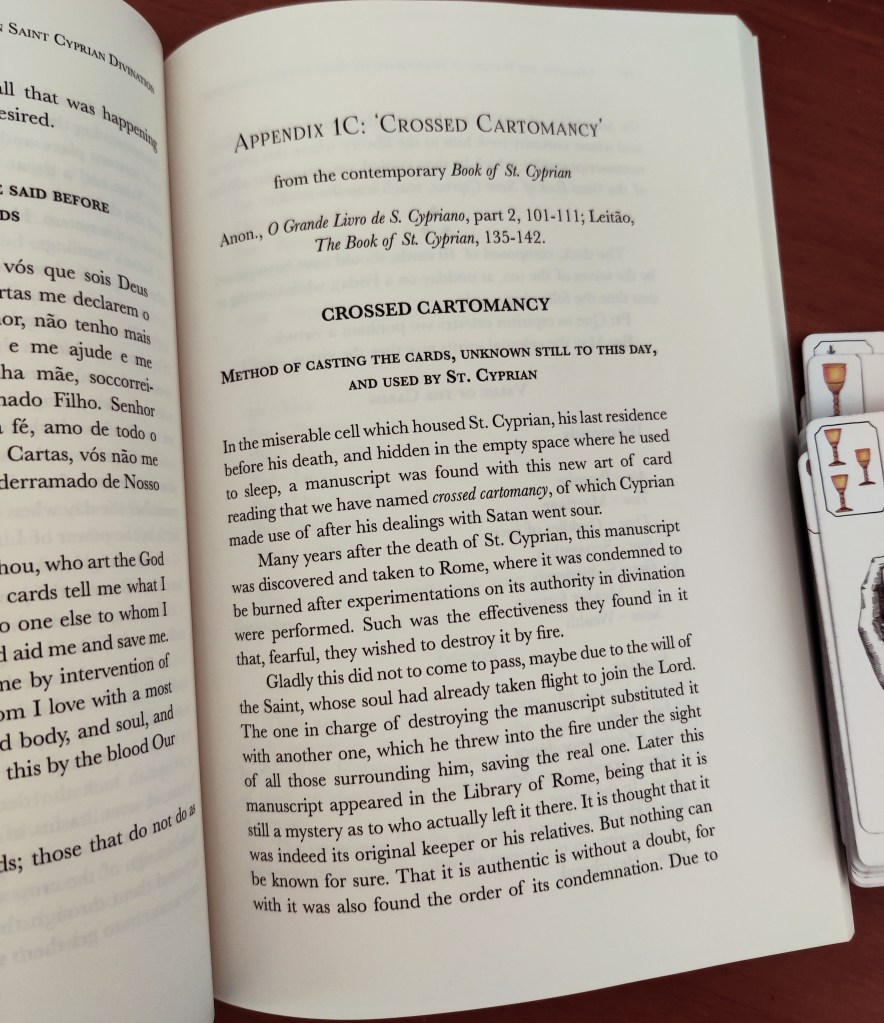
    Recently, I sat down and read one of the latest publications from Hadean Press by Jose Leitao, Clearing the Waters: A Monograph on Saint Cyprian Divination From the 17th to the 19th Century. It is a compact book, 142 pages long including the index, that explores divination through a Cyprianic lens, especially filtered through the iconic historiola:

    St. Cyprian,

    Seven years the sea thou roamed,

    To learn news of thy lady

    Seven [lots] thou threw in…

    Thy luck thou took out right…

    I ask thee now my dearest miraculous Saint,

    That thou discover this for me.

    (pg. 15, Leitao)

    On the practical specifications, the book is divided into two parts. The first being the monograph, or the exploration of Cyprianic divination methods both via inquisition records and through the published Cyprian books, and the Appendices. The font is well spaced and easy to read, and the book includes both a lengthy bibliography and an index. It is more or less trade paperback size, slim, and easily portable.

    The first part offers a thorough study that allows the reader, especially one interested in divination and it’s changes through time, a look into how Cyprian divination methods shifted and morphed. Focusing on hydromancy and its offshoots, like favo-mancy (divination with the fava beans) and reading playing cards.

    Through the lens of this historiola, and its use in hydromancy, the landscape wherein these practices (or doings) flourished unfolds. Which to me feels it did so in between, or amidst, a sort of threshold between rural living and the growing urban milieu. I will quote here from the book regarding hydromancy and its attendant historiola:

    Noticeably, the majority of questions addressed in this form of divination tended to deal with the determination of the health status, survival, or fidelity of traveling or seafaring men. In this way, it filled a very specific purpose within the extensive arsenal of the early Portuguese urban folk magician, which could help explain why this was never the most common divination used within this magical milieu. Overall, general questions on love, wealth, or any other mundane preoccupation could be much more easily addressed by any other form of divination, and this one, given its clear seafaring motif, was likely relegated to questions concerning seafaring travelers.

    (pg. 32)

    With the changing tides, and from the variability of procedures and incantations associated with divination, both including and circling around Cyprian among other popular Saints within the Iberian (and consequent transatlantic) landscape, it is not surprising to find that the incantation of Saint Cyprian roaming the sea seven years transformed to envelope more of the growing urban terrain. A sort of expansion and inclusion, wherein the commonality of divination through playing cards came to reach more ground. Like a rhizome entangling and reaching outward, and growing and flourishing in different and particular ways.

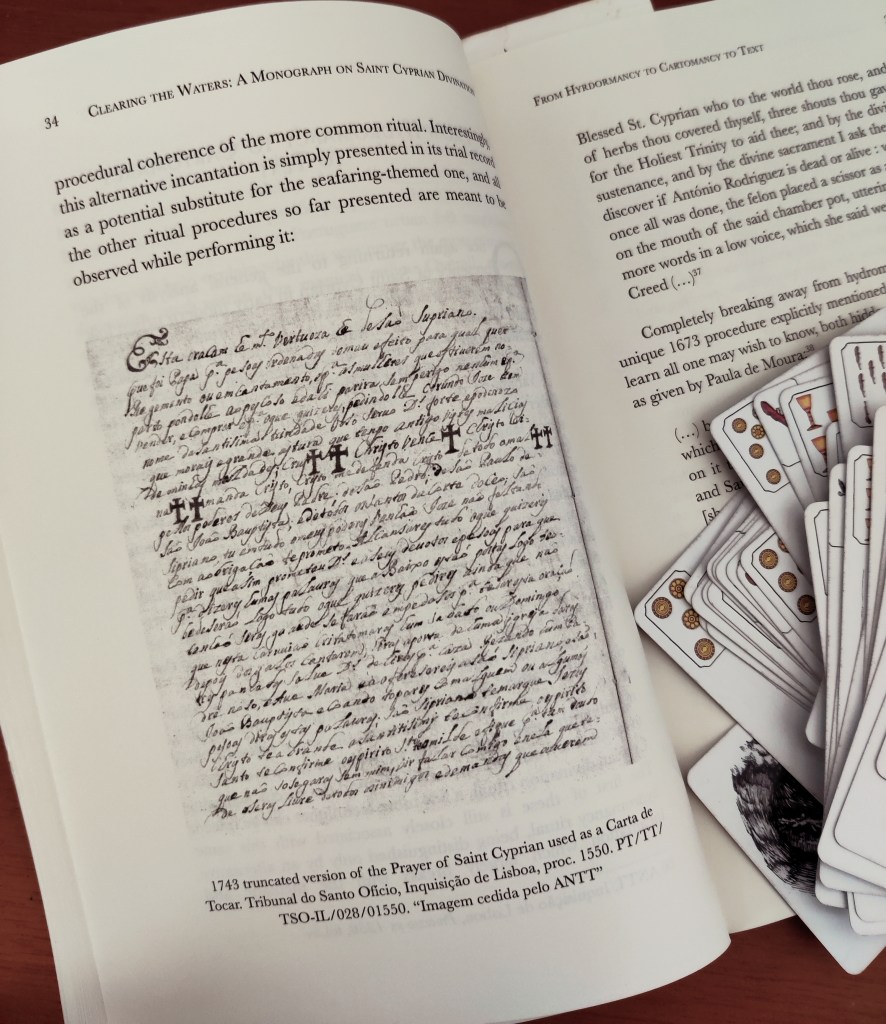
    One key aspect of the book that stands out for me is the translation and inclusion of details on inquisition records and the methods described therein, reaching outside cartomancy and hyrdromancy. For example, there is also a look at divination with fava beans, and another for seeking voices, “the search for answers to a question based on random words heard on the street or during specific religious ceremonies” (37).

    Toward the back in the appendices, one has a look at specific cartomantic methods and examples taken from the Book of Saint Cyprian. One also finds a deeper look at the different inquisition records in dual language format, Portuguese and it’s translation into English.

    In totality, this little book contains a treasure trove of methods and procedures, along with a rich monograph exploring the transformations of Cyprianic cartomancy through a changing landscape. Unfolding for the reader the rich soil wherein many of the now contemporary methods grew and flourished. As an historical document that delves into a unique area of inquiry it is invaluable, and as a practical book it is an excellent resource for any diviner, cartomancer, and magic practitioner.

    A couple personal notes: I find it curious how this particular seafaring incantation came to circulate around Cyprian, how water and water divination comes to perambulate around the saint. It also reminded me of “La plegaria del naufrago” frequently prayed in spiritist circles here in the Caribbean,

    Torna tu vista, Dios mío, hacia esta infeliz criatura

    no me des mi sepultura entre las olas del mar.

    Dame la fuerza y valor para salvar el abismo,

    dame gracias por lo mismo, que es tan grande tu bondad.

    Si yo, cual frágil barquilla, por mi soberbia halagado,

    el mar humano he cruzado, tan sólo tras el placer;

    déjame, Señor, que vuelva a pisar el continente,

    haciendo voto ferviente de ser cristiano con fe.

    Si yo con mi torpe falta me he mecido entre la bruma

    desafiando la espuma que levanta el temporal,

    te ofrezco que en adelante no tendré el atrevimiento

    de ensordecer el lamento de aquel que sufre en el mal.

    Y si siguiendo mi rumbo he tenido hasta el descaro

    de burlarme de aquel faro que puerto me designó;

    yo te prometo, Dios mío no burlarme de esa luz

    que brilla sobre la cruz por el hijo de tu amor.

    ¡Oh! Tú, Padre de mi alma, que escuchas al afligido

    y me ves arrepentido de lo que mi vida fue.

    Sálvame, Dios mío, sálvame y dame, antes que de cuenta,

    para que yo me arrepienta en el tiempo preciso. Amén

    Colección de Oraciones Escogidas del Nuevo Devocionario Espiritsta (English translation)

    In my view, I can see how a divination method and incantation specifically targeted for the seafarer can transform, given the transatlantic movement within and around Iberia, to encompass a more diverse milieu, and used to seek answers beyond the realm of the seas. If one takes living as a voyage upon the seas, and we each as seafarers in the seas of life, then it is easy to perceive how the various forms of the incantation transformed to include more methods, including the cards, and hence addressing a wider variety of life questions.

  • A 12 month spread…

    In the beginning of the month I mentioned that I would be adding a reading option to my offerings, today is the day I do so. What I want to do here is share a little bit on how the reading will work.

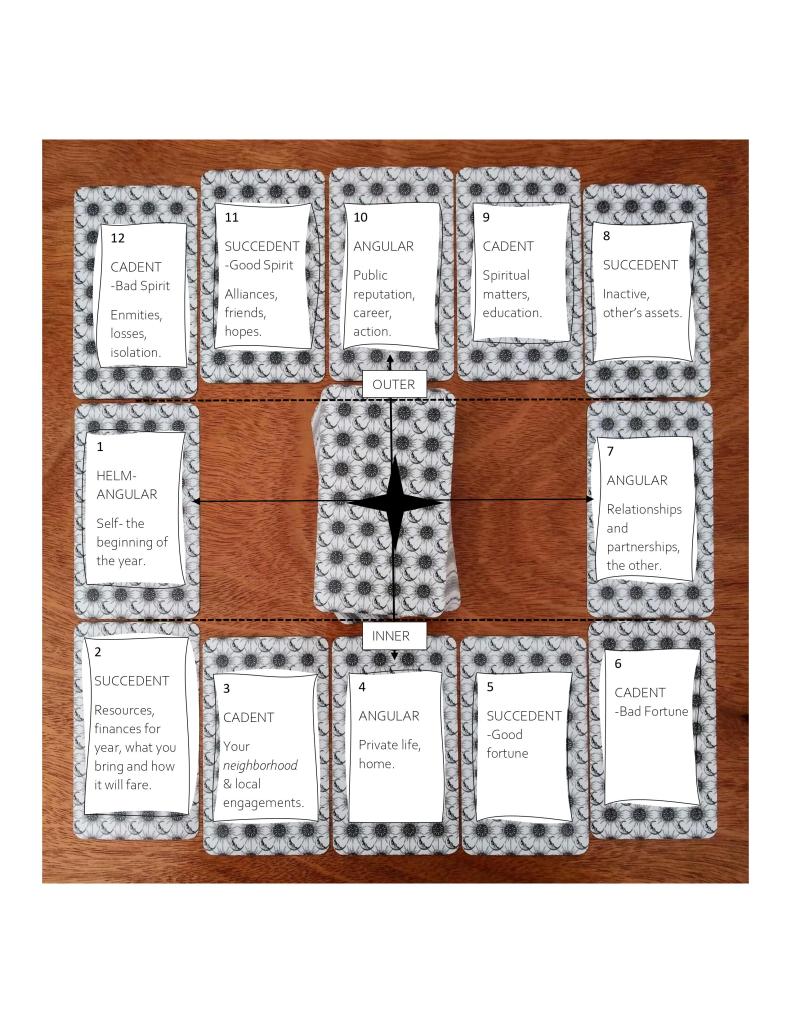
    The template of the reading spread will be the astrological map of the whole sign house system, but in the reading I will not be overtly considering the planets nor zodiac signs, I will instead be using the narrative of the houses vis a vis the cards situated there as they play out for the year. A basic outline of the spread and how I will be reading the cards is pictured below. I will begin the reading with the general tone for the year ahead, underscored by the cards that land in the angular spots, positions 1,4,7 and 10. This will sketch out how you will enter and move about the year in general, the lay of the land so to speak. Then I will go into the inner and outer aspects of your year, underscored by positions 1-6 (inner), and 7-12 (outer). By inner and outer you can read personal /private versus public.

    Once this general foundation is set, I will look at relationships, starting from cards opposite each other, and how this will color your year. Getting into the specifics of the reading and how they pertain to your year, I look at positional relationships, triangulations, making special note of particular considerations as they arise, bringing focus to areas as the cards indicate. Lastly, I will write up a month to month snappy view of the landscape.

    I will say that even though for this reading no questions are necessary, I do always encourage a question or focus area, this provides context and that is always welcome. If you have a particular topic or goals you want to see play out next year, this spread can aid in highlighting them, helping you gauge potential and possibilities.

    ~~~

  • Seeing what there is to see

    I have been painting lately, or rather drawing. The hiatus I took between October and now led me down a way where I picked up pen and paper and began sketching and drawing. It happened spontaneously. I was sitting about in my house, thinking on playing cards, barajas, fortunetelling packs, and Cyprianic cartomancy. Reflecting on these different types of reading narratives let me to wonder what would a Cyprian inspired cartomancy deck look like for me. Then I grabbed one of my cheap brisca packs (or baraja), shuffled through the cards, scribbled on them, spread them out, and thought, what if?

    This what if pulled me to grab an old sketchbook and pencils, and sketch parts of what I had in mind. About a week in, I decided this was a thing I was going to pursue, hence I needed more structure and direction, especially if this was to truly present what a Cyprian deck would look like for me. So I opened up the Cyprian black books* I own and began writing an excel sheet with a list of all the playing card meanings found in the books.

    Laying out the card meanings within the Cyprian books I have allowed me to notice recurring patterns and themes in the suits, while also tracking card meanings. Then this whole idea began to take shape in earnest. So here I am, it’s December and I’m drawing everyday, little by little creating a card deck. Currently I have about half the cards sketched in their complete or almost complete form, and the other half is just around the corner.

    This whole experience has been a revelatory adventure, a daring, especially the drawing aspect of it. I’m starting to understand how to qualify the ways, the hows, the tones, and the forms of what I see. How shapes, edges, light and shadow weave together, how each relates, co-relates, move, and transform. Perceiving that through this (the doing) I’m recognizing that the act of seeing and putting words to what I see is a conscious act I play with in many areas of my life, and especially with the cards. (We all do this whether aware or not). This whole process has been teaching me different aspects of seeing, creating, and translating, which I’ve found enlightening outside of the act itself of drawing. My hands and these forms they’re creating on paper are speaking this other story for me, that I’m thoroughly enjoying.

    And why do I share all this? Well first, I’m creating a cartomancy pack! Second, wanting to share my experiences around seeing, context, and awareness. How one see leads one’s attention via different ways, through gradations, shadows, flows of light. Yet despite this inconspicuous marvel, I don’t think one ever truly grasps seeing the full picture of what is being looked at. What we see and how we see depends largely on context, where we are, what we’re doing, and why. I find this realization lyrically potent as I move from one day to the next (which as yet unknown), or more aptly applied, navigating out of 2020 into 2021. Whatever is unfolding will unfold, and we navigate these folds, these plays of shadow and light, by tuning our seeing toward the different ways we do so (the act of seeing). Interpreting, giving words to what we see, is also a thing we can learn to play with, always aware of context. I have a sense that with these ideas in mind one can better navigate different terrains and landscapes with aplomb.

    Rounding out this conversation, I’m expecting to have a draft of the deck I’m creating complete by the end of this month. After the draft is complete I will print a copy and test it out, making sure the narratives, the language it speaks, is what I’m aiming for and that it is cohesive. After this step, I plan on going back and redrawing all the cards again, honing the whole aesthetically, fixing mistakes etc. I have a newsletter, and I plan on sharing more as I go along there, including images. It’s a monthly newsletter, and it includes a short lyrical reading for the month ahead. If you’d like to hop on, you can do so by signing up here.

    Lastly, I want to mention that I plan on adding an end of year reading option, it will be a 2021 forecast reading, highlighting what to look for in this new year. The angle will be from an omen and fortuneteller perspective. Which just means, I take a look at the overall tones and highlight key omens. I will share more details when I do make the reading available toward early next week.

    This is my re-introduction after a two month hiatus, I hope everyone has been well and here’s to creating ways through…

    ~~~

    *Most of the St. Cyprian literature I work with is via  José Leitão and his ongoing research, most of which has been published by Hadean Press.